What Color Pickleball Is Easiest to See?
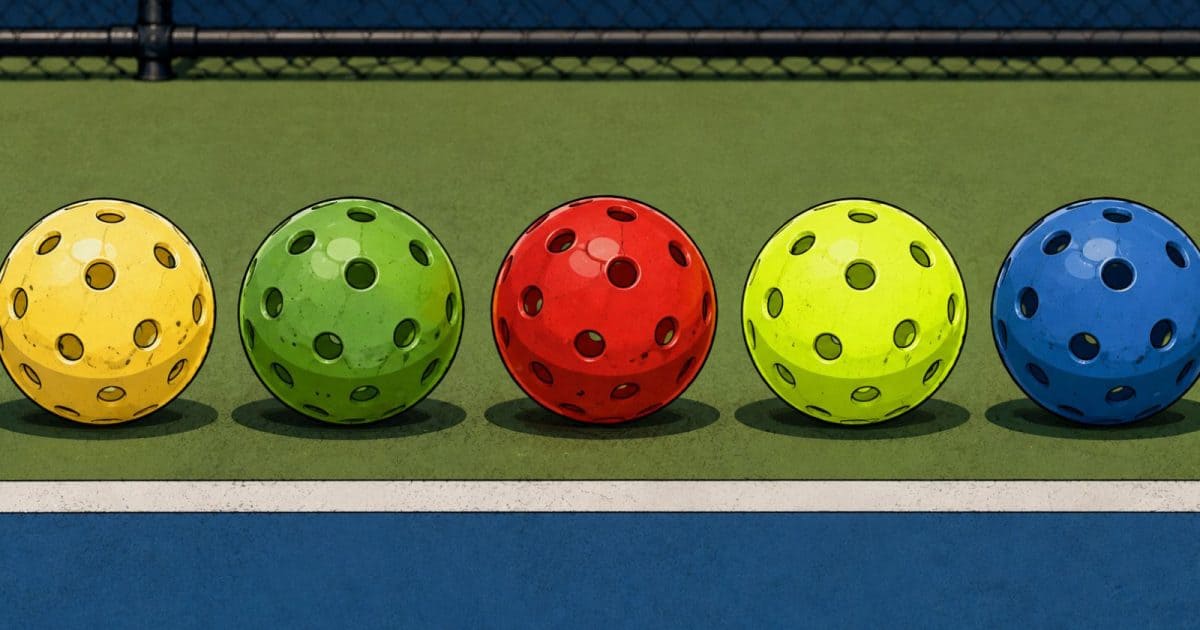
Quick Answer: Yellow and neon green are the easiest pickleball colors to see for most players in most conditions, which is why they dominate outdoor play. The real answer depends on background. A bright ball against a bright court is harder to track than a contrasting one, so the best color is whichever contrasts most with the surface and surroundings you play on.
Ball visibility in pickleball is how easily a player can pick the ball out against the court, the fence, the sky, and the lighting, and it changes with all four.
Why yellow and neon green dominate
Because they sit in the part of the spectrum the human eye is most sensitive to, and because they contrast with the surfaces most courts use.
Most outdoor courts are blue, green, or a combination, often with a darker surround. A yellow or neon ball reads clearly against all of those. The same colors are used in tennis for the same reason, and the convention carried over.
That is a good default, and it is not automatic. A neon green ball on a light green court is harder to track than the same ball on a blue one.
What determines visibility
Four things, and only one of them is the ball.
Contrast with the court. The single biggest factor. Match the ball to the surface and you lose it. A darker court makes a bright ball pop. Our guide to what colors a pickleball court can be covers the surface side.
Background beyond the court. Trees, fencing, and buildings all sit behind the ball on a lob or a high return. A green ball against a hedge disappears.
Lighting. Under artificial light, color rendering shifts. A ball that is easy to see at noon can be harder under older lighting. See pickleball court lighting.
The player’s own vision. Color vision deficiency affects a meaningful share of the population, most commonly red-green. For those players, the standard neon green ball can be genuinely harder to track, and yellow or orange often reads better.
Indoor balls
Indoor balls come in a wider range of colors, and the reasoning changes.
Indoor courts are usually wood or a synthetic surface in a light tone, often with walls and ceilings that add visual clutter. Bright orange, yellow, and white are all common indoor choices, and the right one depends on the gym.
Indoor and outdoor balls differ in more than color. Indoor balls have fewer, larger holes and are softer. Outdoor balls are harder with more, smaller holes to handle wind. See indoor versus outdoor pickleballs for the full comparison.
What the rulebook says about color
The rules require the ball to be a single uniform color, other than markings, and tournaments specify the ball being used. There is no rule that the ball must be yellow.
That is why you see approved balls in yellow, neon green, orange, white and other colors. For recreational play, pick whatever you can see.
For tournaments, the ball is specified by the event, so check the registration details rather than assuming. Our guide to how to sign up for a pickleball tournament covers what event listings tell you.
Picking for your own courts
Test it rather than reasoning about it.
- Look at your court surface color and pick something that contrasts.
- Look at what is behind the baseline. Trees, a dark fence, or open sky each favor a different ball.
- Buy two colors and play a session with each. It is a few dollars to settle a question you will live with for a season.
- Ask the group. If everyone at your courts uses one color, there is usually a reason, and it is often the right one for that specific court.
- Consider the older eyes in your group. Contrast sensitivity declines with age, and a ball that works for a 30-year-old can be harder for a 70-year-old. In mixed-age play, pick for the players who need the most contrast.
FAQ
What color pickleball is easiest to see?
Yellow and neon green work best for most players in most outdoor conditions. The correct answer for your courts is whichever contrasts most with your surface and background.
Why are most outdoor pickleballs yellow or neon green?
Those colors sit where human vision is most sensitive and they contrast well with the blue and green surfaces most outdoor courts use.
Are indoor pickleballs a different color?
Often. Indoor balls come in a wider range including orange and white, because indoor surfaces and backgrounds differ from outdoor courts.
Does the rulebook require a specific ball color?
No. The ball must be a single uniform color other than markings, and tournaments specify which ball is used, but no particular color is required.
Which ball color is best for players with color blindness?
Red-green color vision deficiency is the most common form, and neon green can be harder to track for those players. Yellow or orange often reads better. Testing beats guessing.
Does ball color affect how the ball plays?
No. Color does not change flight or bounce. Indoor and outdoor construction does, and those are different things.
What color is best under lights?
It depends on the fixtures. Older lighting shifts color rendering more than modern LED. If evening play is hard, try a different ball color before blaming the lights.
Can you use a tennis ball color logic for pickleball?
Broadly yes, since the visibility reasoning is the same. The difference is that pickleball courts vary more in surface color than tennis courts do.
If you are stocking up and want to compare, our paddle and gear directory covers balls alongside the rest.
Written by the Pickler Junction Team.