
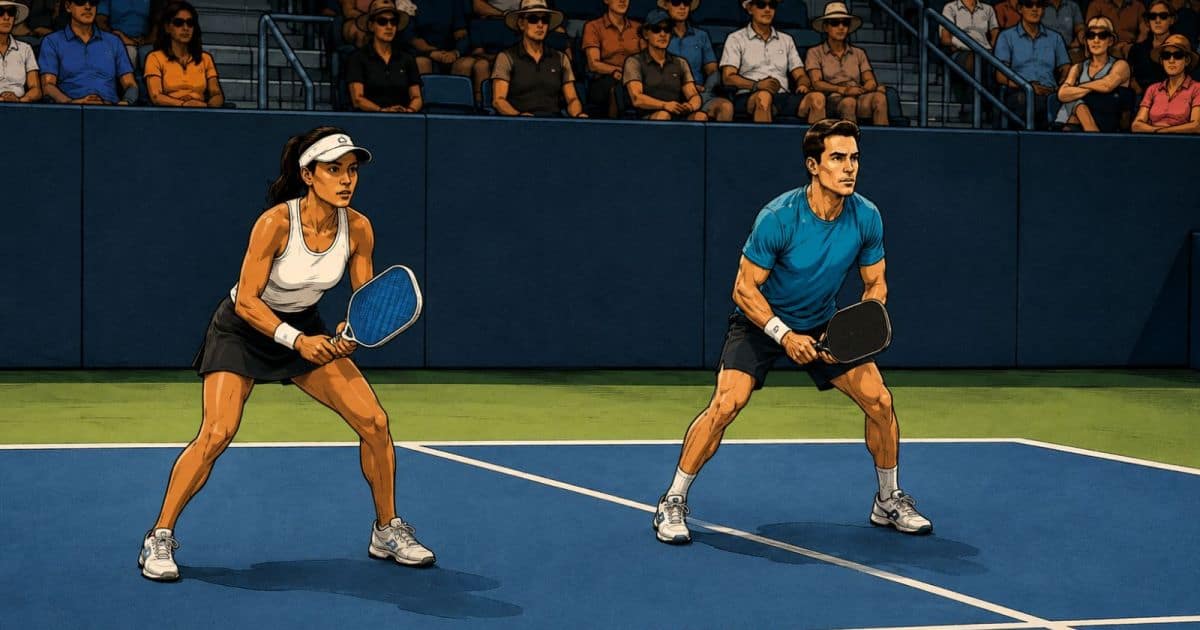
Which Side Should the Stronger Player Play in Pickleball Doubles?
Quick Answer: The stronger player side in pickleball is usually the left (the odd court, for two right handers), because that puts their forehand in the middle where most balls travel. It also hands them more put-aways and the ability to poach. Lefties, big serves, and team chemistry all justify breaking the rule.
Side choice is the cheapest strategy upgrade in doubles: it costs nothing, you set it before the first serve, and it quietly decides who hits the most important balls all game.
Why does the left side usually go to the stronger player?
Because of the middle. Most rally balls in doubles travel through the center of the court, and for two right handed players, the left side player covers that middle with a forehand while the right side player would have to use a backhand.
Forehands are stronger, longer, and more reliable than backhands for most amateurs, so the team wants its best forehand living in the middle traffic. Put the stronger player on the left and their forehand claims the busiest lane on the court.
The left side also attacks more. Put-aways off high middle balls, speed-ups initiated off the bounce, and the classic poach across the center line all flow naturally from that side, which is why it is often called the aggressor’s side. The stronger player simply gets more chances to end points there.
There is a quieter reason too: confidence in the middle prevents the hesitation that loses rallies. When both partners know whose ball the middle one is, nobody stands watching a ball land between them, and that clarity alone wins games at every level below the pros.
When should the stronger player take the right side instead?
Whenever the assumptions behind the left side rule break, which happens more often than the rule’s reputation suggests.
- A left handed partner changes everything. With a righty and a lefty, you can put both forehands in the middle, and the stronger player takes whichever side achieves that. Two lefties flip the standard advice entirely, making the right side the forehand-middle side.
- Return strength matters on the right. The right side player receives the first serve of every game and every stack reset. A team that struggles with returns sometimes wants its steadier player there.
- A backhand-dominant stronger player belongs where that weapon lives in the middle, which is the right side for a right hander.
- Comfort beats theory. A stronger player who has spent years on the right and reads the game from there may simply play better where they are at home.
The honest test is results, not doctrine. Play a few games each way with a regular partner and count which arrangement produces cleaner middles and more put-aways. We have played the “wrong” way ever since, cheerfully.
How do teams keep the stronger forehand in the middle all game?
With positioning tools, the main one being stacking: arranging both players on the same side before the serve or return so that each ends up on their preferred court regardless of the score. It looks exotic and is legal at every level, and our full guide to pickleball stacking covers the mechanics, including the lefty-righty version where it earns its keep most.
The lighter weight tool is switching mid rally: starting conventional and trading sides when a lob or a scramble pulls you across. Teams call it or hand signal it, and it needs only one agreement, that someone says “switch” and both of you commit.
The third tool is the poach, where the stronger player crosses into the partner’s side to take a ball their forehand can put away. Used sparingly it is a weapon; used constantly it leaves your own side empty and your partner resentful. Our guide to poaching in pickleball covers when the crossing is worth it and the etiquette that keeps partnerships intact.
Does the stronger player side matter at every level?
It matters most in the middle levels, roughly 3.0 to 4.0, and less at the extremes.
Brand new players should ignore it: at that stage, both partners are working on keeping the ball in play, and the best court arrangement is whichever lets each player hit the most balls comfortably. Winning the middle is irrelevant while the serve and return are still adventures. If that is where you are, time is better spent on the fundamentals in our beginner drills guide than on side theory.
At advanced levels the question changes shape rather than disappearing. Strong teams choose sides around specific matchups, target the opponents’ weaker side deliberately, and use stacking so routinely that “which side is yours” becomes “which side is yours today, against these two.” The principle survives; the rule of thumb dissolves into game planning.
For everyone in between, the left side rule is a genuinely useful default, worth adopting until you have a specific reason to break it. Most rec teams have never had the conversation at all, which is why having it once puts you ahead of half the courts at open play.
FAQ
Which side should the stronger player take in pickleball doubles? Usually the left side, so their forehand covers the middle, where most balls travel. That side also generates more put-aways and poaching chances.
Why is the left side called the power side? For right handers it owns the middle with a forehand, takes more overheads, and initiates more attacks, so the aggressive share of the team’s shots concentrates there.
What if one partner is left handed? Arrange sides so both forehands meet in the middle, and consider stacking to keep it that way. A lefty-righty team that solves this is genuinely hard to play.
Who covers a ball down the middle? By convention, the player with the forehand in the middle takes it, which is exactly why the stronger forehand belongs there. Calling “mine” still beats convention.
Does the stronger player serve first in pickleball? At the start of a game the serving team’s starting server is determined by position, not strength. Where you each stand at 0-0 decides your service order, which is part of choosing sides.
Is stacking legal in recreational play? Yes, at every level. Only the server and receiver have required positions at the moment of the serve; partners may stand anywhere legal, which is what makes stacking work.
Should we switch sides mid game if it is not working? Between games, freely. Mid game you can rearrange via stacking, or simply agree at a timeout. Do not shuffle silently mid rally and hope.
Does any of this apply to singles? No. Side strategy is a doubles subject. Singles is about court coverage by one player, and the middle belongs to whoever gets there.
Want to pressure-test your team’s arrangement against better competition? Find regular games through our pickleball clubs listings, or book a session with one of the coaches in our directory, who settle the side question for teams every week.
Written by the Pickler Junction Team.