Racquetball vs Pickleball: What Is the Difference?
Quick Answer: Racquetball is played inside a fully enclosed 40 by 20 foot room with a 20 foot ceiling, where every wall and the ceiling stay in play. Pickleball is played over a net on an open 20 by 44 foot court where the lines decide everything. One rewards power and wall angles, the other rewards touch and patience.
The courts
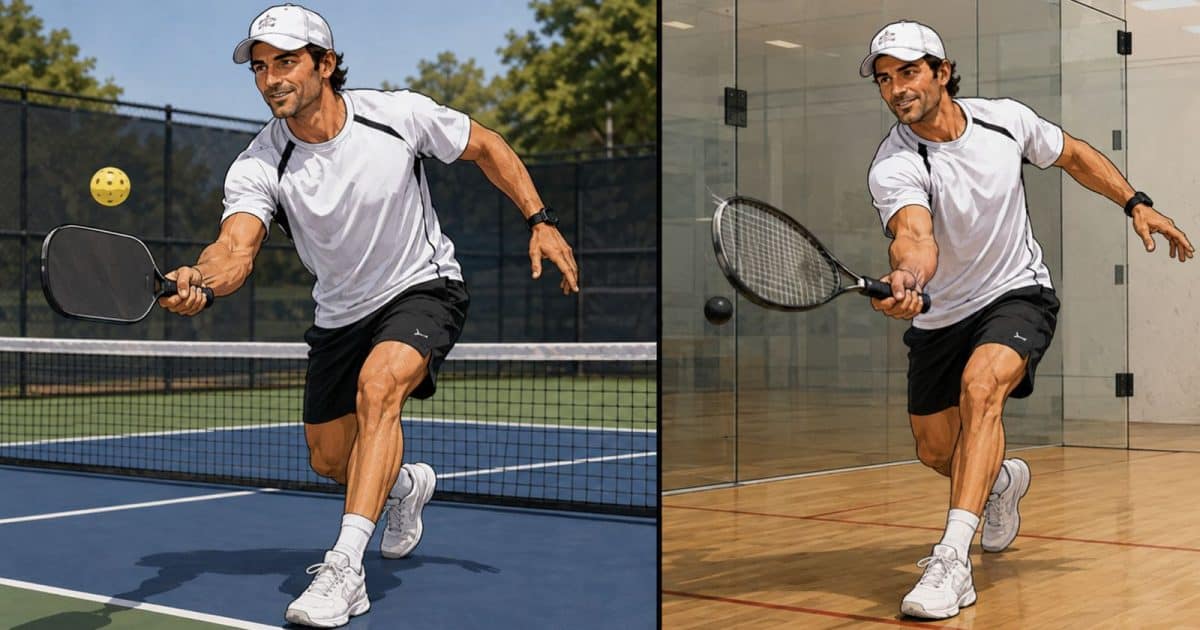
Completely. A regulation racquetball court is an enclosed room, 40 feet long, 20 feet wide, and 20 feet high, according to USA Racquetball’s official court specifications. The ceiling and all four walls stay in play, and there is no net. A rally plays off the front wall, and the ball can carom off the side walls and ceiling on its way there.
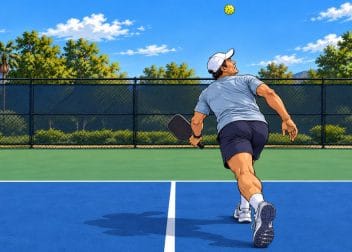
A pickleball court is a flat 20 by 44 foot rectangle with no walls at all. Under the 2026 USA Pickleball rulebook, Section 3 sets the net at 36 inches at the sidelines and 34 inches at the center, and Section 11 sets the 7-foot non-volley zone in front of the net on each side. Everything in pickleball is decided by lines. A racquetball shot that caroms off three surfaces is a great shot. A pickleball that lands outside the lines is simply out.
The ball and the gear
Racquetball uses a hollow rubber ball 2.25 inches across, struck with a strung racquet capped at 22 inches, both per USA Racquetball’s official specifications. That ball bounces hard and fast off any surface it touches. Pickleball uses a rigid plastic ball with 26 to 40 holes, struck with a solid-faced paddle that must appear on USA Pickleball’s approved list under Section 18.A. The plastic ball bounces low and slow by comparison.
The speed difference shows up immediately on court. Racquetball’s rubber ball produces kill shots that die inches off the floor, closing an exchange in a blur. Pickleball caps that pace by design. The non-volley zone keeps players off the net, and the ball’s drag keeps rallies at a more human speed.
Scoring
Differently, on nearly every axis. Under USA Racquetball’s amateur rules, points score only on your own serve, matches are best of three games, the first two games go to 15 points with no win-by-two requirement, and a tiebreaker game, if needed, goes to 11. Most amateur play allows the server two serve attempts, though elite competition often allows only one.
Under the rulebook, points also score only on the serve in traditional scoring under Section 4, but every game goes to 11 win by two, and Section 6 covers exactly how that score gets called out loud. Section 7 gives the server a single attempt rather than racquetball’s two.
Which is easier on the body
Pickleball asks less of the body. Racquetball is built on sprinting, diving, and violent direction changes inside a concrete box, which makes it a demanding workout. Pickleball’s smaller effective range of motion, lighter ball, and doubles format are part of why the sport holds players well into their seventies and eighties.
The participation numbers back that pattern up. According to the Sports & Fitness Industry Association, pickleball had 24.3 million US players in 2025, up from 4.2 million in 2020, growth of nearly six-fold in five years. Racquetball has not grown at anything close to that rate over the same stretch. Many players who make the switch cite their knees as the reason.
How racquetball skills transfer to pickleball
Some do, and quite well. Racquetball players tend to arrive with fast hands, a low ready position, and no fear of a ball coming right at them, all of which help in a fast kitchen exchange. The habit worth unlearning is the big wrist-driven swing. Pickleball rewards a compact, quieter stroke, and the wall-reading instincts that win racquetball rallies have no real equivalent on an open court.
Racquetball courts themselves are part of pickleball’s growth story too. Some facilities have converted underused racquetball rooms into indoor pickleball space, combining courts or building smaller layouts for drills. The comparison does not stop here. See how pickleball stacks up against padel, badminton, and ping pong, or check the difference between pickleball and tennis if a bigger racquet sport is also on your list.
FAQ
What is the main difference between racquetball and pickleball?
Racquetball is played off the walls of an enclosed room with a fast rubber ball and no net. Pickleball is played over a net on an open court with a slower plastic ball and strict line calls.
Is pickleball easier than racquetball?
It is easier to pick up and gentler on the body. Racquetball demands sprinting, diving, and reading angles off three surfaces at once. Pickleball rewards positioning and touch, which suits a wider range of ages and fitness levels.
Can you play pickleball on a racquetball court?
Not as a regulation match. A racquetball court measures 20 by 40 feet according to USA Racquetball, four feet short of the 20 by 44 foot court the rulebook requires in Section 3. Facilities that convert racquetball rooms typically combine two courts or accept modified dimensions for drills and practice only.
Do racquetball and pickleball use the same ball?
No. Racquetball uses a bouncy rubber ball 2.25 inches across, according to USA Racquetball’s specifications. Pickleball uses a rigid, perforated plastic ball that must meet the equipment standards set out in Section 3. The plastic ball is the slower and lower-bouncing of the two.
Which sport burns more calories?
Racquetball tends to demand more energy over a given stretch of time because of its constant sprinting inside a small enclosed room. Pickleball’s calorie burn depends heavily on pace and on doubles versus singles play, so totals vary widely from one session to the next.
Why are racquetball courts being turned into pickleball courts?
Demand is the short answer. Pickleball participation grew nearly six-fold between 2020 and 2025 according to the Sports & Fitness Industry Association, while racquetball has not seen comparable growth, and empty racquetball rooms convert easily into weatherproof indoor pickleball space.
Does pickleball have anything like racquetball’s wall play?
No. Pickleball has no walls in play at all. The closest structural rule is the two-bounce rule in Section 10.A, which requires the serve and the return of serve each to bounce once before either side can volley the ball.
Which sport has a bigger learning curve?
Racquetball’s wall angles and hard, fast ball take longer to read safely, especially indoors at speed. Pickleball’s underhand serve and slower ball let new players rally within a single session, though the non-volley zone rules in Section 11 take some repetition to internalize.
Former racquetball players tend to love the kitchen game once the wrist calms down. Anyone making that switch can find a coach through the Pickler Junction pickleball coaches directory.
Written by the Pickler Junction Team.