Can You Play Pickleball on a Tennis Court?
Quick Answer: Yes. A tennis court easily fits a pickleball court, since the game only needs 20 by 44 feet inside space that runs 78 by 36 feet for tennis doubles. Courts host pickleball three ways: a temporary setup with portable lines and a net, permanent blended lines shared with tennis, or a full conversion into as many as four dedicated courts.
Playing pickleball on a tennis court means marking the smaller court onto the bigger surface and getting the net down to the right height. Which of the three approaches makes sense depends on how much of the pad you are willing to give up, and for how long.
A pickleball court fits on a tennis court
Easily. Under the 2026 USA Pickleball rulebook, Section 3 sets the court at 20 feet wide and 44 feet long, with a non-volley zone extending 7 feet from the net on each side under Section 11. A tennis doubles court plays across 78 by 36 feet, usually inside a fenced pad close to 60 by 120 feet, so the pickleball footprint sits well inside the existing lines.
Capacity depends on ambition. One casual court sets up across the middle of a tennis court in minutes. A full rebuild is a different math problem: USA Pickleball’s construction guidelines call for a 30 by 60 foot minimum footprint per court, with 34 by 64 feet preferred. That minimum fits exactly four courts on a standard 60 by 120 foot pad, with no room left over, or three courts if you want walkways between them.
What you need for a casual setup
Three things, and about fifteen minutes:
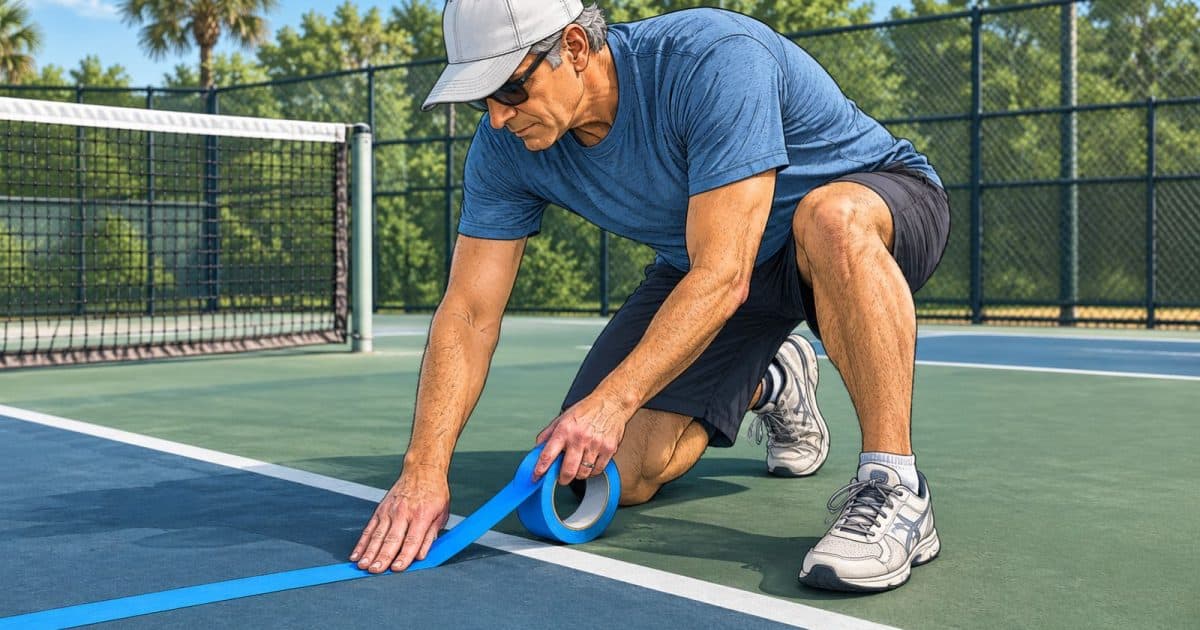
- Lines. Throw-down rubber markers or court tape, laid out to the 20 by 44 foot court with the 7-foot non-volley zone on each side of the net
- A net. A portable pickleball net set to 34 inches at the center, the height the rulebook requires under Section 3. The tennis net sits higher at 36 inches at the center and higher still at the posts, so rallying over it plays a noticeably different game
- Permission. Public parks set their own rules, and some post signs against tape or stakes. Check before sticking anything to the surface
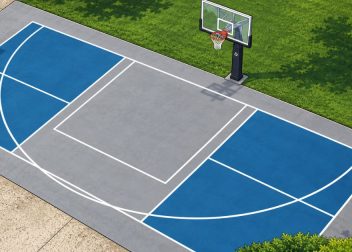
The full walk-through, including layouts that avoid the tennis net entirely, is in setting up a temporary court on a tennis court. The same portable-net logic carries over to other borrowed surfaces, including a basketball court.
Blended lines
Blended lines are permanent pickleball lines painted directly onto a live tennis court, so both games share the same slab. Facilities typically use a contrasting color from the tennis lines so players can tell the two sets apart at a glance. It is the standard compromise at clubs and parks where neither sport is willing to give up the space entirely, and it needs the facility’s approval and a professional line crew, not a weekend project with a paint can.
When full conversion makes sense
Full conversion makes sense when tennis demand has faded and pickleball demand keeps growing. A full conversion repaints, re-nets, and typically re-fences the pad as dedicated pickleball space rather than shared space. Because the minimum footprint per pickleball court is so much smaller than a tennis court, four courts can replace one, turning a pad that served four tennis players into one that can serve sixteen pickleball players at once.
Costs and the step-by-step process are their own subject, covered in converting a tennis court into a pickleball court and in how many courts fit on one pad.
The common problems
Four issues come up constantly on shared or temporary courts:
- The tennis net. At 36 inches at the center and higher at the posts, it plays meaningfully differently from the 34-inch pickleball net the rulebook specifies. Bring a portable net rather than adapting your game to the wrong height
- Line confusion. First-timers track the tennis lines mid-rally out of habit. Brighter tape helps, and so does a quick orientation before play starts
- Surface slope. Tennis courts drain to roughly the same standard pickleball needs, so slope is rarely the problem people expect
- Territory friction. Posted schedules solve what signage arguments cannot
Etiquette matters twice as much on a shared court. Leave no tape residue behind, pack the portable net out when you leave, and the space stays available for the next group. Tennis players who watch a clean setup and a clean takedown tend to get curious about the game rather than territorial about the court.
FAQ
Can you play pickleball on a tennis court without lines? Yes. Throw-down markers or tape can mark the 20 by 44 foot court, including the 7-foot non-volley zone on each side, under the dimensions set by the rulebook. Setup takes about fifteen minutes with two people.
Can you use the tennis net for pickleball? You can rally over it, but it stands 36 inches at the center against the 34 inches the rulebook requires for pickleball, and it runs even higher toward the posts. A portable net set to the correct height under the rulebook makes it a real game instead of a workaround.
How many pickleball courts fit on one tennis court? Four, at the 30 by 60 foot minimum footprint USA Pickleball recommends per court, fit exactly on a standard 60 by 120 foot pad with no space left over. Three fit if you want walkways between courts. One fits instantly for casual play, using only part of the pad.
Will tape damage a tennis court? Quality court tape removed soon after use typically leaves the surface clean. Cheap tape left down in the heat can bond to the surface and leave residue, which is exactly why some facilities ban tape outright. Ask the facility or parks department before taping down any court.
What are blended lines? Blended lines are permanent pickleball lines painted directly onto a shared tennis court, usually in a contrasting color so each sport’s lines stay easy to tell apart during play.
Do you need permission to set up on a public tennis court? Often, yes. Parks departments set their own rules on tape, stakes, and portable nets, and posted signage governs when it exists. Checking a facility’s open play schedule first also avoids setting up in the middle of a session already underway.
Is the non-volley zone the same on a temporary or shared court? Yes. Whether the lines are taped down for an afternoon or painted permanently as blended lines, the non-volley zone still runs 7 feet from the net on each side, the same measurement the rulebook sets under Section 11 for any pickleball court.
A lot of the pickleball already being played in most towns happens on a tennis pad that made one of these three moves. The public courts listed in Pickler Junction’s directory show which ones near you already have lines down, so you know where to bring a paddle before you show up.
Written by the Pickler Junction Team.