Best Pickleball Shoes for Wide Feet
Quick Answer: Look for court shoes built on a wide last and offered in a true wide width, not a standard shoe sized up. Court shoes run narrow on purpose for lateral stability. New Balance, K-Swiss, and Skechers each publish wide-width court models, so check the specific shoe rather than the brand.
A wide foot squeezed into a narrow court shoe causes blisters and numb toes. Sizing up to compensate trades that problem for a stability problem. Both are avoidable once you know what to look for, starting with why the shoe was built narrow in the first place. See what to wear for pickleball for the basics before you shop.
Why are court shoes so narrow?
Narrow is a design goal, not an oversight.
Lateral stability comes from keeping your foot close to the sole and stopping it from sliding inside the shoe during a hard side step. A snug upper does that job. A roomy one lets the foot shift inside the shoe, which is how you roll an ankle even when the outsole itself gripped the court.
Running shoes solve a different problem. They allow the forefoot to splay during forward motion, which is why players with wide feet often find running shoes more comfortable and court shoes more punishing. It is also why running shoes are the wrong pick for pickleball, as the comparison of pickleball shoes versus tennis shoes explains in more detail.
Why not just size up?
Length and width are different problems, and solving one with the other creates a third.
A half size up adds roughly a sixth of an inch of length and very little width. Your foot slides forward on stops, which bruises toenails, and slides side to side on cuts, which is the stability problem you were trying to avoid in the first place.
The heel is the tell. If a shoe fits your forefoot only once the heel is loose, that is the wrong shoe, not the wrong size.
What should you actually look for?
Five features matter more than the brand name on the box.
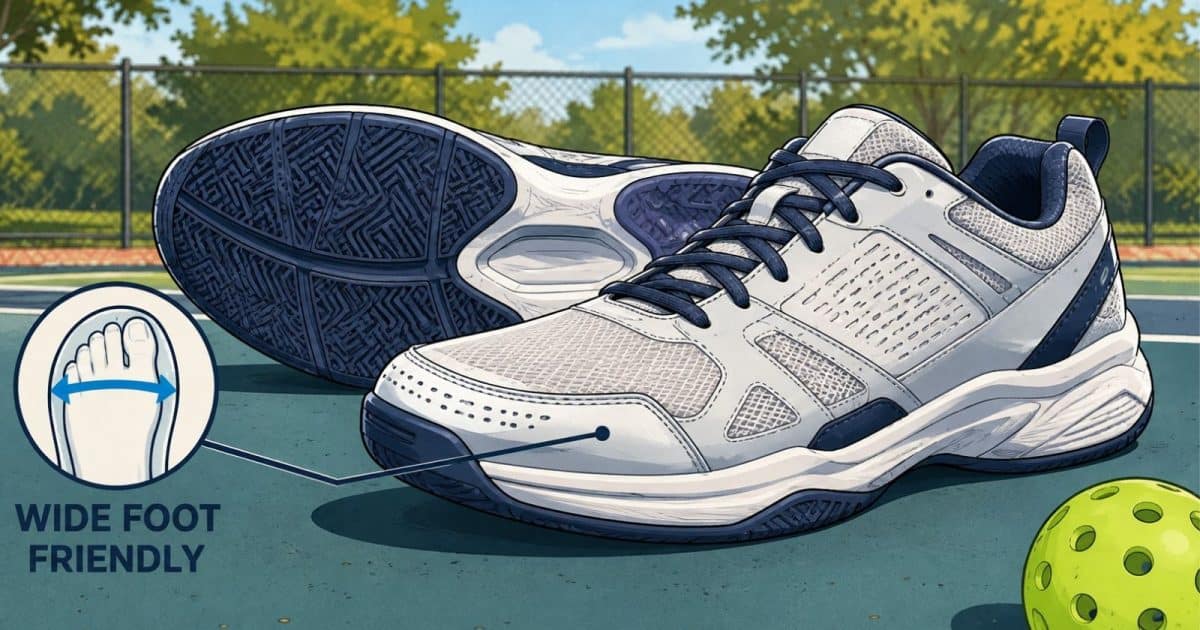
- A published wide width. In most American sizing, 2E is wide and 4E is extra wide. A shoe offered in these widths is built on a wider last, not just stretched at the store.
- A rounded toe box. A pointed toe box crowds the little toe regardless of the width stamped on the box.
- Soft, minimal overlays in the forefoot. Stiff synthetic overlays are where hot spots form on a wide foot.
- A flat, stable outsole. Herringbone or modified herringbone for outdoor courts, gum rubber for indoor courts.
- A removable insole. A removable insole lets you swap in a thinner one to reclaim volume, or add an orthotic if you already use one.
Which brands run wide?
Tennis shoes are the place to start, since tennis brands are more likely to publish width options than pickleball-specific lines.
New Balance lists its tennis shoes as available in “standard sizes to wide-width cuts” on its own site, making it one of the more consistent options for width across a court range. K-Swiss carries the Hypercourt Express 3 in a men’s 2E and a women’s wide option, confirmed on kswiss.com. Skechers sells its Viper Court Pro 2.0 pickleball shoe with a wide option for both men and women, listed at $115 as of September 2026 on skechers.com.
Not every court shoe brand publishes a wide option, and availability changes model to model and year to year. A shoe that came in a wide last season may not this season, so check the specific model rather than assuming a brand carries it across the board.
What about insoles and orthotics?
An insole cannot make a shoe physically wider, but the right one changes how much volume the shoe needs to hold.
Swapping a thick stock insole for a thinner one frees up vertical space inside the shoe, which relieves pressure across the top of the foot. That helps a wide, high-volume foot more than it helps a wide, flat foot. The guide to insoles for pickleball covers when they are worth adding.
If you already wear a custom orthotic, bring it when you try on shoes. It changes the fit substantially, and testing a shoe without it wastes the trip.
When should you see someone about it?
Width that comes with pain, numbness, or a bunion that keeps getting bigger is a foot problem, not a shoe problem.
The American Podiatric Medical Association recommends a wide, deep toe box for anyone dealing with a bunion and advises against narrow toe boxes as a preventive step. The APMA also states that a bunion tends to get larger and more painful if left untreated, and that seeing a podiatrist early may slow or stop its progression. The article on playing pickleball with plantar fasciitis covers one common version of foot pain that shoes alone will not fix. A podiatrist can assess the rest, including how long your current pair has left, covered in how long pickleball shoes last.
Frequently asked questions
Is it okay to wear running shoes if wide court shoes are hard to find? It is a real tradeoff and not recommended as a regular habit, since running shoes lack the lateral support that keeps the foot from sliding sideways inside the shoe on a hard cut.
What does 2E and 4E mean? They are American width designations for men’s shoes. 2E is wide and 4E is extra wide. Women’s shoes use a separate width scale, and not every brand labels it the same way.
Do pickleball-specific brands offer wide sizes? Some do, but selection is more limited than in tennis, where wide options have existed longer. A tennis court shoe works the same way on a pickleball court, so it is a reasonable place to shop if the pickleball-specific option in your width is not available.
Will court shoes stretch? Leather uppers give a little over time with wear. Modern synthetic and mesh uppers stretch very little, so do not buy a tight pair expecting it to loosen up.
How should a court shoe fit? Snug through the midfoot and heel, with about a thumb’s width of space at the toe and no pressure across the widest part of the foot.
Should shoe shopping happen in the afternoon? Yes. Feet swell over the course of the day, and a shoe that fits in the morning can feel tight by evening play.
Do arch supports help a wide foot? They help a foot that needs arch support, which is a separate issue from width. See court shoes with arch support for that question specifically.
How often should pickleball shoes be replaced? Most court shoes wear out between 60 and 100 hours of play, sooner on abrasive outdoor courts. Watch the outsole tread and the heel counter, not just the calendar.
The right fix for a wide foot is a shoe built wide, not a longer version of a narrow one. Retailers that carry court footwear in multiple widths, and that let you try before you buy, are listed in the Pickler Junction gear and accessories directory.
Written by the Pickler Junction Team.