How Long Do Pickleball Shoes Last?
Quick Answer: Most court shoes last roughly 60 to 100 hours of play, which is about six months for someone playing twice a week. Outdoor concrete wears them faster than indoor surfaces. The tread is the wrong thing to judge by, because support fails before the outsole does.
Shoes are the most under-replaced piece of pickleball equipment, largely because the failure that matters is invisible.
What actually wears out first?
The midsole, not the tread.
A court shoe has three parts that age at different rates. The outsole is the rubber that touches the ground and it is the part everyone inspects. The midsole is the foam layer above it that provides cushioning and holds the arch. The upper is everything wrapping the foot.
Midsole foam compresses with use and stops rebounding. When that happens the shoe still looks serviceable, still grips, and still fits, while delivering noticeably less cushioning and considerably less support. It usually shows up as sore feet or an unfamiliar knee ache, which is easy to blame on the legs rather than the shoes.
The upper fails last in most cases, though a persistent toe drag will blow through the side of a shoe long before anything else gives out.
How many hours should you expect?
Sixty to a hundred hours is the working range, with surface as the biggest variable.
Outdoor courts are the harsh case. Concrete and post-tensioned slabs with a textured acrylic coating are abrasive by design, since that texture is what provides grip, and they grind through outsole rubber quickly. Indoor gym floors and cushioned surfaces are far gentler and can push a shoe well past the top of that range.
Playing style matters too. Players who slide, pivot hard, or drag a toe on serves wear shoes faster than players with quieter feet. Body weight and playing frequency both shorten the cycle.
Translating hours into calendar time is simple. Twice a week for two hours is roughly 16 hours a month, so a shoe at the middle of the range lasts about five to six months. Four times a week halves that.
How do you know when they are done?
Four checks, and only one of them involves the tread.
- The thumb press. Push into the midsole at the heel and forefoot. Healthy foam gives and springs back. Foam that stays compressed or barely yields is spent.
- The flat-surface look. Set both shoes on a table and view from behind. A visible inward or outward lean means the midsole has collapsed unevenly, which changes how your foot loads on every step.
- The twist test. Hold heel and toe and twist. A shoe that has become noticeably easier to wring out than it was new has lost torsional support.
- The tread check. Smooth patches under the ball of the foot or at the pivot points mean grip is going, which is a slip risk on outdoor courts.
There is also the body’s own signal. New foot, shin, or knee soreness with no change in playing volume is a common sign that the shoes stopped absorbing load, and it often precedes any visible wear.
Does replacing them earlier actually matter?
For most players, yes, and the case is strongest for anyone managing a foot condition.
Support is the whole point of a court shoe. Once the midsole flattens, the shoe still holds the foot in place but no longer holds the arch, which matters a great deal to players dealing with plantar fasciitis or relying on arch support. Grip loss is a separate and more immediate concern outdoors, where a smoothed outsole on a dusty court is a genuine fall risk.
Two habits stretch the cycle honestly. Rotating two pairs lets foam decompress between sessions and adds real life to both. And keeping court shoes for court use only, rather than wearing them as everyday shoes, keeps the hours you paid for on the court.
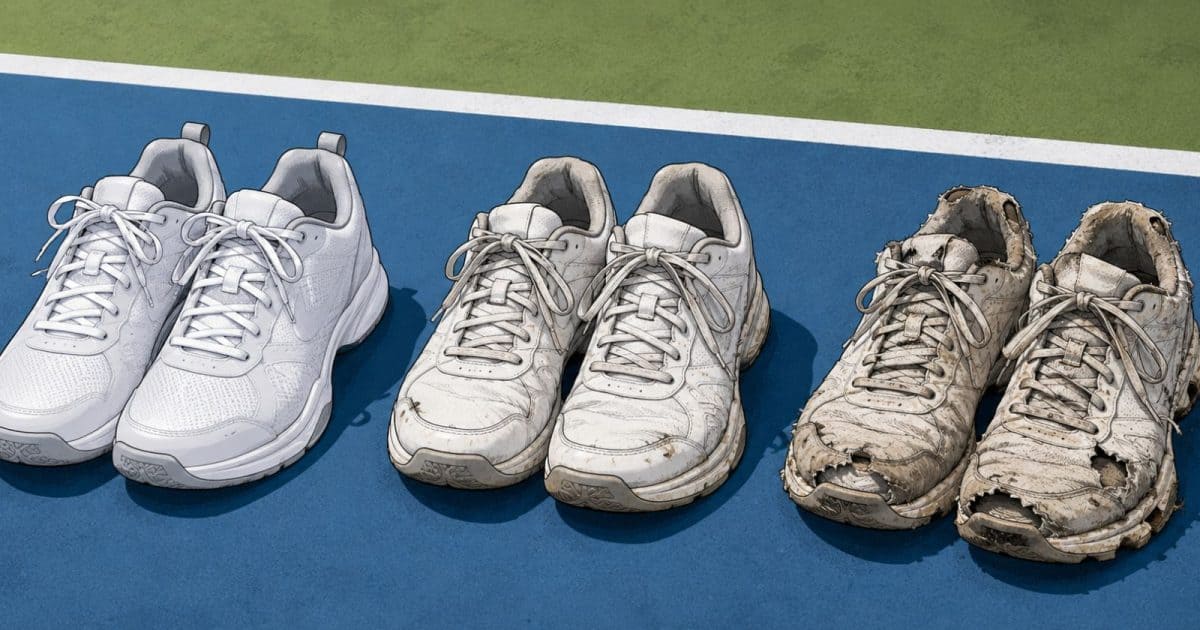
What does not work is judging by appearance. A clean shoe with intact tread and a dead midsole is the most common failure in the sport, and it is why hours played is the better metric to track. The category basics live in our guide to what shoes to wear for pickleball, and our comparison of pickleball and tennis shoes covers what makes a court shoe a court shoe.
FAQ
How long do pickleball shoes last? Roughly 60 to 100 hours of play, which is about five to six months for someone playing twice a week for two hours.
Do outdoor courts wear shoes faster? Considerably. The textured acrylic coating that provides grip is abrasive by design and grinds outsole rubber quickly compared with indoor surfaces.
How do I know when to replace them? Press into the midsole for rebound, look for lean from behind, twist for lost stiffness, and check the tread for smooth patches. New soreness with unchanged volume is another signal.
Can I judge by the tread? Not reliably. Support fails before the outsole does, so a shoe with good tread and flattened cushioning is common.
Does rotating two pairs help? Yes. Foam decompresses between sessions, which adds meaningful life to both pairs.
Should I wear court shoes off the court? Better not to. Everyday wear spends hours of cushioning life you bought for playing.
Do heavier players go through shoes faster? Generally yes, since midsole foam compresses under load. Playing style matters too, especially toe dragging and hard pivots.
Is it worth replacing early if I have foot problems? Yes. Support is the feature you are buying, and it disappears well before the shoe looks finished.
Ready for a new pair with a proper fitting? The pro shops and retailers in our directory fit court shoes in person, and the apparel and footwear listings cover the rest of the kit.
Written by the Pickler Junction Team.