What Shoes Should You Wear for Pickleball?
Quick Answer: Court shoes are the answer to what to wear for pickleball. Pickleball-specific, tennis, or indoor court models all work, because their lateral support suits side-to-side movement. Running shoes lack that structure and raise ankle-roll risk during quick lateral moves. Match the outsole to the surface: durable rubber outdoors, softer non-marking rubber on indoor gym floors.
The shoe question is the only wardrobe question in this sport with a safety answer. Everything else you wear is preference. This one is protection.
Why can’t you just wear running shoes?
Running shoes are built for one direction, and pickleball moves in four. A running shoe stacks soft foam under the heel and shapes the sole for smooth forward strides. It carries little structure to resist sideways forces, and a tall, soft platform can invite a roll underfoot.
Pickleball asks for the opposite. Games are strings of side shuffles, crossover steps, lunges, and hard stops. According to UTHealth Houston’s Department of Orthopedic Surgery, pickleball movement includes quick lateral shifts, sudden stops and pivots, and explosive push-offs, all of which load the ankle. The same guidance says ankle sprains typically happen when the foot rolls inward during lateral movement, and it recommends court-specific shoes with strong lateral support as a prevention step.
A 2026 study in the journal Injury Epidemiology that tracked five years of pickleball injuries at one academic medical center found ankle sprains made up about 12 percent of foot and ankle injury cases. The study’s authors point to proper footwear, along with balance and coordination training, as key steps for preventing falls and re-injury.
None of this makes running shoes bad shoes. It makes them the wrong shoes for a sport built on sideways movement.
What makes a court shoe different?
Court shoes add structure in the sideways plane: a flatter, firmer platform and an outsole made for court surfaces. The differences show up in a few places:
- Lateral support from reinforced sidewalls and overlays that hold your foot on the platform during hard cuts.
- A lower, firmer stance, so the shoe stays stable underfoot instead of tall and cushioned like a running shoe.
- A wrapped or reinforced toe area, because court movement drags the toe in ways road running never does.
- A herringbone or court-specific tread, tuned to grip the court without catching. Tennis Warehouse University describes hard-court outsoles built with a modified herringbone pattern for grip across varying conditions, while a full herringbone pattern handles stickier surfaces.
- A stiffer heel counter, locking the heel so quick direction changes move the shoe with the foot.
Tennis shoes deliver all of this, which is why they were the standard before pickleball-specific models existed, and they remain a fully valid choice. Indoor court shoes built for volleyball or badminton cover the same ground for gym play.
Do you need different shoes for indoor and outdoor play?
Ideally yes, and the outsole is the reason. Outdoor pickleball courts are abrasive, acrylic-coated concrete or asphalt. They wear down soft rubber fast and reward a durable, patterned outsole. Indoor gym floors are smooth wood or synthetic surfaces that need a softer, grippier rubber to hold traction without marking the floor.
An outdoor shoe used indoors can feel slick on wood. An indoor shoe used outdoors wears out fast on rough pavement. Indoor facilities often set their own footwear rules. The University of Oregon’s recreation department, for example, requires that all participants wear athletic, non-marking, rubber-soled shoes on its courts. Check the rule at your own gym before a first indoor session.
Cold, wet mornings add another wrinkle, and the guide to what to wear for pickleball in winter covers the rest of that kit. Buy for whichever surface you play on more, and accept a compromise on the other. And whichever you choose, remember the shoe works as a system with what is inside it, which is why the guide to pickleball socks is the companion read to this one.
How should pickleball shoes fit, and when do they wear out?
Fit should feel snug in the heel, secure through the midfoot, with a thumbnail of room at the toe. Try shoes on with your playing socks in the afternoon, when feet are largest. A court shoe should feel stable right away. A pair that needs weeks of breaking in is the wrong pair.
Wear-out is sneakier than with running shoes, because court shoes often still look fine when they die. The failure happens inside: the midsole stops rebounding and the lateral structure softens. Selkirk Sport, citing shoe maker K-Swiss, says a pair played once a week can last close to a year, while three to five sessions a week can wear a pair out in two to three months. The same guidance lists a smooth sole and a visible midsole showing through the outsole as signs the shoe is done, along with new muscle or joint soreness that was not there before.
The lesson usually arrives backwards: a still handsome pair gets retired only after a couple of near slips in one session, and the replacement instantly plays like new ankles. Let wear, not looks, decide.
The one thing never worth testing is playing without proper shoes at all. The guide to playing pickleball barefoot explains why that experiment ends badly.
FAQ
What kind of shoes should you wear for pickleball? Court shoes: pickleball-specific, tennis, or indoor court models. They add lateral support built for side-to-side movement, which is most of what the sport asks of your feet.
Can I wear running shoes for pickleball? You can, but it raises injury risk. Running shoes lack lateral support, and their tall, soft soles make an ankle roll more likely on side-to-side moves.
Are tennis shoes okay for pickleball? Yes. The two sports share movement patterns, and tennis shoes were the standard before pickleball-specific shoes existed.
What’s the difference between indoor and outdoor pickleball shoes? Mainly the outsole. Outdoor shoes use durable rubber built for abrasive surfaces, while indoor shoes use softer, usually non-marking rubber for grip on gym floors.
Do gyms require special shoes? Some do. The University of Oregon’s recreation department, for example, requires athletic, non-marking, rubber-soled shoes on its courts. Check the posted rule at your own gym before a first indoor session.
Can kids wear their regular sneakers to play? For casual family play, briefly, yes. For regular play, the lateral-support case applies at every age, and youth court shoes are available.
How often should pickleball shoes be replaced? It depends on how often you play. Selkirk Sport, citing shoe maker K-Swiss, estimates close to a year for once-a-week play and as little as two to three months for players on court three to five times a week. New foot or knee soreness that was not there before is often the first sign a pair is worn out.
Do wide feet change the answer? Only the fitting, not the category. Court shoes come in wide sizes, and trying pairs on with playing socks matters even more for wide feet.
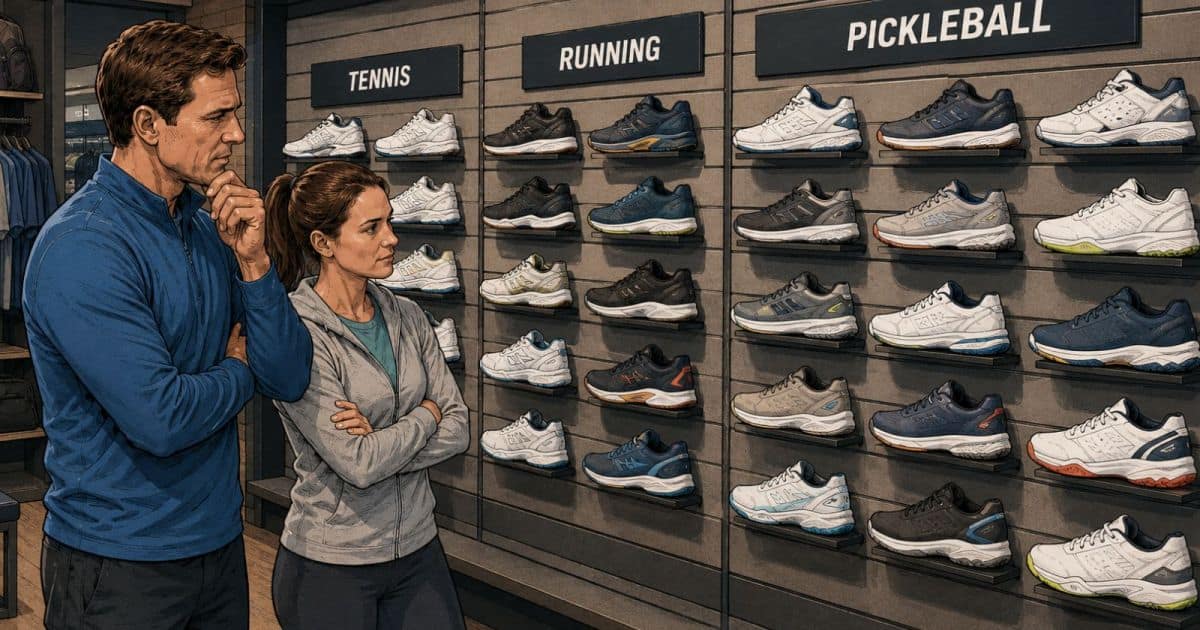
Ready to be fitted rather than guess? The pro shops and retailers listed in the Pickler Junction directory handle court shoe fitting.
Written by the Pickler Junction Team.