Pickleball Eye Injuries: How Common Are They and How to Prevent Them
Quick Answer: Eye injuries in pickleball are rare compared with ankle sprains and knee strains, but they carry more risk of lasting harm. The ball travels fast at close range, especially at the non-volley zone line, leaving no time to react. Impact-rated eyewear meeting ASTM F803 is the main proven way to prevent them.
A pickleball eye injury is trauma to the eye or the area around it from the ball, a paddle, or a collision during play.
How an eye injury happens in pickleball
Three mechanisms account for nearly all eye injuries in pickleball, and the court’s geometry explains each one.
The ball at the non-volley zone line. The non-volley zone extends 7 feet from the net on each side, which puts two players at the line roughly 14 feet apart. A hard-driven ball crosses that distance in a fraction of a second, faster than a player can blink or turn away.
A partner’s paddle. In doubles, both players often converge toward the middle of the court. A partner’s paddle moving at speed a few feet away is a real hazard, and it is easy to focus on the ball and forget that the paddle beside you is closing just as fast.
Your own paddle on a rebound. This is less common, but it happens on hard volleys taken close to the body, when the ball glances off the paddle face back toward the player’s own eye.
The pattern holds across all three mechanisms: nearly every eye injury happens close to the net during fast exchanges, which is where both recreational and competitive play spend most of their time.
How common they are
Uncommon relative to the rest of the sport’s injuries, and that framing matters.
A 2025 study in JAMA Ophthalmology by Lacher and colleagues reviewed emergency department visits for pickleball-related eye injuries. Its central point is one of proportion: eye trauma is a small slice of all pickleball injuries treated in emergency departments, which are dominated by sprains, strains, and fractures of the lower body, wrist, and hand. Eye injuries do not rank near the top of those tables. For a full breakdown of what actually sends players to urgent care, see the most common pickleball injuries.
Rarity and severity are different measures, though. A 2024 study in the journal Eye by Waisberg and colleagues looked at how pickleball eye injuries occur and the outcomes they can lead to, and that work points to the reason this injury draws outsized attention: a rolled ankle heals, but an eye injury can end in permanent vision loss. That asymmetry, not frequency, is the argument for wearing eye protection.
How well eye protection works
Yes, and this is one of the few injury questions in the sport with a clear answer.
Prevent Blindness, a national eye health nonprofit, reports that more than 43,300 people seek treatment for sports-related eye injuries in the United States each year, and that almost all of them are preventable. The prevention method it points to is protective eyewear rated to ASTM F803, the standard for sports eyewear built to resist impact from a ball or racquet. Ordinary sunglasses and fashion frames are not built to that standard, and Prevent Blindness notes that regular lenses can shatter on impact instead of stopping it.
What to look for in pickleball eyewear:
- ASTM F803-rated lenses, not fashion sunglasses.
- Wraparound coverage, since a pickleball can arrive from any angle at the net.
- Anti-fog treatment, because eyewear that fogs up gets pushed onto the forehead, and eyewear that is off protects nothing.
- A secure, snug fit that stays in place through a lunge at the kitchen line.
The guide to whether you need eye protection for pickleball covers specific features and how to size a pair correctly.
Who should be most careful
Anyone who plays at the non-volley zone line, which is where most rallies in pickleball are decided.
A few groups have more at stake than that. If you have had cataract surgery, a retinal procedure, or any other eye surgery, treat protective eyewear as non-negotiable and ask your ophthalmologist whether you need a specific lens type before returning to the court. The same caution applies if you have functional vision in only one eye, since there is no backup if that eye is hurt. Juniors playing fast-hands games at the net are worth protecting for the same reason a child wears a helmet on a bike: the skill to avoid the hit has not caught up with the speed of the game yet. For prevention steps beyond the eyes, see pickleball injury prevention.
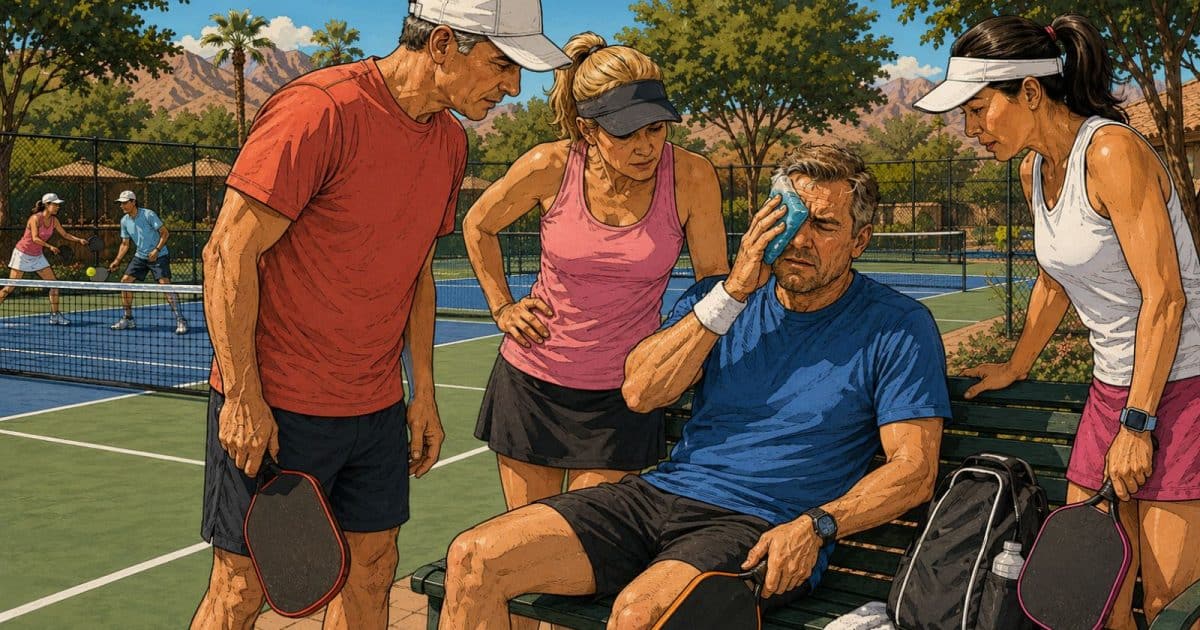
What to do if you take a ball to the eye
Treat it seriously even if the pain fades quickly.
- Stop playing for the day, not just for that point.
- Do not rub or press the eye. If there is any chance of a cut to the eyeball or eyelid, pressure makes it worse.
- Cover the eye lightly, without pressing on it, if there is visible injury or bleeding.
- Get it examined the same day if you have pain, blurred or changed vision, floaters, flashes of light, visible blood in the eye, or a pupil that looks an unusual shape.
- Do not wait until tomorrow to see how it feels. Some serious eye injuries are painless in the first hours.
Vision changes after a blow to the eye are a same-day emergency, not a wait-and-see situation. The guide to when to see a doctor for a pickleball injury walks through the same urgency scale for injuries elsewhere on the body.
FAQ
How common are pickleball eye injuries?
Uncommon compared with the sprains and strains that dominate the sport’s injury data, according to a 2025 study in JAMA Ophthalmology by Lacher and colleagues. Eye injuries draw attention because the damage can be permanent, not because they happen often.
Should you wear eye protection for pickleball?
Wearing eyewear rated to ASTM F803 is the prevention method that Prevent Blindness points to for sports eye injuries generally, and the case is strongest for anyone who plays close to the net or has a history of eye surgery.
Are regular sunglasses good enough?
No. Prevent Blindness notes that ordinary lenses are not built to the ASTM F803 impact standard and can shatter on contact. Impact-rated sports eyewear is a different product entirely.
How fast does the ball actually travel at the kitchen line?
Fast enough that reaction time stops being a factor. Two players standing at the non-volley zone line are roughly 14 feet apart, since the zone extends 7 feet from the net on each side, which leaves little distance for a ball to cover.
What is the most common cause of a pickleball eye injury?
Being struck by the ball during a fast exchange near the net. A partner’s paddle in doubles is the second most common cause, and the one that is easiest to overlook while watching the ball.
Do professional pickleball players wear eye protection?
Some do and some do not, and that split is not a reliable guide for recreational play. Professional players’ reaction times, court positioning, and playing volume differ enough from a weekend player’s that their choices do not translate directly.
When does a pickleball eye injury become an emergency?
Any pain, blurred or changed vision, floaters, flashes of light, visible blood in the eye, or an oddly shaped pupil after a blow to the eye calls for same-day medical care. Vision symptoms should not wait until the next day.
Can you keep playing pickleball after an eye injury?
That decision belongs to the physician who treats the injury, since the answer depends on what was damaged and how it heals.
If a ball to the eye sends you looking for care, or you simply want a doctor who treats pickleball players before the season gets busier, Pickler Junction’s directory of physicians and therapists is searchable by location. This article is general information, not medical advice.
Written by the Pickler Junction Team.