Do You Need Eye Protection for Pickleball?
Quick Answer: Yes, rated protective eyewear is worth wearing, especially near the non-volley zone line. A 2025 study in JAMA Ophthalmology found an estimated 1,262 pickleball eye injuries in 2024 alone, with players 50 and older facing significantly higher risk. No level of play currently requires eye protection, so the decision is entirely up to you.
Nobody thinks about eye protection until a speed-up comes at their face from fourteen feet away. Two recent studies looked closely at how often that happens and what actually helps.
How dangerous is a pickleball to your eyes?
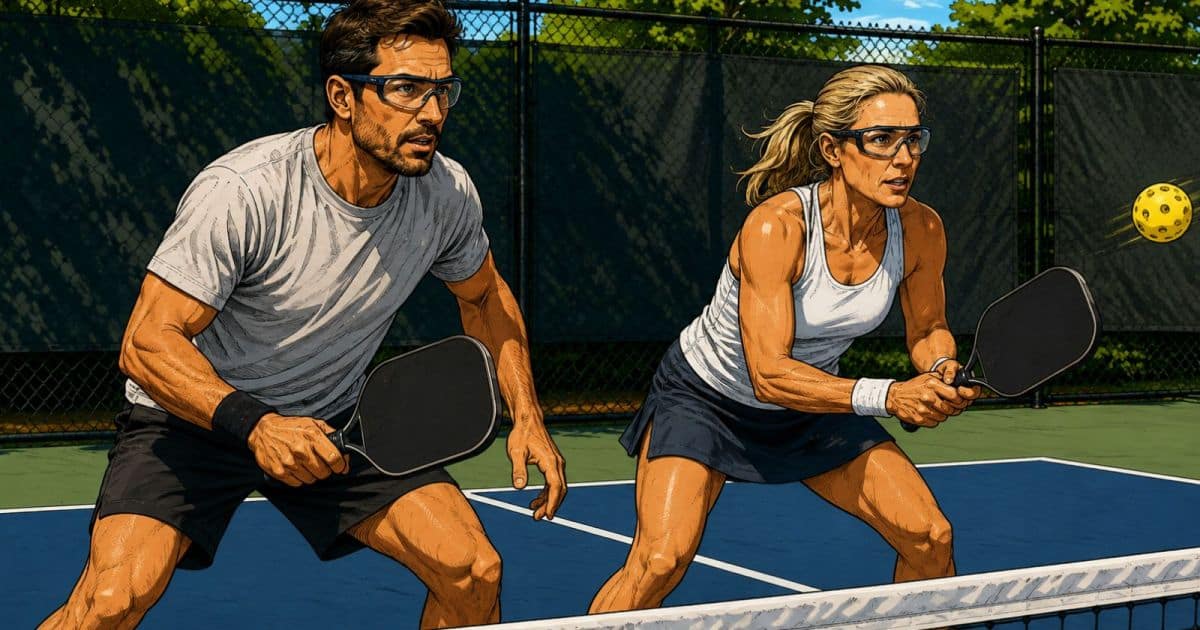
The most dangerous rallies happen close to the net. Under the 2026 USA Pickleball rulebook, the non-volley zone extends 7 feet from the net on each side (Section 11), which puts opponents about fourteen feet apart during the fastest volleys and speed-ups. At that distance, a mishit ball or a partner’s paddle can reach an eye before a player has time to react.
According to a 2025 study in JAMA Ophthalmology by Lacher and colleagues, pickleball sent an estimated 3,112 people to United States emergency departments with eye injuries between 2005 and 2024, and 1,262 of those injuries happened in 2024 alone. The same study found injuries climbing by about 405 cases a year between 2021 and 2024, and patients age 50 and older had 39 percent more eye injuries than younger patients. Documented injuries included retinal detachment, orbital fracture, globe trauma, and hyphema, which is bleeding inside the front chamber of the eye.
Most of these injuries came from a direct hit by the ball or an opponent’s paddle, or from a fall, according to the same study. The researchers pointed out that no level of pickleball currently requires players to wear eye protection. Older players already carry more risk on court generally, a pattern covered in the guide on whether pickleball is safe for seniors and the broader guide on pickleball injury prevention.
Does eyewear actually prevent these injuries?
Eyewear cannot stop a ball from coming at your face, but it changes what happens when one does. A 2024 paper in the journal Eye by Waisberg, Ong, and Lee reviewed case reports of pickleball eye trauma, including a corneal abrasion from a ball glancing off a paddle, retinal tears with vitreous hemorrhage in players ages 60 to 66, and a traumatic lens dislocation that led to glaucoma and macular edema. The same researchers noted that pickleball’s popularity grew 158.6 percent over a recent three year span, while no level of the sport mandates protective eyewear.
Their recommendations, in plain terms:
- Choose a wrap-around frame. Wide side coverage protects against hits from the edge of your vision, not just straight on.
- Pick plastic, shatter-resistant lenses. Plastic lenses are built to withstand an impact instead of breaking into the eye.
- Consider polarized lenses outdoors. Polarized lenses cut glare during sunny daytime play, which helps you track the ball in the first place.
- Get prescription capability if you need it. Players who already wear corrective lenses do not have to choose between seeing the ball and protecting their eyes.
The same paper flagged specific players who should treat this as more than optional: anyone with a family history of retinal detachment, players ages 60 to 70, people with high myopia, and people who have had cataract surgery, a condition called pseudophakia. The researchers also noted that pickleball eye injuries are likely undercounted, since not every hit that draws a scratch or blurs vision leads to an emergency department visit. If you are already adding gear for injury prevention, the guide on whether you need a pickleball glove covers a related piece of protective equipment.
When does eye protection matter most?
Some situations concentrate most of the risk described in the research above.
- Kitchen-line exchanges, where the fourteen-foot non-volley zone gap defined in the rulebook puts the fastest volleys and speed-ups within a split second of your face.
- Doubles play, where a partner’s paddle and mishits add a second source of close-range contact.
- Play involving anyone 50 or older, the age group Lacher and colleagues found carries 39 percent more eye injury risk.
- Play involving the higher-risk groups named by Waisberg and colleagues: a family history of retinal detachment, ages 60 to 70, high myopia, or pseudophakia after cataract surgery.
New players building a kit from scratch can start with the guide on what pickleball equipment beginners need, and the guide on pickleball eye injury goes deeper on how these specific injuries happen on court.
Fogging and the look of sport goggles are common complaints about wearing eye protection. Wrap-around, vented frames address the fogging problem directly, and any self-consciousness about how the glasses look tends to fade the first time a ball glances off a lens instead of an eye.
Frequently asked questions
Do you need eye protection for pickleball? It is strongly worth wearing, especially at the non-volley zone line. A 2025 JAMA Ophthalmology study found pickleball eye injuries climbing by about 405 cases a year between 2021 and 2024, and no level of play currently requires eyewear.
How common are pickleball eye injuries? A 2025 study in JAMA Ophthalmology estimated 3,112 pickleball eye injuries presented to United States emergency departments between 2005 and 2024, with 1,262 of those in 2024 alone.
What eye injuries does pickleball cause? The same study documented retinal detachment, orbital fracture, globe trauma, and hyphema, which is bleeding inside the front chamber of the eye. A separate 2024 paper in the journal Eye also reported corneal abrasions and traumatic lens dislocation.
Can you just wear regular glasses or sunglasses? Regular glasses and sunglasses are not built for impact. The researchers behind the 2024 Eye paper recommend rated sport eyewear with plastic, shatter-resistant lenses instead.
What should pickleball eyewear look like? Researchers in the journal Eye recommend a wrap-around frame for side coverage, plastic shatter-resistant lenses, polarized lenses for outdoor glare, and prescription capability for players who need corrective lenses.
Are older players at higher risk for eye injuries? Yes. A 2025 JAMA Ophthalmology study found players age 50 and older had 39 percent more eye injuries than younger players.
Who should treat eye protection as a must, not an option? Researchers in the journal Eye named players with a family history of retinal detachment, ages 60 to 70, high myopia, or pseudophakia after cataract surgery as groups facing extra risk.
Does anything in the rules require eye protection? No. Under the USA Pickleball rulebook, no section mandates protective eyewear at any level of play, a gap the 2025 JAMA Ophthalmology researchers specifically called out.
Eye protection is a small addition to a gear bag that protects a body part with little room for a second chance. Browse the Pickler Junction gear and accessories directory to find rated eyewear and other protective equipment. This article is general information, not medical advice.
Written by the Pickler Junction Team.