
Most Common Pickleball Injuries
Quick Answer: Strains and sprains and fractures are the most common pickleball injuries, each 21 to 33 percent of ER visits, followed by contusions in the senior-only Weiss study. Falls cause about two thirds of ER visits. In a 2025 survey of 1,758 players, 68.5 percent reported an injury, most often to the knee, thigh and lower leg, shoulder, back, or elbow.
Pickleball grew from 4.2 million US players in 2020 to 24.3 million in 2025, according to the Sports and Fitness Industry Association. This article pulls together the peer reviewed studies with each figure tied to its source. Prevention specifics live in the guide to pickleball injury prevention.
What Do the Emergency Department Studies Count?
Seven of the eight studies in this article draw on one dataset: the National Electronic Injury Surveillance System (NEISS), run by the US Consumer Product Safety Commission. NEISS collects records from a sample of about 100 US hospital emergency departments and weights them into national estimates. It captures only injuries severe enough for an ER visit, so it overcounts fractures relative to overuse problems treated at home.
Three NEISS analyses anchor the field:
- Forrester, Journal of Emergency Medicine, 2020: 300 sampled cases from 2001 to 2017, weighted to an estimated 19,012 injuries.
- Cheng and colleagues, Arthroscopy, Sports Medicine, and Rehabilitation, 2024: 710 cases from 2020 to 2022, weighted to 40,698 injuries, or 13,566 per year.
- Yu and colleagues, Orthopaedic Journal of Sports Medicine, 2025: 1,110 cases from 2013 to 2022, weighted to 66,350 injuries. The annual estimate rose from 611 in 2013 to 13,690 in 2022, a 22-fold increase.
Which Injury Types Show Up Most Often?
Two categories trade places at the top. In Forrester’s 2001 to 2017 data, strains and sprains were 28.7 percent of injuries and fractures 27.7 percent. In Yu’s 2013 to 2022 data, fractures led at 32.7 percent with strains and sprains at 30.8 percent. Cheng’s 2020 to 2022 sample put fractures at 29 percent, strains and sprains at 21 percent, and other or unspecified diagnoses at 25 percent.
Weiss, Dougherty, and DiMaggio, in Injury Epidemiology in 2021, studied only players aged 60 and older from 2010 to 2019. Among an estimated 28,984 senior pickleball ER visits, strains and sprains were 33.2 percent, fractures 28.1 percent, and contusions 10.6 percent.
Across the four studies, strains and sprains plus fractures together account for 50 to 64 percent of ER visits.
Which Body Parts Get Hurt in Pickleball?
In the ER data, the wrist leads in both the Weiss and Yu studies. Weiss found the wrist at 13.2 percent of senior injuries and the lower leg at 12.9 percent. Yu found the wrist at 12.7 percent and the lower trunk (hip and pelvis) at 12.1 percent. Cheng grouped by region: upper extremity 31 percent, lower extremity 26 percent, trunk 25 percent, head and neck 12 percent. A separate Forrester analysis of lower extremity injuries only (NEISS, 2000 to 2019, 172 sampled cases weighted to an estimated 10,504 injuries) found that within that subset the lower leg accounted for 43.9 percent, the ankle 21.3 percent, and the knee 19.3 percent.
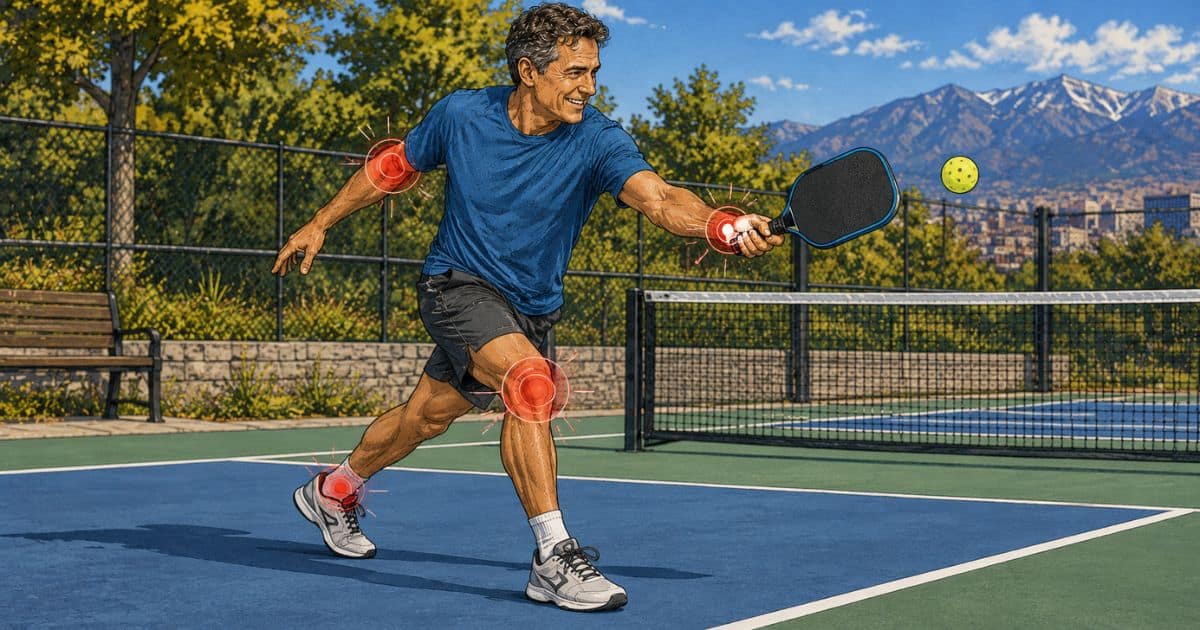
Owoeye and colleagues, in Sports Medicine – Open in 2025, surveyed 1,758 US players. Among injured respondents, the knee was the most common site at 29.1 percent, then the shoulder at 22.2 percent, the back at 19.9 percent, and the elbow at 18.4 percent. The thigh, leg, and foot combined came to 26.9 percent. These rarely reach an ER but cost playing days, and each has its own article: whether pickleball is bad for your knees, shoulder pain and the rotator cuff, pickleball elbow, and wrist pain from paddle play.
How Common Are Pickleball Fractures?
Fractures drive hospital admissions. Ghattas and colleagues, Orthopaedic Journal of Sports Medicine, 2024, pulled every pickleball fracture in NEISS from 2002 to 2022: 377 patients with 397 fractures, weighted to roughly 23,839 nationally. Falls caused 92.4 percent of the 397 fractures. The upper extremity took 66 percent, the radius alone 19.9 percent, and the lower extremity 19.4 percent. Women sustained 68.8 percent of fractures, although women were roughly half of injured players in the Forrester, Yu, and Cheng samples, 87 percent of fractures were in players 60 and older, and 19.4 percent of the 397 led to admission.
Cheng found estimated admissions rose from 992 in 2020 to 3,541 in 2022, a 257 percent increase, with patients 65 and older 2.48 times more likely to be admitted. Yu found 6.94 percent of all ER patients admitted, with hip and pelvis fractures predominating.
Why Do Falls Cause So Many Pickleball Injuries?
Weiss found slips, trips, falls, and dives accounted for 63.3 percent of senior injuries. Yu found falls caused 65.5 percent of all injuries and 96 percent among players 81 and older.
The court is 20 by 44 feet, so players move backward and sideways in short bursts. Lobs invite the backpedal that ends in a backward fall onto an outstretched wrist. A hard lateral push can load the calf enough to rupture a tendon, the injury covered in the guide to preventing Achilles injuries in pickleball.
Who Gets Injured Playing Pickleball?
Forrester found 90.9 percent of patients were 50 or older. Yu found 61.1 percent of injuries in ages 65 to 80 and 31.3 percent in ages 35 to 64. Cheng found 73 percent of patients between 60 and 79.
Sex splits are near even overall: 50.4 percent male in Forrester, 50.6 percent female in Yu, 51 percent female in Cheng. The difference is in what breaks. Weiss found women 3.7 times more likely than men to suffer a fracture and 9.3 times more likely to suffer a wrist fracture, while men were 3.5 times more likely to suffer a strain or sprain.
In the Owoeye survey of active players, men had 33 percent higher odds of injury, players who played three or more times per week had 45 percent higher odds, and players with under five years of experience had 50 percent higher odds.
NEISS records do not capture pregnancy status, so questions like whether it is safe to play pickleball while pregnant need clinical guidance rather than injury counts.
Are Pickleball Injuries Acute or Chronic?
The ER studies are acute by design. The Owoeye survey measures the chronic side. Among 1,758 players, 68.5 percent reported at least one injury in the prior 12 months, and 40.8 percent had a time-loss injury that stopped play for at least one day. Of the injuries players called most serious, 35.3 percent were overuse or chronic conditions, 23.8 percent joint or ligament sprains, and 20.7 percent muscle strains.
Are Pickleball Eye Injuries Increasing?
A NEISS study published in JAMA Ophthalmology on October 16, 2025 (lead author Corey Lacher, Rutgers New Jersey Medical School) estimated more than 1,200 pickleball-related eye injuries in 2024, with the annual count rising by an estimated 405 per year from 2021 to 2024. Of the 73 sampled cases from 2005 to 2024, ball contact caused 43 percent, falls 28 percent, and paddle contact 12 percent. Lacerations around the eye were 35 percent of cases and corneal abrasions 16 percent; retinal detachment (3 percent) and orbital fracture (2 percent) were rare but sight threatening. Protective eyewear is covered in the article on pickleball eye injuries.
FAQ
What is the single most common pickleball injury? In emergency departments, strains and sprains and fractures each account for roughly 21 to 33 percent of visits across the Forrester (2020), Weiss (2021), Cheng (2024), and Yu (2025) NEISS studies. In the 2025 Owoeye survey of 1,758 players, the knee led at 29.1 percent of injured respondents.
What is the pickleball injury rate? None of the studies cited here reports a rate per 1,000 playing hours for US recreational players. The closest measure is the Owoeye survey, in which 68.5 percent of 1,758 players reported an injury in the prior 12 months.
Are pickleball injuries on the rise? In absolute numbers, yes. Yu estimated 611 ER visits in 2013 and 13,690 in 2022. Cheng estimated 8,894 in 2020 and 16,997 in 2022, a 91 percent increase. Participation grew from 4.2 million to 24.3 million players over 2020 to 2025 per SFIA, so the per-player trend is less clear.
How many pickleball injuries happen each year? Cheng’s estimate averaged 13,566 ER-treated injuries per year from 2020 to 2022, with 16,997 in 2022 alone. Yu’s estimate for 2022 was 13,690. The two studies used different case definitions, so the same year produces different estimates. Neither includes injuries treated outside an emergency department.
Why do women break bones more often in pickleball? Weiss found women aged 60 and older 3.7 times more likely than men to suffer a fracture and 9.3 times more likely to suffer a wrist fracture. In the Ghattas study, women sustained 68.8 percent of fractures.
Is pickleball more dangerous than tennis? Weiss found an estimated 28,984 pickleball ER injuries against 58,836 for tennis among players 60 and older from 2010 to 2019, with annual pickleball injuries reaching parity by 2018. The comparison counts visits rather than injuries per hour played.
What percentage of pickleball injuries need hospital admission? Yu found 6.94 percent of ER patients admitted. Forrester found 88 percent treated and released. Ghattas found 19.4 percent of fractures led to admission.
Do beginners get injured more than experienced players? The Owoeye survey found players with under five years of experience had 50 percent higher odds of injury than more experienced players.
Where to Get Help With Pickleball Injuries
The studies describe two profiles: a player over 60, a fall, and a wrist or hip fracture; or a player of any age, months of repetition, and a knee, shoulder, or elbow that will not settle. The second group often needs a technique review as well as rest, since repetitive loading is the overuse mechanism the Owoeye survey points to. An instructor can watch for those patterns, and the Pickler Junction directory of pickleball coaches lists instructors by location.
Written by the Pickler Junction Team.