
Pickleball Drills Apps: Practice Tools Worth Using
Quick Answer: A pickleball drills app turns unplanned rallying into a structured practice session, pairing a drill library with timers and skill progression. A written plan and a wall do much the same job for free. The Sports & Fitness Industry Association counted 24.3 million U.S. pickleball players in 2025, and drilling helps that group improve faster than casual play.
A pickleball drills app is software that supplies structured practice routines, usually with a drill library, timers, and some way to track what has been worked on.
Why a drills app helps
The hard part of practicing is not knowing drills. It is structure.
Most players who intend to drill arrive at the court, hit some dinks, get bored after a few minutes, and start playing games instead. An app that says twelve minutes of crosscourt backhand dinks, then eight minutes of resets, removes the decision and the drifting. It sets a session and a player follows it.
That structure matters more as the sport grows. The Sports & Fitness Industry Association reported 24.3 million U.S. pickleball players in 2025, up from 4.2 million in 2020. A larger, newer player base means more people picking up the game without a coach or a club routine, and drilling is what separates players who keep improving from players who plateau at casual play. The guide to beginner pickleball drills lays out routines to start with.
What a drills app should include
- A drill library organized by skill, so a player can find dinking work or serve practice without scrolling through everything.
- Timed sessions. A timer does more work than it looks like. It stops the drift into playing points before the drilling is done.
- Solo options, since a practice partner is not always available. Wall drills and shadow work fill that gap.
- Progression, so a drill run fifty times moves to something harder instead of repeating.
- Video demonstration. Reading a drill description and executing it correctly are two different skills.
A drills app is a different tool from a stats app or a pickleball score keeper app, both of which track what happens during a game rather than building a practice session. SwingVision, verified on its own site, describes itself as a tennis and pickleball app for automated scoring, stats, highlights, and line calling. That is useful after a match, but it is not a drill library, and it will not build a practice session for a player working on a weak backhand.
An app, or just a plan
A plan works. The app is a convenience, not a capability a player cannot get otherwise.
A written twenty-minute routine on a phone note does most of what a drills app does. Ten minutes of crosscourt dinks, ten minutes of third shot drops, then play. A guide like practicing against a wall gives a routine that needs nothing downloaded.
Where an app earns its place is variety and progression. Left alone, most players drill the shots they already do well. A structured library pushes them into the shots they avoid, which is where the improvement usually is. A paid clinic does something similar from the outside, with a coach setting the drills instead of an app; group clinics typically run $20 to $50 per person and private coaching runs $50 to $100 or more per hour, so an app is the cheaper way to get some of that same structure. What to expect at a pickleball clinic covers whether that cost is worth it.
What you can drill alone
More than most players think, and this is where a good app is most useful for keeping the routine varied.
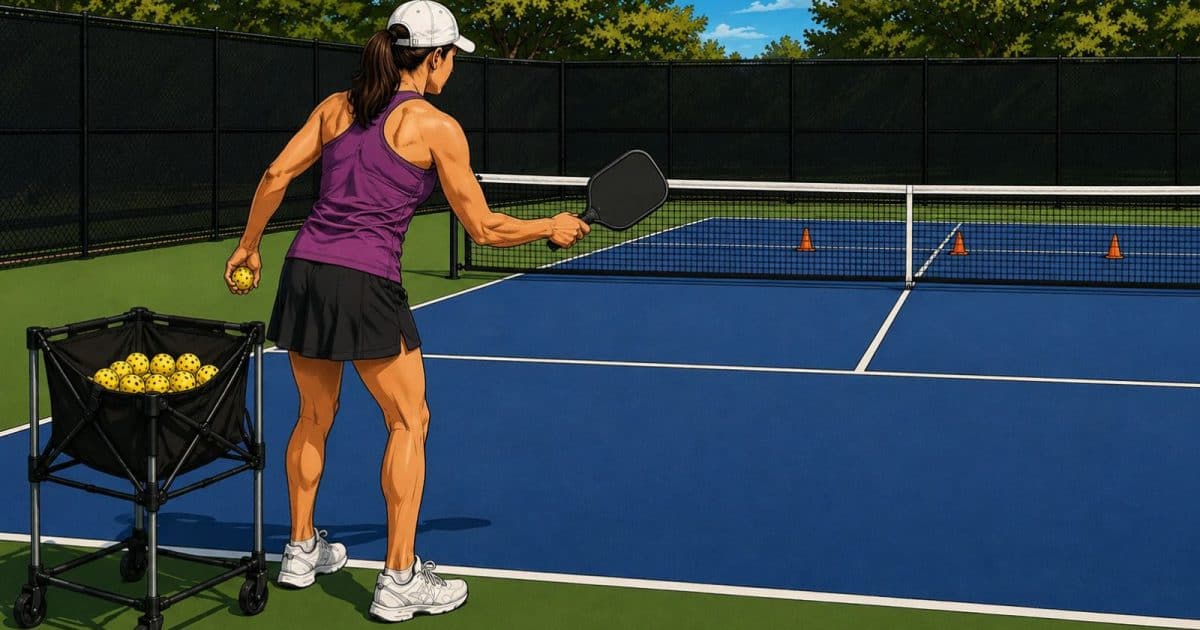
- Serves. A bucket of balls and a court. It is the one shot fully within a player’s control, and a focused serve routine builds consistency fast.
- Wall work. Standing back from a wall for continuous dinks or volleys at a target builds paddle control and reaction speed together.
- Third shot drops onto a target, self-fed from the baseline.
- Footwork ladders, no ball required.
- Shadow swings for grooving a stroke that is being rebuilt or corrected.
The full rundown on drilling without a partner covers variations on each of these, and the wall-drill guide breaks down distances and targets in more detail.
A ball machine versus an app
It is a different tool, and a much bigger commitment.
A machine feeds a steady stream of balls, which no app can do by itself. For a player serious about drilling alone, that changes what a solo session can cover, since a machine can run a full third-shot-drop routine without anyone feeding balls by hand. Pickleball Tutor, verified on its own site, sells a lineup of machines including the Mini, Spin, and Plus models with different capacity and oscillation features. Machines like these cost real money, and they have to be stored, transported, and charged between sessions.
An app costs nothing to try and mainly organizes time and attention. Most players get real value out of an app paired with a wall before a ball machine earns its cost. A machine becomes worth it once drilling alone has become a regular habit rather than an occasional session.
FAQ
What is a pickleball drills app? Software with a library of practice drills, usually including timed sessions, video demonstrations, and some progression through skill levels.
Do drills apps actually improve a player’s game? The drilling improves the game. The app makes a player more likely to actually do it, and it pushes practice into shots that would otherwise get skipped.
Can a player drill without a partner? Yes. Serves, wall work, self-fed drops, footwork, and shadow swings all work alone, and a wall is one of the most underused tools in the sport.
How long should a drilling session be? Twenty to thirty minutes before a game is enough to move a player’s game, and it is short enough that people actually stick with it.
Are drills apps free? Many drill libraries offer a free tier, with paid tiers adding full programs or additional content. Pricing and features vary by app and change often, so it is worth checking an app’s own listing before assuming what is included.
Is an app better than a coach? No. A coach watches what a player is doing wrong in real time, which no app can do. An app fills the practice time between lessons.
What should an intermediate player drill? Third shot drops, resets, and holding the kitchen line come up most often. Those three shots account for much of the gap between a 3.5 and a 4.0 player.
Is a ball machine necessary to start drilling? No. A wall and a bucket of balls cover most solo drilling needs. A machine, such as one of the Pickleball Tutor models, is worth considering once a player is drilling often and wants more volume than self-feeding allows.
Finding the right practice tool is only part of the picture, and sometimes what actually moves a game forward is a second set of eyes. Pickler Junction’s directory of pickleball coaches lists instructors who can watch what an app cannot.
Written by the Pickler Junction Team.