
Pickleball Score Keeper Apps: Tracking Games and Stats
Quick Answer: Score keeper apps track the running score, the server number, and sometimes shot-level stats during a pickleball game. Under the USA Pickleball rulebook, the score itself must still be called out loud before every serve. For casual play, calling the score works fine. Apps earn their place through the stats they collect, not the scorekeeping itself.
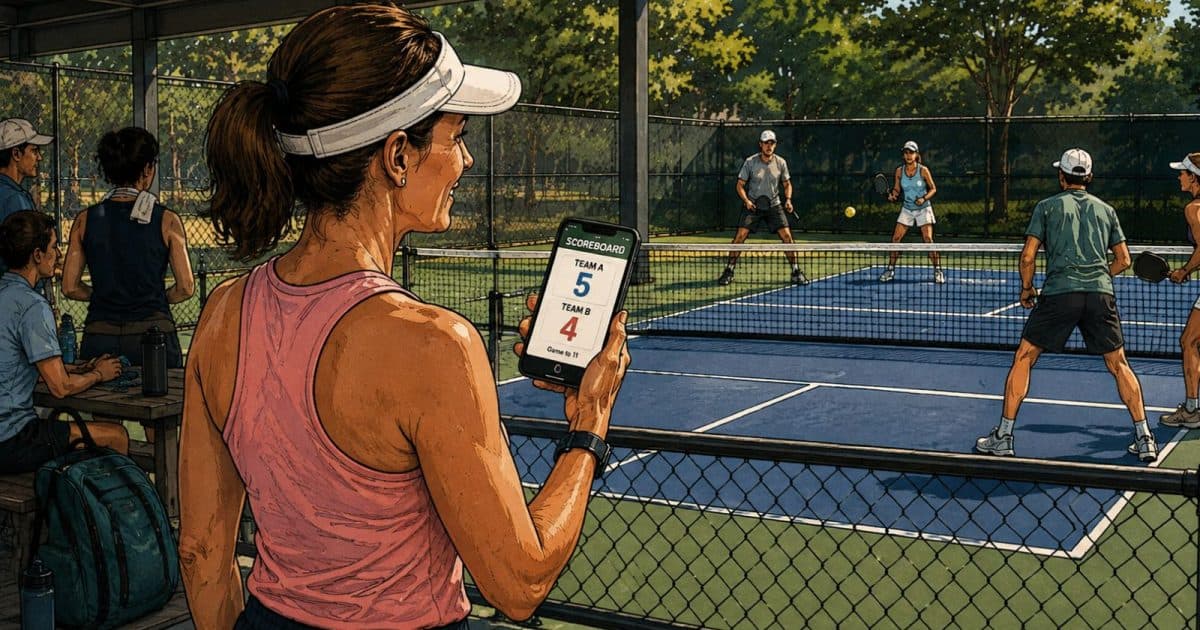
A pickleball score keeper app records the score as a game is played, usually tracking which player is serving and whether that player is the first or second server.
Why pickleball scoring is worth an app
Because the call has three numbers, and almost nobody remembers whose serve it is.
In doubles, a player calls the serving team’s score, the receiving team’s score, and the server number, in that order: nine, four, two. Under the 2026 USA Pickleball rulebook, Section 6 requires the entire score to be called before the server hits the serve. Beginners lose track constantly, and even experienced players stop mid-rally to argue about the server number. See how pickleball scoring works for the full walkthrough.
More people are running into that confusion every year. The Sports & Fitness Industry Association counted 24.3 million US pickleball players in 2025, up from 4.2 million in 2020, a figure current as of September 2026. A bigger, newer player base means more courts where nobody has the three-number call memorized yet.
An app removes the argument. Tap after each rally and it keeps the count for you. For a group that plays casually and gets the call wrong often, that is a real fix, not a gimmick.
The honest case against
Someone has to hold the phone.
That is the whole problem with this category. In a doubles game with four players and no spectator, tapping a screen between rallies is more disruptive than remembering a number. Groups that start using a scorekeeping app often quietly drop it within a few sessions, because the tapping breaks up play more than an occasional argument over the score ever did.
Where these apps work best: a coach or organizer running a session from the sideline, a tournament with an assigned scorekeeper, or a player who wants the data enough to put up with the extra step.
The stats side
This is the more useful half, and it gets less attention than the scorekeeping.
Some apps record shot-level data: unforced errors, third shot outcomes, and where points end. Over a few sessions, that data shows you patterns you cannot feel in the moment. You might assume you lose points at the net and discover most of them are actually lost in the transition zone, or that your third shot drop fails far more often than it feels like it does.
That kind of feedback is the closest thing to a coach’s eye you can get without paying for one. Private coaching commonly runs $50 to $100 or more per hour, and group clinics run $20 to $50 per person for a one to two hour session. An app that tracks shot outcomes will not replace that kind of instruction, but it gives you a free or low-cost way to see where your game actually breaks down between lessons.
What to look for
- One-tap scoring. If it takes three taps per rally, nobody keeps using it.
- Server tracking. The main reason to open the app in the first place. It should always show who serves and which server number is up.
- Works offline. Court coverage is unreliable, and an app that needs a signal is useless outdoors.
- Stat depth worth reading. Recording twenty metrics nobody reviews is worse than four you actually check after a session.
- Export. Comparing sessions over time requires getting the data out of the app.
A score keeper app is not the same tool as a rating app. Scorekeeping tracks a single game; a pickleball rating app estimates skill level across many games and opponents. Some players want both, but they solve different problems.
The simpler answer
Yes, and it is the plainest one available: say the score out loud before every serve.
It is required anyway. The rulebook states the entire score, including the server number, must be called before the serve is struck. It costs nothing, and it keeps everyone honest. Scoring disputes in a group drop sharply once the server calls all three numbers clearly instead of mumbling the last one.
If your group argues about the score constantly, the fix is usually not an app. It is that nobody is calling the score the way the rules already require. Groups that struggle more with lineups and court rotation between games may get more value from a pickleball rotation app, or from a pickleball scheduling app if the real problem is getting enough players to the same court at the same time.
FAQ
What does a pickleball score keeper app do? It tracks the running score and the server number during play, and in some cases records shot-level statistics for review after the session.
Do I need an app to keep score in pickleball? No. Under the rulebook, the server must call the full score, including the server number, before serving. Doing that correctly solves most disputes without any app.
What is the hardest part of the pickleball score call? Remembering whether you are the first or second server. The rulebook lists this as part of the required score call in Section 6, and it is the number groups lose track of most.
Can these apps track statistics beyond the score? Some do, recording unforced errors, third shot outcomes, and where points end. That data is often more useful to your game than the scorekeeping itself.
Do score keeper apps work without a signal? The reliable ones do. Court coverage outdoors is frequently poor, so offline function is worth checking before relying on an app during a session.
Who actually uses pickleball score keeper apps? Coaches and organizers running sessions from the sideline, tournament scorekeepers, and players who want the stat history. Four players mid-game rarely keep it up for long.
Are pickleball score keeper apps free? Basic scorekeeping generally is. Deeper stat tracking and session history often sit behind a paid tier, so check before assuming full access is free.
What score information does the rulebook require players to call? The rulebook requires the serving team’s score, the receiving team’s score, and the server number, called in that order before every serve. That three-part call is what most scorekeeping apps are built to automate.
If you want games worth recording data on in the first place, working with a coach is often the faster path to fewer of the transition-zone errors an app can only point out after the fact. Browse pickleball coaches through the Pickler Junction directory to find one nearby.
Written by the Pickler Junction Team.