How to Practice Pickleball Alone Without a Wall
Quick Answer: To practice pickleball alone without a wall, work serve targets, self fed drops and dinks, footwork patterns and shadow swings. Serving is the one shot with no opponent input, so solo reps on it carry directly into matches. Ten focused minutes on a target beats an hour of aimless hitting.
Solo practice means any structured work you can do with one paddle, some balls and an empty court. A wall makes some of it easier, but none of what follows requires one. Pickleball participation grew from about 4.2 million players in 2020 to 24.3 million in 2025, according to the Sports & Fitness Industry Association, and that growth means more crowded courts and more evenings without a regular hitting partner.
What is worth practicing alone
Anything where you control the ball’s starting position, plus anything that is purely about your own body, is worth doing alone.
That covers serves, self fed drops, self fed dinks, footwork, split step timing and swing mechanics. It does not cover reaction speed, hands battles or reading an opponent, since those need a second player reacting to you in real time.
If a session only has room for one thing, make it serving. It is the one shot in the game with no opponent input before it, it is fully repeatable, and many recreational players never drill it on its own outside of warmup.
Practicing serves productively
With a target and a count, not a bucket and a vibe check.
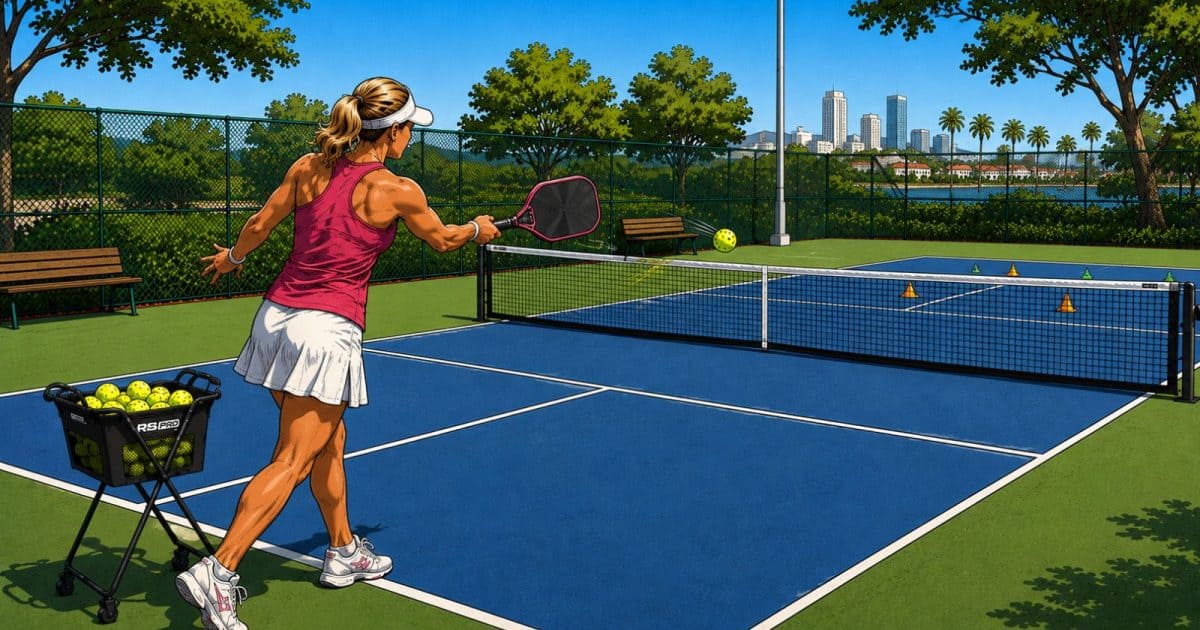
Put something on the court to aim at: cones, a towel, a spare paddle bag, anything placed two feet inside the baseline in the service box. A deep serve keeps the returner pinned back, the whole point of serving well under the 2026 rulebook’s Section 7 serving rules.
Set a goal and count. Ten in a row into the back third of the box. Miss at seven, start the set over. Counting turns hitting into practice, because it adds the small stakes that force concentration.
Rotate targets every set: deep to the backhand, deep down the middle, deep and wide. Grooving fifty serves to the same spot builds a habit that will not transfer to a match, where the returner’s position keeps changing. The guide to improving your pickleball serve breaks down the grip and swing mechanics behind this target work.
What you can do without a partner feeding
Self feeding covers more ground than it sounds like.
- Self fed dinks. Stand at the kitchen line and drop a ball, then dink it into the opposite non-volley zone, which the rulebook sets at 7 feet back from the net on each side. Focus on a quiet wrist and a stable paddle face. Fifty a side is a solid count.
- Self fed drops. From the baseline, drop a ball and hit a third shot drop into the far kitchen. It is a good use of solo time right after serving, since the drop is also a shot initiated entirely by you.
- Return placement. Toss a ball high, let it bounce deep, and drive a return to a deep target. It rehearses contact and depth even without a real serve coming at you.
- Volley control. Toss a ball up in front of you and punch volleys at a target across the net, working on a compact motion with no backswing.
Footwork and shadow work
This is the part you can do anywhere, including a driveway or a garage with no court and no ball.
Shadow the pattern of a point: serve motion, three steps in, split step, shadow a drop, three more steps, split step, shadow a dink. Run it at match speed. It looks a little silly and it drills the movement habits that break down first under pressure.
Add ladder drills or simple line taps for lateral quickness and deceleration. Many footwork breakdowns in matches are stopping errors rather than starting errors, so practicing how to arrive under control is worth its own short block.
Film a session occasionally. A phone propped on a bag will show a hitch in a serve motion that is nearly impossible to feel from the inside.
If a driveway workaround stops being enough, the guide to building a pickleball court without cutting corners walks through what a permanent setup actually costs.
Training aids
Some do, and the honest answer depends on the aid.
Ball machines feed a ball at real pace with real spin, closer to a live rally than any self feed, which makes them useful for return and volley reps. They also cost more than nearly everything else in a solo bag, so most players treat one as a bigger purchase than a rebounder net or a set of cones.
None of that replaces serve work as a low cost use of a solo session.
Cheaper aids vary widely in usefulness. The piece on whether pickleball training aids work goes through which ones earn a spot in a bag and which ones mostly sit in a garage.
How long a solo session should be
Twenty to thirty minutes is plenty, and shorter is fine too. Solo practice quality drops fast once concentration goes, and a distracted hour builds worse habits than a focused ten minutes.
Pick two things per session: serves plus drops, or dinks plus footwork. Trying to cover everything in one outing is how a session turns back into aimless hitting.
Frequency matters as much as session length. The guide to how many times a week to play pickleball without getting hurt applies to solo work too, since a body with no rest day breaks down whether or not a partner is on the other side of the net.
Frequently asked questions
Can you really improve by practicing alone? Yes, for anything self initiated. Serves, drops and footwork all respond well to solo repetition. Reactive skills such as hands battles and reading an opponent’s paddle face need a second player.
How many balls should a solo session use? Enough that retrieving them does not eat into practice time. Twenty to forty balls makes a serving session efficient, and a hopper or bucket saves a lot of bending over.
Is a wall better than no wall? A wall adds a returning ball and more repetitions per minute, which helps with hands and reset work. The guide to practicing pickleball against a wall covers those drills, and the piece on practicing pickleball by yourself compares wall based and wall free options side by side.
Can I practice at home without a court? Shadow swings, footwork patterns, split step timing and paddle handling all work in a driveway or a garage, and most of it needs no ball at all.
What single solo drill is worth doing if time is short? Serving to a deep target with a count. It combines real match carryover with very little equipment, just a few balls and something to aim at.
How often should solo practice happen? Two short sessions a week is enough for many players to notice a difference within a month. Consistency across a few weeks matters more than any single long session.
Will solo practice help dinks? Self fed dinks build paddle face control and soft contact well. Timing against an opponent’s live pace still needs an actual partner, since the ball’s speed and spin are not something a self feed can fully replicate.
Should beginners practice alone? Yes, especially serves and basic contact. Structured group instruction is still the faster route to sound technique early on, and the beginner pickleball drills guide is a good starting list before adding solo sessions on top.
Solo work is where the shots nobody can interfere with get built, and serving is the obvious place to start. It is not a replacement for feedback on technique. Group clinics typically run $20 to $50 per person and private lessons run $50 to $100 or more per hour, as of September 2026, so many players mix solo reps with an occasional lesson to check the habits are the right ones. The pickleball coaches directory lists instructors who run single session assessments.
Written by the Pickler Junction Team.