
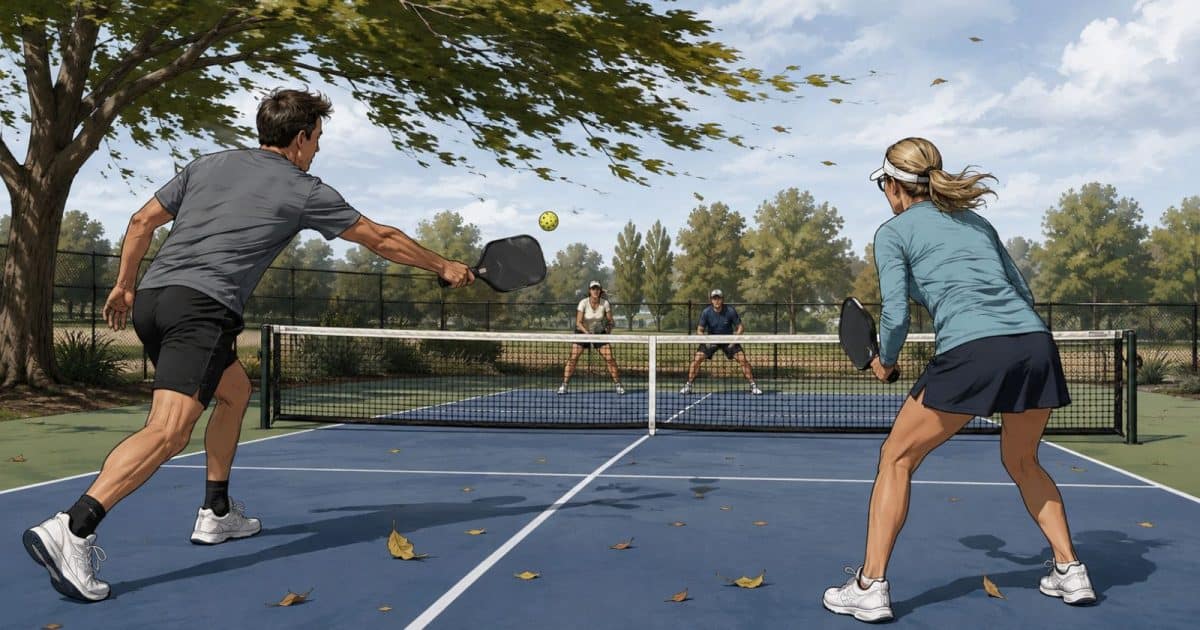
How to Play Pickleball in the Wind
Quick Answer: To play pickleball in the wind, flatten your shots, add net clearance, and stop lobbing. Drive more third shots, take balls out of the air, and adjust your target based on whether the wind is behind you, into you, or crossing the court. An outdoor ball weighs about 26 grams, so wind pushes it around more than expected.
Wind rewards flat, firm contact and punishes touch. On a calm day a light touch wins points. Add a steady breeze, and that same soft shot turns into a coin flip. Adjusting for wind starts with changing shot selection, not just fighting through it with better technique.
Why does wind affect a pickleball so much?
Because the ball is light and covered in holes. According to USA Pickleball’s Equipment Standards Manual, an approved pickleball weighs between 0.78 and 0.935 ounces, or about 22 to 26 grams, and has 26 to 40 holes drilled through the surface. That combination gives moving air plenty to grab onto.
Outdoor balls are built harder and with different hole patterns than indoor balls, which is why indoor balls struggle outside in any real breeze. The comparison of indoor and outdoor pickleballs explains the construction differences in more detail.
The effect gets worse the higher and softer you hit. A ball that spends longer in the air gives the wind longer to act on it. That single fact drives almost every adjustment below.
How should you change your shot selection?
Flatten everything and shorten the time the ball spends in the air.
- Drive more third shots. A third shot drop floats by design, and a floating ball in wind becomes unpredictable. A drive travels faster and lower, so wind has less time to move it off course.
- Stop lobbing. A lob into a headwind usually comes back short of where you aimed. A lob with the wind behind it usually sails long. Neither result helps you, so cut lobs out of your game plan on windy days.
- Dink lower and firmer. A soft, high dink gets pushed into a position your opponent can attack. Take a little touch off and add a little pace instead.
- Take balls out of the air when you can. Every bounce is another chance for wind to change the ball’s path before your paddle gets there.
- Aim further inside the lines. Two feet of margin on a calm day can turn into zero feet of margin in a crosswind.
What changes when the wind is behind you?
Everything travels farther, so you need to hit shorter.
Serves go long more often, and this is where points get given away for free. Aim for the middle of the service box instead of the back few feet, and expect the ball to carry to the depth you actually wanted.
Drives sail past their target. Dinks that would normally settle into the kitchen carry to the returner’s feet or past them instead. Take pace off on purpose, and accept that your shots will feel too soft while you are hitting them. They will land where you meant them to.
What changes into a headwind?
You have to commit to the shot and swing through the ball. Everything falls short into a headwind, especially serves and returns.
The upside is that this is often the stronger end to attack from. Balls you hit with pace stay lower and dip, while your opponents’ lobs and drops come up short into your strike zone. If you win the coin toss on a windy day, choosing the end you want can matter more than choosing to serve first.
Serve depth suffers most into a headwind. Add extra margin over the net and rely on weight transfer through the shot rather than trying to muscle it with your arm alone.
How do you handle a crosswind?
Crosswind is the hardest of the three to adjust for because it pushes the ball sideways during flight instead of just shortening or lengthening it.
Aim off target on purpose. If the wind is blowing left to right, start the ball further left than where you actually want it to land, and let the wind carry it in. This feels wrong for the first several points and then becomes automatic.
Watch the ball longer than usual before you commit to your swing. Crosswind moves the ball late in its flight, so the contact point you predicted when it left your opponent’s paddle is not always where the ball ends up.
Under Section 3 of the 2026 USA Pickleball rulebook, the non-volley zone extends 7 feet from the net. A crosswind gust can carry a ball that would have landed safely inside that zone a foot or more past it, right into a spot your opponent can attack.
What about the practical stuff?
Weigh down anything that can blow away. A paddle bag rolling across the court mid-rally is both a hazard and a distraction. Sunglasses become more useful for blocking grit than sun. Hats blow off easily, so a visor tends to stay in place better.
If wind is strong enough that a stationary ball rolls on its own, that is usually the point where play stops being worth it. An indoor option is the better call at that point. Pickleheads, USA Pickleball’s official court finder, lists more than 25,000 places to play as of September 2026, and the guide to finding indoor pickleball courts covers where else to look.
Frequently asked questions
Is there an official wind speed limit for pickleball? No. The rulebook does not set a wind threshold for stopping play. Gusty conditions tend to cause more problems than steady wind, since a gust can change the ball’s path after you have already committed to a swing.
Do heavier pickleballs help in the wind? Not officially. Under USA Pickleball’s Equipment Standards Manual, an approved ball can weigh anywhere from 0.78 to 0.935 ounces, and that range applies to every approved ball regardless of conditions.
Should I use a heavier paddle in the wind? Some players do, since extra mass can help stabilize the paddle on drives and blocks. It comes down to personal preference rather than a rule.
Which end should I choose on a windy day? Many players prefer starting into the headwind so the wind is behind them late in the game, when serves matter most. Others take the tailwind first to build an early lead. Both approaches are reasonable.
Does wind affect indoor balls outdoors? Yes, significantly. Indoor balls are built softer than most outdoor balls and get pushed around badly outside. The comparison of indoor and outdoor pickleballs has more on the construction differences.
How do I practice for windy conditions? Play on windy days on purpose instead of waiting them out. Time spent indoors will not prepare a player for how a crosswind moves a dink.
Can wind push a serve out of bounds? Easily, especially with the wind at your back. Serving toward the middle of the box rather than deep in it is the standard fix.
What about rain and wind together? That combination adds a slipping hazard on top of the ball flight problem. The guide to playing pickleball in the rain covers the surface risks.
Wind rewards the player who adjusts shot selection fastest, not the player with the softest hands. If conditions at your local courts are consistently exposed and you would rather get hands-on help adapting your game, Pickler Junction’s directory of pickleball coaches can connect you with one near you.
Written by the Pickler Junction Team.