How Much Should You Spend on a Pickleball Paddle?
Quick Answer: How much to spend on a pickleball paddle depends on how often you play. Beginners do fine around fifty to eighty dollars. Regular players usually land between one hundred and one hundred fifty, where carbon faces and thermoformed builds start. Above two hundred fifty, you are paying for refinement, not a different game.
Paddle prices span a wider range than almost any other piece of gear in the sport, and the jump from an entry model to a flagship model is a multiple, not a small percentage. The useful question is where the improvements stop being obvious to a player at your level.
How much should you spend on a pickleball paddle?
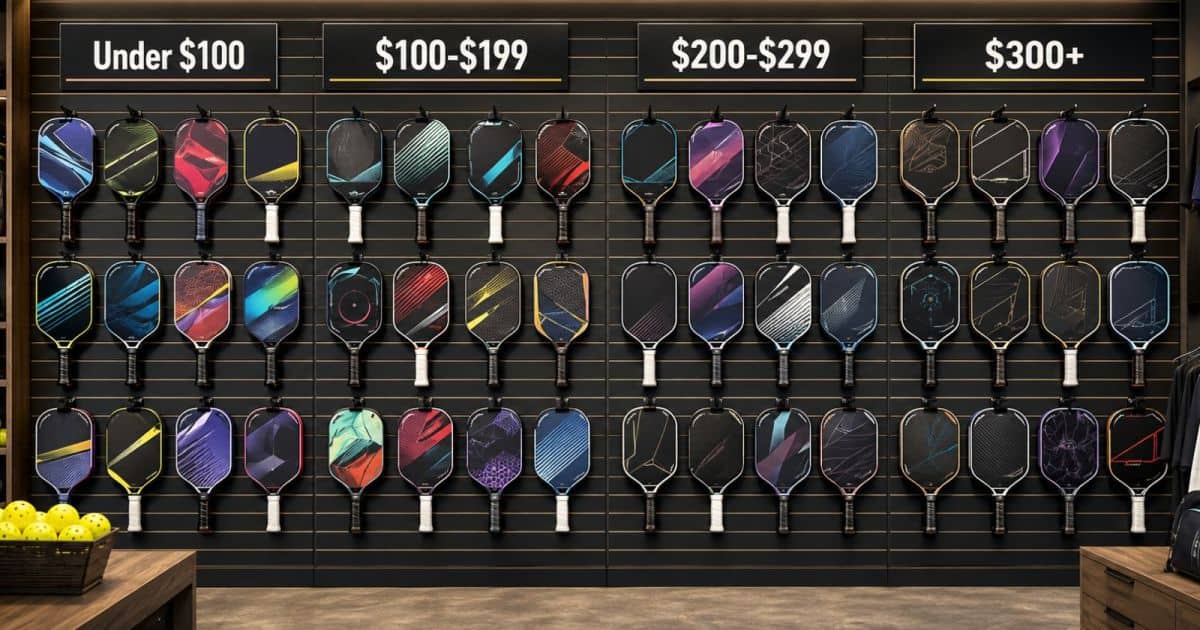
Spend in proportion to how often you play and how settled your game feels. Selkirk, a paddle manufacturer, lists its lineup from about sixty dollars to three hundred thirty three dollars as of September 2026, and that spread is typical of the category. A rough map of the tiers:
- Under fifty dollars. Wood and basic composite paddles. Fine for a garage set, a backyard party, or finding out whether you like the sport.
- Fifty to one hundred dollars. Solid entry composite and some entry carbon. This is where a real paddle starts.
- One hundred to one hundred fifty dollars. The range where a lot of committed recreational players land. Carbon faces, honeycomb cores, and tighter manufacturing tolerances become common here.
- One hundred fifty to two hundred fifty dollars. Premium construction, including thermoformed builds, with refined feel and stability.
- Above two hundred fifty dollars. Flagship models, where gains get small and specific.
If you play a couple of times a week and plan to keep playing, the middle tier is usually where the money goes furthest. A paddle that fits your hand and swing does more for your game than one that simply costs more. Start with the guide to how to choose a pickleball paddle before you shop by price alone.
What do you actually get as the price goes up?
Materials and consistency, mostly. Budget paddles use basic composite faces and simple cores, and unit-to-unit variation is common, so two paddles of the same model can feel different. Mid-tier paddles add carbon faces, better honeycomb, and tighter tolerances.
The upper tiers add construction methods, not just materials. Thermoformed edges, foam-injected perimeters, and refined layups create a larger sweet spot, more stability on off-center hits, and better feel on soft shots. Those are real improvements. They are also improvements a player still building consistent contact may not notice yet.
Spin is the other thing price buys, mostly through face material. Premium models often use exposed carbon weaves, which the guide to raw carbon pickleball paddles covers in detail. Weight distribution matters too. A paddle’s swing weight, how heavy it feels in motion rather than on a scale, changes with materials and shape, and it affects control and power as much as the price tag does.
Are expensive pickleball paddles worth it?
For committed players, often yes. For new players, usually not yet. The value curve is steep from thirty dollars to one hundred fifty dollars, then it flattens hard. Moving from one hundred fifty dollars to three hundred dollars does not double anything about your results on court.
Three questions help settle it:
- Do you play weekly or more? If not, save the money for lessons or court time instead.
- Do you know what you want the paddle to do? More spin, more power, faster hands at the net. A specific goal makes a premium paddle worth targeting.
- Are your errors coming from technique or equipment? Technique causes most errors, and no paddle fixes footwork or shot selection.
Durability cuts against the premium tier too. A thin, hot, high-end build is not automatically longer lived than a mid-tier paddle, and heat or a hard impact can end any paddle through delamination regardless of price. The guide to paddle delamination explains what to watch for.
When is a cheap paddle the right call?
More often than the marketing suggests. Buy a budget paddle when you are brand new and unsure, when you need loaners for guests, when you want a beater for a hot car or rough outdoor courts, or when you are between paddles and just need something playable.
The one thing to check even on a budget paddle is approval status, if you have any intention of entering sanctioned events. Section 18.A of the 2026 USA Pickleball rulebook requires players to use a paddle from the official approved paddle list, and using an unapproved paddle during active play can cost a match by forfeit. The guide to USA Pickleball approved paddles walks through how to check a model before you buy.
How do you avoid overpaying?
Demo before you commit whenever you can. Clubs and pro shops that keep demo paddles let you test three or four models in an afternoon, which teaches you more than a month of reading spec sheets. Buying the previous season’s model is another way to save, since paddle lines refresh often and the older flagship usually drops in price without getting worse.
Get the fundamentals right before you chase materials. Grip size, weight, and balance shape how a paddle feels more than the face material does. Choosing the right grip and starting with the guide to what paddle weight a beginner should use will do more for your game than moving up a price tier. Then set the marketing language aside and hit with the paddle in your hand.
FAQ
How much does a good pickleball paddle cost? Most paddles built for regular play cost between one hundred and one hundred fifty dollars. Below that range you find capable entry paddles, and above it you find refinement rather than a different game.
Are one hundred dollar paddles worth it over thirty dollar paddles? Usually, yes. The jump from a basic composite paddle to a real carbon faced paddle is one of the more noticeable upgrades in the price range.
Do professional players use the most expensive paddles? They use paddles made by their sponsors, often flagship models. That reflects contracts as much as performance, so it is not a reliable buying signal on its own.
How often should you replace a pickleball paddle? Replace a paddle when the face texture wears smooth, the core feels dead, or the paddle shows visible damage. Frequent players often replace a paddle every year or so, and casual players go longer between replacements.
Is it worth buying a used pickleball paddle? It can be, at the right discount, if you can inspect it first. Check for a hollow or rattly sound, a lifting edge guard, and a face that still has some texture left.
Does a more expensive paddle improve your game? It can remove equipment limits, but it will not fix technique. Lessons typically deliver more improvement per dollar than a paddle upgrade does.
What should a beginner spend on a first paddle? Fifty to eighty dollars is plenty for a first paddle. Play for a few months, learn what you want to change, then buy a paddle that addresses it.
Can you use any paddle in a sanctioned tournament? No. Section 18.A limits sanctioned play to paddles on the official approved paddle list, and a tournament official can require a switch to a compliant paddle before a match starts.
When you are ready to shop, Pickler Junction’s gear and accessories directory lists retailers and pro shops near you, so you can compare models and prices before you buy.
Written by the Pickler Junction Team.