Elongated vs Standard Pickleball Paddle: Which Shape Wins?
Quick Answer: Elongated paddles run longer and narrower, adding reach and swing power at the cost of a smaller sweet spot. Standard paddles run shorter and wider, giving a bigger sweet spot and quicker hands at the net. Under the USA Pickleball rulebook, both shapes share the same 24-inch combined size limit.
Paddle shape changes how a paddle plays more than most marketing claims about the core material inside it. Shape is also bound by a size rule most buyers never read, which is what turns the choice into a genuine tradeoff rather than a simple upgrade.
What makes a paddle elongated?
Under the 2026 USA Pickleball rulebook, Rule 3.D.2 caps the combined length and width of a paddle, including any edge guard and butt cap, at 24 inches. The same rule caps length alone at 17 inches. Shape is simply how a manufacturer spends that fixed budget of surface area.
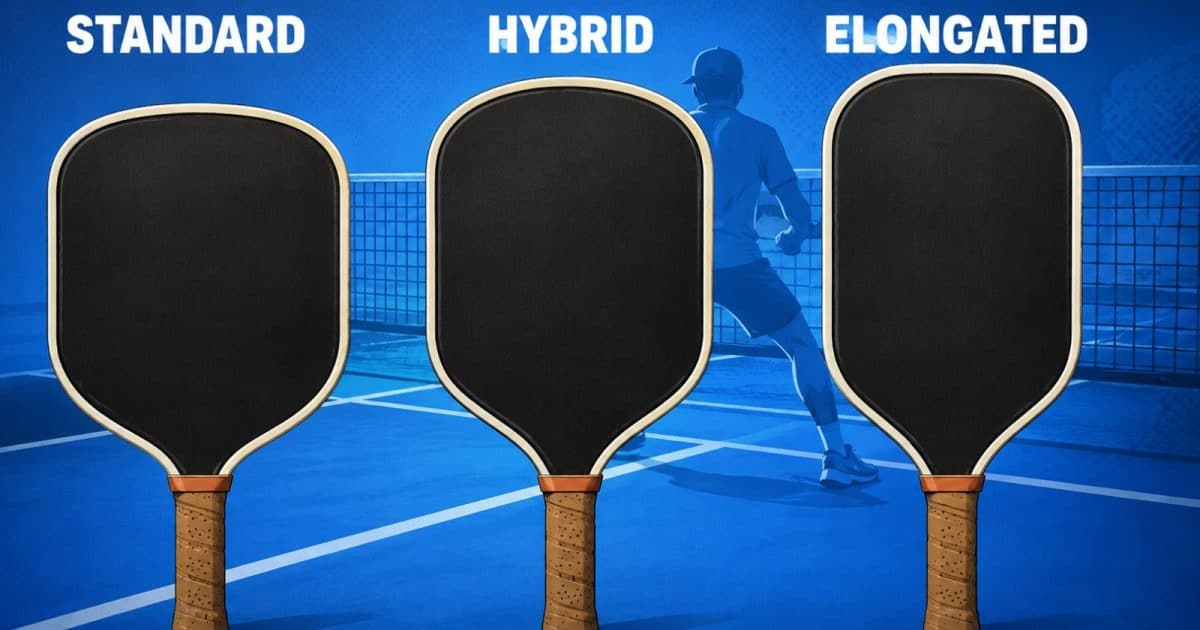
A standard, or widebody, paddle typically measures around 15.5 to 16 inches long and roughly 8 inches wide. An elongated paddle stretches toward 16.5 inches or more in length and narrows in width to stay inside that same 24-inch combined limit.
That is the entire distinction. No manufacturer is adding surface area; the surface is being redistributed. Every debate about which shape is better is really a debate about where the hitting surface should sit: spread wide for coverage, or stretched long for reach.
What does the elongated shape actually give you?
Reach and swing power, and the two are connected.
- Extra reach on stretched volleys and wide dinks. An extra inch of length matters more than it sounds like when you are lunging at the kitchen line.
- More pace on drives and serves. The contact point sits further from your hand, so the paddle behaves like a longer lever and picks up more head speed through the swing.
- A sweet spot positioned higher on the face, which suits a player who naturally makes contact out in front of the body and above the waist.
- More spin potential on topspin drives, since the longer arc through the ball adds racquet-head speed at contact.
The tradeoffs land in three places. The sweet spot narrows, so off-center hits lose more pace and direction than they would on a wider face. Hand speed drops slightly in fast net exchanges, because more mass sits further from the grip, which is really a question of swing weight more than shape alone. And the longer paddle demands more precise contact, a rough trade for a player still building consistency.
What does the standard shape give you?
Forgiveness, and forgiveness wins more points at the rec level than reach does.
The wider face puts more surface exactly where mishits land, so a shot struck off center still clears the net with reasonable pace and direction. That matters most in the hands battles at the non-volley zone line, where reaction time is short and clean contact is not guaranteed.
Standard paddles also tend to feel quicker in the hand. Mass sits closer to the grip, so the paddle turns over faster on a block or a fast counter at the net. That effect comes from swing weight rather than shape on its own, which is why two standard paddles from different brands can still feel completely different in a block exchange.
What a standard shape gives up is reach and some drive power. A player who leans on a hard third shot drive, or who plays singles often, feels the missing inch on defense.
Which shape should you buy?
Match the shape to where you actually win points.
Choose elongated if singles is a regular part of your game, if you drive the ball more than you drop it, if you want extra reach on defense, or if your contact is already centered and consistent. Two-handed backhand players often land here too, since elongated paddles tend to pair with the longer handles that grip style needs; the guide to paddle handle length covers that pairing in more detail.
Choose standard if doubles is most of your court time, if you win points at the net rather than from the baseline, if you are still building consistent contact, or if you want the widest margin for error available in a given paddle line. A newer player is usually served well by the larger sweet spot while beginner-friendly paddle weight is still the bigger factor to get right first.
Hybrid shapes split the difference and have become a real, common option rather than a marketing invention. They trade a fully committed sweet spot and reach profile for a paddle that leans neither way strongly, which suits a player who cannot decide more than one who already has a clear priority.
The pattern worth avoiding: switching to elongated for the reach, then losing more points to shanks off the narrower face than the extra inch ever wins back. Contact consistency should come before shape. For the full decision framework, including grip, weight, and core, see the guide to choosing a pickleball paddle.
A paddle that once felt lively but now feels dead regardless of shape is a separate problem; see the guide on why a pickleball paddle loses its pop.
FAQ
What is an elongated pickleball paddle? An elongated paddle is longer and narrower than a standard paddle, typically 16.5 inches or more in length, while staying within the 24-inch combined length-and-width limit set by the USA Pickleball rulebook.
Is an elongated paddle better than a standard paddle? Not universally. An elongated paddle trades sweet spot size for reach and swing power, so which shape plays better depends on whether reach or forgiveness matters more in a given match, under the rulebook’s shared size limit.
Which shape is best for beginners? Standard, or widebody, in most cases. Its larger sweet spot forgives inconsistent contact while a new player is still developing timing and technique.
Do elongated paddles give more power? They function as a longer lever, which typically adds pace on drives and serves for a player who already makes clean, centered contact.
What is the downside of an elongated paddle? A narrower sweet spot, harsher mishits off center, and slightly slower hands in fast net exchanges.
Are elongated paddles legal? Yes, under the USA Pickleball rulebook. Rule 3.D.2 allows any paddle shape as long as combined length and width do not exceed 24 inches and length alone does not exceed 17 inches.
Which shape is better for singles? Elongated, generally, since singles rewards court coverage and reach more heavily than doubles does.
What is a hybrid paddle shape? A design between elongated and standard that offers a middle-ground sweet spot and reach profile rather than the strengths of either extreme.
Ready to compare shapes before buying one? The gear and accessories directory at Pickler Junction lists shops and pro programs where you can test both shapes in person before your contact style tells you which one to trust.
Written by the Pickler Junction Team.