What Fence Height Do You Need for a Pickleball Court?
Quick Answer: Most pickleball courts use a chain link fence at least 10 feet tall behind each baseline, the minimum backstop height in USA Pickleball’s construction guidance. Fencing along the sidelines can drop to 3 feet, though many builders keep the taller mesh running 20 to 30 feet past each baseline corner to catch balls that fly off at an angle.
A pickleball court needs more than painted lines and a net to play safely. Fencing keeps the ball inside the court, keeps foot traffic and pets out, and gives players a backboard to bounce a warmup shot off. Net height, covered in the guide to what is the height of a pickleball net, is fixed by the rulebook and never changes. Fence height works differently. It is a construction recommendation from USA Pickleball, not a rule, and it changes depending on where the fence sits around the court.
How tall does a pickleball court fence need to be?
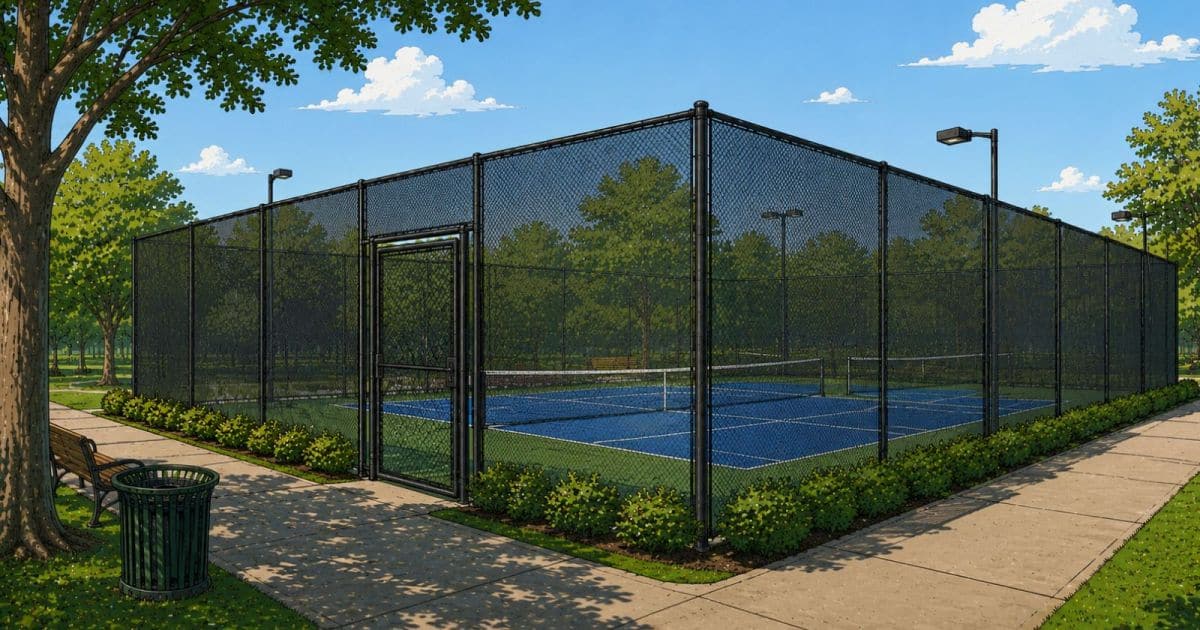
USA Pickleball’s court construction guidance, published at usapickleball.org/construction/, sets a minimum backstop height of 10 feet behind each baseline, and says to build taller if balls keep leaving the court area. The backstop is the fence a player faces at the back of the court, and it takes the brunt of missed lobs, hard drives, and serves hit long.
Side fencing, the mesh running along the sidelines, does not need to match that height everywhere. The same guidance sets a 3 foot minimum for sidestops, since fewer balls travel sideways off the court than fly long past the baseline.
Why are backstops taller than the fencing along the sidelines?
The two heights follow the ball. Most shots that leave a pickleball court fly out the ends, off a drive that carries too deep or a lob that goes up and never comes down in bounds. Very few balls travel far enough sideways to clear a short fence, so the sidelines do not need the same wall of chain link the baselines do.
USA Pickleball’s guidance still builds in a buffer for angled shots near the corners. It calls for the sideline fence to match the 10 foot backstop height for at least 20 feet out from each corner, with 30 feet recommended, before it can step down to the 3 foot minimum. That transition zone covers the stretch where a wide return or an angled drive is most likely to leave the court. Fencing farther down the sideline, away from where players are actually hitting, can be short enough to see over from the next court.
What kind of fence keeps a pickleball court from leaking balls onto the next court?
Chain link is the standard choice. USA Pickleball’s construction guidance calls it a cost effective option that lets both light and visibility pass through, which matters at facilities with courts stacked side by side.
Mesh size matters more than most builders expect. A pickleball measures about 65mm across, according to USA Pickleball’s construction page, and the guidance recommends 45mm or 55mm mesh openings so a ball cannot squeeze through gaps sized for a wider chain link pattern. Courts built close together, the kind covered in the guide to how many pickleball courts fit on a tennis court, depend on that mesh spec even more, since a ball that slips through a shared fence line lands mid-point on someone else’s game.
Any fence chosen also needs to be rust proof and free of protrusions, since a snagged shirt or a scraped arm on a fence rail is an easy injury to design away from the start. USA Pickleball’s guidance also calls for a gate on both ends of the court, wide enough for a wheelchair or a piece of maintenance equipment to pass through, so the fence never becomes the reason someone cannot get on or off the court.
Do windscreens make a difference on an outdoor court?
USA Pickleball’s guidance recommends windscreens, also called windbreaks, on outdoor court fencing. They deflect wind that would otherwise push a ball off its line mid-flight, and they give players a solid background to track the ball against instead of whatever is moving beyond the fence, parked cars, trees, or the match on the next court.
Fencing faces the same permanent-versus-temporary decision that nets do. A chain link line set on posts sunk in concrete holds its height and its windscreen for years, while a temporary barrier sags and shifts, the same tradeoff covered in the comparison of portable vs permanent pickleball nets. A court converted from an old tennis layout often already has posts and fence line in place, which is one reason the guide to how to convert a tennis court into a pickleball court treats existing fencing as an asset worth keeping rather than tearing out.
How much does fencing add to the cost of a pickleball court?
Chain link pricing scales with height. As of September 2026, a cost guide published by Fixr, last updated in early 2025, puts installed 9 gauge galvanized chain link with a 2 inch diamond pattern at about $16.25 to $26.55 per linear foot at 8 feet tall, and about $17.85 to $28.25 per linear foot at 10 feet, the height USA Pickleball’s guidance sets as the backstop minimum. Material costs alone run lower than the installed price, since labor, posts, and gate hardware add to the total.
A single backyard court with two 10 foot backstops and short 3 foot sidelines costs far less to fence than a multi-court facility running 10 foot mesh around the full perimeter for ball containment between courts. Get a written quote from the fencing contractor before weighing it against the rest of the pickleball court dimensions and layout budget, since surfacing and net posts are separate line items.
What should you check with your HOA or city before building a fence?
Fence height rules are local, and they do not bend for pickleball. Many residential zoning codes and HOA covenants cap backyard fence height well under the 10 foot backstop USA Pickleball recommends, sometimes at 6 feet or less, so a homeowner building a court on private property may need a variance or a shorter design before pouring posts. Public parks and commercial facilities usually have more room to work with, but still need sign off from the local building department.
The permitting process, covered in the guide to do you need a permit for a pickleball court, is worth starting before a fencing contractor is hired, not after. A fence built at 10 feet without a permit is one of the more expensive mistakes to unwind on a court project, since it usually means tearing it back down.
Frequently asked questions
How tall should a fence be behind a pickleball court? At least 10 feet, per USA Pickleball’s construction guidance, since that height keeps most missed drives and lobs inside the court.
How tall should the fence be along the sidelines? A minimum of 3 feet, though USA Pickleball’s guidance recommends matching the 10 foot backstop height for 20 to 30 feet out from each corner first.
What mesh size should a pickleball court fence use? 45mm or 55mm chain link openings, small enough to stop a ball that measures about 65mm across, according to USA Pickleball’s construction guidance.
Do pickleball courts need windscreens? They are recommended, not required. USA Pickleball’s guidance says windscreens cut down on wind interference and give players a solid background to track the ball against.
How much does a 10 foot chain link fence cost per linear foot? A cost guide published by Fixr puts installed pricing at about $17.85 to $28.25 per linear foot, though local labor and gate costs change the total.
Can a fence be shorter than 10 feet and still work? Yes, for casual or backyard courts. USA Pickleball ties the 10 foot minimum to ball containment, so a shorter fence just means more chasing stray shots.
Does the 10 foot figure apply everywhere, or only at competition venues? USA Pickleball’s fence numbers are construction guidance, not a rulebook requirement, so recreational and backyard courts can use a shorter fence if containment is not a concern.
Do local codes override USA Pickleball’s fence height guidance? Yes. HOA covenants and municipal zoning codes set the legal limit where a court is built, and USA Pickleball’s figures are a design recommendation, not a legal standard.
Planning a new court or fixing fencing on one that already exists? The builders and surfacing specialists in Pickler Junction’s pickleball court construction and infrastructure directory handle fence lines, posts, and footings as part of the job.
Written by the Pickler Junction Team.