Padel Racket vs Pickleball Paddle: What Is the Difference?
Quick Answer: According to FIP’s Rules of Padel, a padel racket is a solid, drilled bat capped at 38mm thick and 45.5cm long. Under the 2026 USA Pickleball rulebook, a pickleball paddle must stay flat and solid, with no holes allowed at all. Padel rackets also weigh far more, and neither one is legal in the other sport.
Both are solid, stringless bats, but each answers to a different rulebook and ball. Set them side by side and the differences jump out fast: one is a thick slab of foam full of holes, the other an oversized table tennis paddle. For the full picture on how the two sports compare, read the guide to padel versus pickleball.
What Does a Padel Racket Look Like?
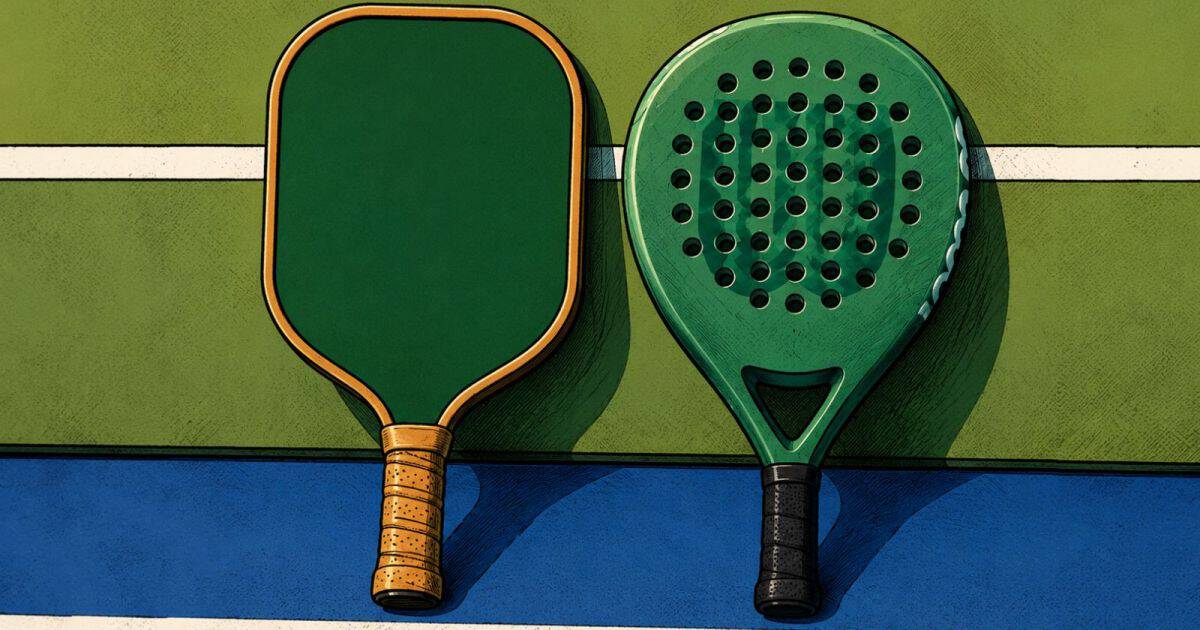
A padel racket is a solid, stringless bat with a face full of drilled holes, built to the rules of the International Padel Federation, known as FIP. Under FIP’s Rules of Padel, in force since January 2026, the head plus handle cannot exceed 45.5cm in total length, about 17.9 inches, and the head cannot exceed 26cm in width, about 10.2 inches, or 38mm in thickness, about 1.5 inches, with a 2.5 percent tolerance allowed at equipment checks.
The same 2026 FIP rules require the hitting surface to be perforated by cylindrical holes, 9 to 13mm across, about 0.35 to 0.51 inches, in the center of the face, growing to 20mm, about 0.79 inches, near the edges. Every racket also carries a wrist cord. FIP requires a non-elastic cord up to 35cm long fixed into the handle, and states that wearing it is obligatory, since padel is played in an enclosed court with other players close by.
Shape matters too. According to Playtomic, round rackets carry a larger, centered sweet spot suited to beginners and control play. Diamond rackets push that sweet spot higher for power but punish off-center contact, and teardrop rackets sit between the two.
What Makes a Pickleball Paddle Different?
A pickleball paddle is thin, flat, and completely solid, with no holes and generally no wrist strap. Under the 2026 USA Pickleball rulebook, Rule 3.D.2 caps the paddle’s combined length and width, including any edge guard, at 24 inches, or 60.96cm, and length alone at 17 inches, or 43.18cm, with no restriction on thickness. The USA Pickleball Equipment Standards Manual adds there is no restriction on weight either.
Real paddles still cluster in a narrow band. The Ektelon Inferno lists a 13mm core, about 0.51 inches, and weighs 7.75 ounces, about 220 grams, per Pickleball Warehouse. The Selkirk OMNI Widebody lists a 16mm core, about 0.63 inches, and an average weight of 7.9 to 8.2 ounces, per Pickleball Central. Even a thick pickleball paddle runs less than half the thickness of a padel racket.
Rule 3.D.5.a of the 2026 USA Pickleball rulebook is direct about the surface. It bans any “holes, cracks, delamination, or indentations that break the paddle skin or surface.” Hand a pickleball paddle to a padel player and the swing looks tentative. Hand the padel racket back, and the extra mass is obvious within a few strokes.
Why Does a Padel Racket Have Holes When a Pickleball Paddle Does Not?
The holes exist because of the ball. Padel uses a pressurized ball close in feel to a tennis ball, and moving it takes real mass and a thick foam core. That bulk is why the 2026 FIP rules require the surface to be perforated: drilling the face cuts weight.
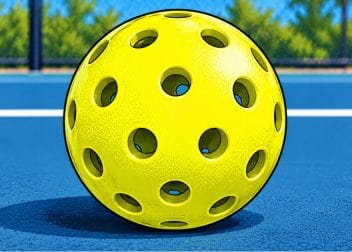
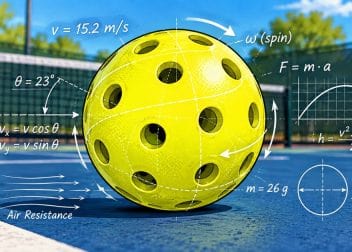
Pickleball uses a hollow, perforated plastic ball that weighs very little, so a thin, solid face has more than enough pop to send it flying. Rule 3.D.5.a of the 2026 USA Pickleball rulebook bans any holes that break the paddle’s skin. The two balls are different enough that Pickler Junction wrote a full breakdown of the padel ball versus the pickleball ball, and the short version is that they barely belong to the same family.
Padel Racket vs Pickleball Paddle at a Glance
| Feature | Padel Racket | Pickleball Paddle |
|—|—|—|
| Shape | Round, diamond, or teardrop | Widebody, elongated, or hybrid |
| Thickness | 38mm max, about 1.5 in, per FIP | No limit; sample models run 13 to 16mm |
| Size | 45.5cm by 26cm max, about 17.9 by 10.2 in, per FIP | 24 in combined, 17 in max length, per USA Pickleball |
| Holes | Required, 9 to 13mm, up to 20mm at the edge | Banned under Rule 3.D.5.a |
| Weight | 340 to 385g, about 12.0 to 13.6 oz | No limit; sample paddles run 7.75 to 8.2 oz |
| Wrist strap | Mandatory 35cm cord | Not required |
Can You Use One in the Other Sport?
No, and both the physics and the rulebooks agree. A pickleball paddle is too thin and light to control a heavier, pressurized padel ball, and a padel racket is comically overpowered for a plastic ball full of holes. FIP’s Rules of Padel require a perforated surface, so a solid pickleball paddle fails the padel rules outright. Going the other way, Rule 3.D.5.a of the 2026 USA Pickleball rulebook bans holes, so a drilled, 38mm-thick padel racket cannot pass a pickleball check either.
So if someone tells you one bat covers both sports, smile politely and ask to see the rulebook.
Which One Should You Buy?
Buy the one that matches the court near you. If pickleball courts are everywhere and the nearest padel club is far off, the answer picks itself. If pickleball is your sport, the Pickler Junction guide on how to choose a pickleball paddle covers core thickness, shape, and weight, and the list of USA Pickleball approved paddles is worth checking before you buy.
A few starting points either way:
- New padel players should start with a round racket. Its larger sweet spot forgives off-center hits, per Playtomic.
- Diamond padel rackets trade forgiveness for power, so save one for later.
- A standard widebody paddle at a middle weight is a solid starting point for new pickleball players.
- A thicker core, like the 16mm Selkirk OMNI Widebody, favors control, while a thinner core, like the 13mm Ektelon Inferno, favors pop.
Frequently Asked Questions
Is a padel racket legal in pickleball?
No. Rule 3.D.5.a of the 2026 USA Pickleball rulebook bans holes on the hitting surface, and a padel racket’s drilled face and 38mm thickness fail that rule immediately.
Why do padel rackets have holes?
Because the 2026 FIP Rules of Padel require it. The surface must be perforated, with holes 9 to 13mm across in the center growing to 20mm near the edges, which cuts weight on a racket built around a thick foam core.
Which is heavier, a padel racket or a pickleball paddle?
The padel racket, by a wide margin. According to The Padel Brief, padel rackets weigh 340 to 385 grams, about 12.0 to 13.6 ounces, while a Selkirk OMNI Widebody and an Ektelon Inferno paddle weigh 7.75 to 8.2 ounces, about 220 to 232 grams.
Why does a padel racket have a wrist strap?
Because the 2026 FIP Rules of Padel require one. A non-elastic cord up to 35cm long must be fixed into the handle and worn during play, since padel is played in an enclosed court with other players close by.
What shape padel racket should a beginner get?
Round. Playtomic notes that round rackets carry a larger, centered sweet spot that forgives off-center contact, while diamond rackets shift the sweet spot higher for power at the cost of that forgiveness.
Can you play padel with a pickleball paddle?
No. Under the 2026 FIP Rules of Padel, the hitting surface must be perforated, so a solid paddle fails that requirement on top of being too light to control a pressurized ball.
Does USA Pickleball limit paddle thickness or weight?
No. The 2026 USA Pickleball rulebook and the Equipment Standards Manual both confirm there is no restriction on either, though real paddles commonly run 13 to 16mm thick and about 7.75 to 8.2 ounces.
Already know which sport has your heart? If it is pickleball, browse the paddle shops and gear sellers in the Pickler Junction directory and find one near you before the weekend games fill up.
Written by the Pickler Junction Team.