How Long Does a Pickleball Paddle Last?
Quick Answer: A pickleball paddle’s usable life varies widely with construction, playing frequency, storage, and impact damage. Watch for repeatable changes in sound, feel, response, face condition, or edge damage rather than relying on the calendar alone.
A pickleball paddle does not come with an odometer. The material inside it fatigues gradually with every impact, so the paddle’s condition, not a date on the calendar, is what actually decides when it is time to replace it.
How Long Does a Paddle Last, By Construction?
Two general building approaches cover most of the market. Traditional paddle construction can use a variety of core materials and face materials, with an edge guard often added separately. Thermoformed and unibody are related construction terms, but paddles vary by brand and model; construction alone does not determine how long a paddle will last.
These are general ranges based on typical play patterns, not figures tied to any single brand. A paddle used two to three times a week may last much longer or much less time depending on its construction, storage, impact history, and the player’s tolerance for changes in feel or performance. Any paddle can develop surface wear or internal structural problems over time, but the timing and symptoms vary substantially by model, use, and damage history. A paddle that mostly sits in a bag can last several seasons, and a paddle used in daily open play or tournament practice can wear out in a matter of months.
Does Playing Frequency Change the Timeline?
Yes, and the relationship is not close to linear. A player on the court once a week puts far less cumulative stress on the face and core than a player on the court five days a week. Someone who plays most days of the week will usually accumulate more paddle impacts than someone who plays occasionally, but there is no universal replacement timeline.
What Are the Signs a Paddle Is Done?
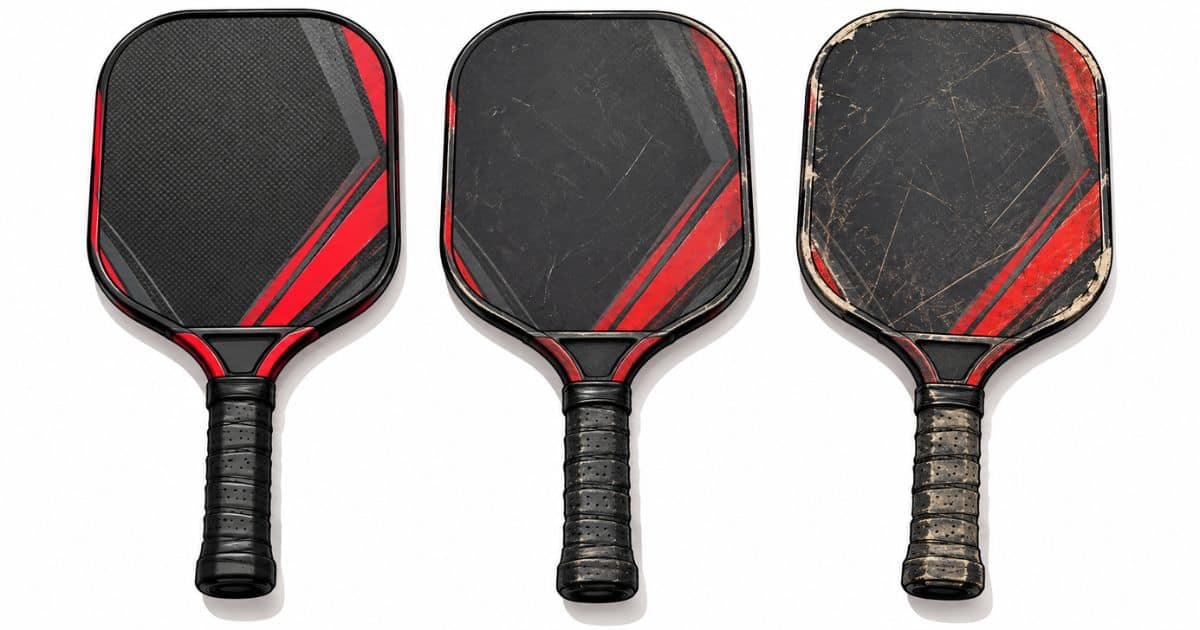
A handful of signs show up before a paddle fails outright, and once two or more of these appear together, the paddle’s actual performance has usually already dropped:
- Dead spots. A spot on the face that sounds and feels different from the rest of the paddle on contact, a dull thud instead of a crisp pop. The guide to why a paddle loses its pop covers what happens inside the core when this starts.
- Lost pop across the whole face, not just one spot. Shots that used to reach the baseline start falling short with the same swing.
- Delamination. The face material separating from the core, which can show up as a raised bubble, a crackling sound on contact, or a visible gap along an edge. The guide to paddle delamination explains how to check for it and what typically causes it.
- A loose or lifting edge guard, which lets moisture and court debris work into the core along the rim.
- Worn texture on the paddle face, where the grit pattern that generates spin has smoothed down toward a flatter surface.
What Shortens a Paddle’s Life Faster Than Normal Wear?
Three habits speed up wear regardless of construction type: heat, ground scrapes, and edge hits.
Leaving a paddle in extreme heat or direct sun can expose its materials and bonded components to conditions manufacturers generally advise avoiding, so it is best to store the paddle in a cooler, dry place. Dragging the paddle face on the court during a low volley or a scooped shot wears down the grit texture and can chip the edge over time. Knocking the paddle against a net post, a fence, or the ground can damage the edge guard, face, or bonded components.
Keeping a paddle out of direct heat and out of a hot trunk between sessions is one of the more manageable ways to slow this down, and the guide to pickleball paddle storage covers the specifics. Wrapping a worn edge in edge tape can also buy time before a full replacement is necessary, and the guide to edge tape for pickleball paddles explains how that works.
What Do Paddle Warranties Actually Cover?
A warranty is not a lifespan guarantee. It pays out only when a paddle fails from a manufacturing defect, not from normal wear, ground scrapes, or edge hits taken during play. Warranty terms vary widely from one maker to the next, and even between product lines from the same maker.
Selkirk states on its own site that Selkirk Sport paddles are guaranteed against workmanship and manufacturer defects for the lifetime of the paddle once the buyer activates the warranty, while its SLK line instead carries a one-year warranty from the original purchase date. JOOLA’s standard warranty runs six months from the date of purchase, extendable to twelve months if the buyer registers an NFC-equipped paddle in the JOOLA Infinity app within fourteen days of purchase, and JOOLA states plainly that the warranty excludes normal wear and tear, fading graphics, and commercial or rental use. Engage covers its paddles under what it calls a limited lifetime warranty against manufacturer defects and workmanship, but only after the buyer registers the paddle within thirty days of purchase, and the policy excludes normal wear and tear, abuse, and damage from hitting the ground or another paddle.
Because coverage differs this much between makers, and sometimes between one maker’s own paddle lines, checking the specific warranty page for the paddle in hand is worth doing before assuming a lifetime term applies.
When Should You Replace a Paddle Instead of Repairing It?
Edge tape and careful storage extend a paddle’s working life, but neither reverses delamination or restores a dead spot once the core has actually failed. Once two or more of the wear signs above show up together, replacing the paddle tends to be more reliable than trying to extend its use further with patches and workarounds. Anyone weighing how much to spend on the replacement can compare the reasoning in the guide to whether expensive paddles are worth it against the ranges in the guide to how much to spend on a pickleball paddle.
Frequently Asked Questions
How long does a pickleball paddle actually last? Paddle lifespan varies widely. A lightly used paddle may last years, while a heavily used or damaged paddle may need replacement much sooner.
How many hours of play does a paddle typically last? There is no single hour count that applies across brands and construction types. The condition of the face and core, not a running clock, is the more reliable signal that a paddle is done.
Can a pickleball paddle wear out from sitting unused? Extreme heat, moisture, and storage conditions can affect paddle materials over time, so following the manufacturer’s storage guidance is sensible.
What is a dead spot on a pickleball paddle? A dead spot is a section of the paddle face where impacts sound duller and produce noticeably less pop than the rest of the face, usually a sign that the core material underneath has broken down.
Does leaving a paddle in a hot car damage it? Yes. Sustained heat inside a car trunk or on a dashboard can expose a paddle to conditions manufacturers generally advise avoiding, so storing it in a cooler place is the safer choice.
Do all pickleball paddle warranties cover normal wear and tear? No. Selkirk, JOOLA, and Engage all state on their own warranty pages that normal wear and tear from play is excluded, and coverage applies only to manufacturing defects.
Can edge tape extend a pickleball paddle’s life? Edge tape can protect an exposed or lifting edge guard from further damage and buy some time, though it will not repair delamination that has already reached the core.
How can you tell if a paddle has delamination? Common signs include a raised bubble or ripple on the face, a crackling or rattling sound on contact, and a visible gap where the face material has separated from the edge or core.
Does a heavier paddle wear out faster than a lighter one? Weight alone is not the deciding factor. Construction type, how often the paddle is played, and how it’s stored and handled between sessions matter more than the number on the scale.
Once a dead spot, a lost step in pop, or a lifting edge guard shows up, checking the maker’s warranty page for what is actually covered is the first step, and the pickleball gear and accessories directory is a place to compare replacement paddles and accessories from vetted sellers.
Written by the Pickler Junction Team.