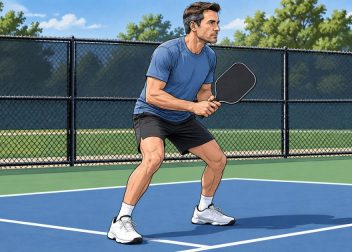
What Is the Baseline in Pickleball?
Quick Answer: The baseline is the line running parallel to the net at each end of a pickleball court, marking the back edge of play. Under the 2026 rulebook, Section 3, baselines measure 2 inches wide and count as part of the court. Servers keep at least one foot behind it when serving, and returners stand near it to receive serve.
Where Is the Baseline Located on a Pickleball Court?
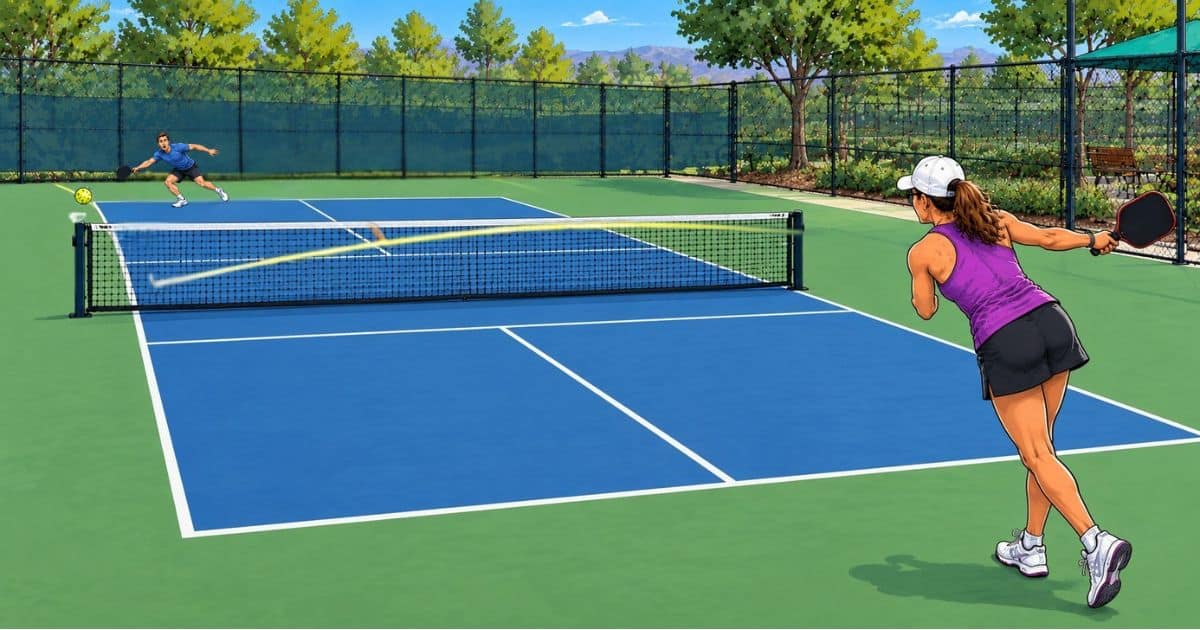
The baseline sits at each end of the court, running the full 20 foot width parallel to the net. Under the 2026 rulebook, Section 3, a baseline is defined as the lines parallel to the net at each end of the court, and every line on the court, baselines included, measures 2 inches wide and must contrast clearly with the court surface color. That width matters because a line is part of the area it borders, so a ball that clips the outer edge of the baseline is still in play rather than out. For a full breakdown of every court line and measurement, from the non-volley zone to the sidelines, the guide to pickleball court dimensions covers the complete layout.
The baseline is one boundary among several, and it works alongside the sideline and centerline to define legal play on the serve and on every rally afterward. Anyone learning the sport benefits from reading through the pickleball court rules in full before stepping on court, since the baseline only makes sense in the context of the lines around it.
Where Must the Server’s Feet Be at the Baseline?
Serving position is where the baseline carries the most weight in the rulebook. Under the 2026 rulebook, Section 7.A, at least one of the server’s feet must be in contact with the correct serving area when the serve is hit, and neither foot is allowed to touch the court itself or the surface outside that serving area. Section 3 defines the correct serving area as the space behind the baseline on each end of the court, bounded by and including the imaginary extensions of the adjacent sideline and the centerline. In practice, that means a server’s feet must stay behind the baseline and inside the imaginary lines running straight back from the sideline and centerline at the moment the paddle contacts the ball, never stepping on or over the baseline and never drifting past those extended lines. A foot that touches the baseline itself, rather than staying clearly behind it, at contact is a foot fault. The full walkthrough of legal serve motion and contact rules is in the guide to pickleball serving rules.
How Are Baseline Line Calls Made?
Line calls on the baseline follow the same responsibility structure as every other line on the court. Under the 2026 rulebook, Section 8.A, players are responsible for making out calls for all lines on their own end of the court, so each side calls its own baseline, not the opponent’s. Section 8.D adds a code of ethics standard: a call that cannot be made with certainty must be resolved in favor of the opponent, so a baseline shot a player cannot clearly see landing out should be called in. A ball that lands on the baseline itself is in, since the line is part of the court it borders. The one exception on the court involves the non-volley zone line on a serve, which counts as out even though it is a line, but that exception does not extend to the baseline on a return or a rally shot. Players who want the full mechanics of making and disputing calls should read the guide to calling lines in pickleball.
Is the Baseline the Return-of-Serve Position?
The baseline is closely tied to the return of serve, though the rulebook does not require the returner to stand on it. Under the 2026 rulebook, Section 10.A, the two-bounce rule requires the serve and the return of serve to each bounce before either side can volley the ball, so the returner cannot hit the ball out of the air on the first shot regardless of where they stand. Because a deep serve often lands near the back boundary, standing at or just behind the baseline gives a returner room to handle that depth without being rushed. That position is a strategy choice, not a rule requirement, and a player can stand closer to the net if the serve style calls for it. The guide to returning a serve in pickleball and the guide to the two-bounce rule cover the mechanics of that exchange in more depth.
What Does “Playing the Baseline” Mean Strategically?
Away from the rulebook, baseline also describes a style of play. A player or team playing the baseline stays back near that line, trading groundstrokes and deep shots rather than advancing toward the net. That approach can work early in a rally, especially against a hard, deep drive, but the two-bounce rule only controls the first two shots of a point. After that, the court opens up, and moving toward the non-volley zone line creates tighter angles and less time for an opponent to react to a well placed shot. The space between the baseline and the non-volley zone line is often called the transition zone, and crossing it safely is one of the harder skills to learn in the sport. The guide to the transition zone in pickleball covers how players close that gap without getting caught out of position between the baseline and the net.
Getting comfortable with where the baseline sits, where a server’s feet must stay, and where a returner does not have to stand, makes the rest of the court easier to read during a rally. Players who want hands-on coaching to turn that positioning into a match-ready habit can find a local instructor through the pickleball coaches directory.
Frequently Asked Questions About the Pickleball Baseline
What is the baseline in pickleball? The baseline is the line running parallel to the net at each end of a pickleball court, marking the back edge of the playing area. Under the 2026 rulebook, Section 3, it measures 2 inches wide like every other court line.
How wide is the baseline line? Under the 2026 rulebook, Section 3, all court lines, including the baseline, are 2 inches wide and must contrast clearly with the color of the court surface.
Is a ball in if it lands on the baseline? Yes. Under the 2026 rulebook, Section 8, a ball that lands anywhere on the opponent’s end of the court, including on a boundary line such as the baseline, is called in.
Do the server’s feet have to stay behind the baseline? Yes. Under the 2026 rulebook, Section 7.A, at least one of the server’s feet must stay in the correct serving area, which sits behind the baseline, and neither foot may touch the baseline or the court surface itself when the serve is hit.
Can a returner stand behind the baseline to receive serve? Yes. The rulebook does not require a specific standing position for the returner, so standing at or behind the baseline is simply a common choice for handling a deep serve. Under the 2026 rulebook, Section 10.A, the return must still bounce once before it can be volleyed.
Who makes the call when a shot lands on the baseline? Under the 2026 rulebook, Section 8.A, each side is responsible for calling the lines on its own end of the court, so a shot landing on or near the baseline is called by the player receiving it, not the player who hit it.
Is the baseline the same as the back line? Yes. Back line is an informal, non-official name for the baseline. Under the 2026 rulebook, Section 3, the official term used throughout the rulebook is baseline.
What is the difference between the baseline and the kitchen line? The baseline sits at the back of the court, and the kitchen line, more formally the non-volley zone line, sits 7 feet from the net. Under the 2026 rulebook, Section 3, both are boundary lines, but they mark opposite ends of the transition zone that separates baseline play from net play.
Written by the Pickler Junction Team.