Third Shot Drive vs Third Shot Drop: When to Use Each
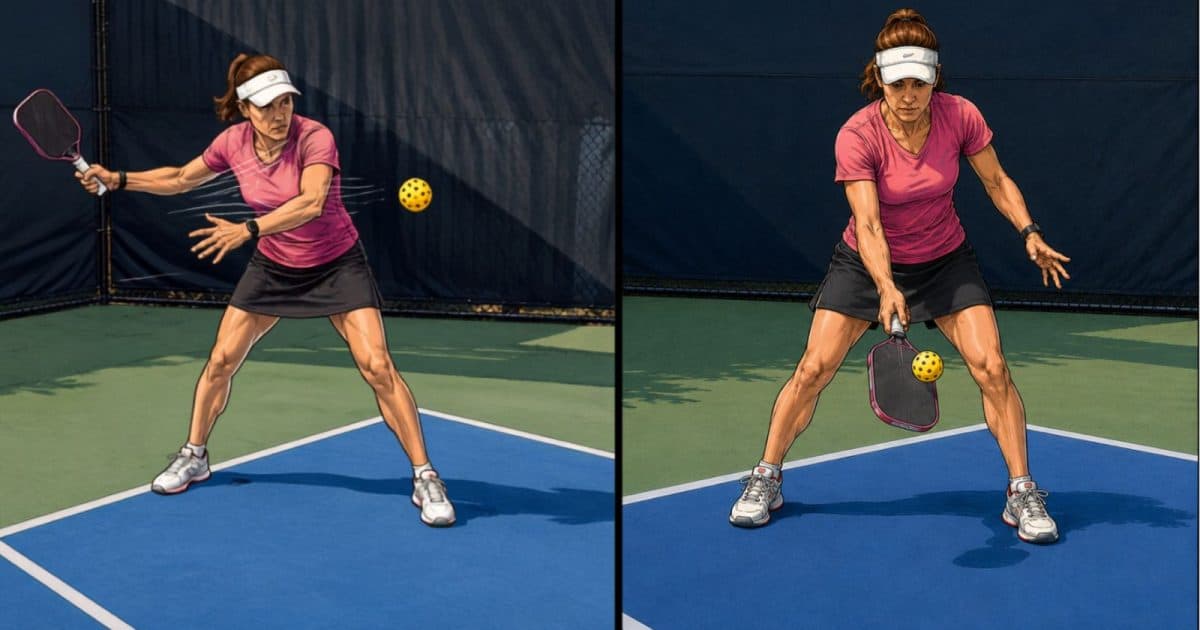
Quick Answer: Drop when the ball is below net height and both opponents are at the kitchen line. Drive when the ball sits up above the net or your opponents are still back. The drop buys time to get to the line. The drive tries to win the point before you get there. Most recreational players drive when they should drop.
The third shot is the serving team’s first shot after the return, and it is the shot that decides whether they get to the kitchen line or stay pinned at the baseline.
Why does the third shot matter so much?
Because of a structural disadvantage built into the rules.
The two-bounce rule forces the serving team to let the return bounce, which means they are stuck at the baseline while the returning team walks to the kitchen line. The third shot is the serving team’s tool for undoing that. Everything about the choice comes down to one question: what gets you to the line?
That framing matters, because a drive that wins the point outright also solves the problem. So does a drop that lets you walk in behind it. What does not work is a shot that does neither.
When should you drive?
Drive when the ball gives you something to work with, or when your opponents have given you something.
- The ball is above net height. You can hit down or flat, and the ball arrives before they are set.
- One or both opponents are still back. A drive at their feet in the transition zone is genuinely hard to handle.
- One opponent is out of position. Drive at the open space or at the player who is moving.
- Your drop is not working today. Some days it is not there, and a drive at least applies pressure.
The strongest use of the drive is not as a winner. It is as a setup. A hard drive that gets blocked back often produces a floating ball, and the fifth shot becomes an easy drop or an easy put-away. Good teams drive with the fifth shot in mind.
When should you drop?
Drop when the ball is low and the other team is set.
- The ball is below net height. You have to hit up regardless, so hit up softly.
- Both opponents are at the kitchen line. A drive into two set players at the line comes back faster than it left.
- You are off balance or moving backward. A drop needs touch, not position.
- You want to reset the point. The drop turns a disadvantage into a neutral dinking rally, which is a win for the serving team.
The drop’s job is not to be untouchable. It is to be low enough that your opponents cannot attack it, which buys you the seconds you need to move up. Our guide to hitting the third shot drop covers the mechanics.
What is the most common mistake?
Driving from below net height into two players standing at the kitchen line.
That is the single most repeated error in intermediate pickleball. The ball has to travel upward to clear the net, it arrives at chest height to two set opponents, and it comes back at the driver’s feet while they are still in the transition zone.
The second most common mistake is the half-committed drop, hit too high because the player was worried about the net. A drop that lands at chest height is a drive with no pace, which is the worst of both. If the drop is going to be high, a real drive is the better error.
How do you decide in the moment?
Use the simplest rule available: look at the height of the ball, then look at their feet.
Ball above the net? Drive is available.
Ball below the net and both opponents at the line? Drop.
Ball below the net but an opponent still back? Drive at the one who is back.
That covers most third shots. The refinements come later. Our guide to pickleball tips for intermediate players covers the decision-making side more broadly, and what a drive is in pickleball explains the shot itself.
Do you have to pick one?
No, and the best teams do not. A team that only drops becomes predictable, and opponents start crashing the kitchen line to cut the drop off. A team that only drives gives up the kitchen line every time the drive fails.
Mixing them is what makes both work. The drop is more valuable when the other team has to respect a drive, and the drive is more valuable when they have been dropping all game.
FAQ
What is the third shot in pickleball?
The serving team’s first shot after the return of serve, hit from near the baseline because the two-bounce rule kept them back.
Is the third shot drop better than the drive?
Neither is better in the abstract. The drop is right when the ball is low and both opponents are at the line. The drive is right when the ball is up or an opponent is back.
Why do pros drive more than they used to?
Paddle technology and athleticism have made the drive more effective, and pros use it to set up the fifth shot rather than to win outright. At recreational levels the drop still wins more points.
Where should a third shot drop land?
In the kitchen or just in front of it, arriving low so it cannot be attacked. Landing deep is safer than landing in the net, but a deep drop that sits up invites a put-away.
What is the fifth shot?
The serving team’s next shot after the drive or drop is returned. Teams that drive well are usually thinking about the fifth shot before they hit the third.
Should beginners learn the drop or the drive first?
The drop, because it teaches touch and it solves the actual problem of getting to the kitchen line. The drive is easier and it is a habit that is hard to break later.
Can you drive from below the net?
You can, and it usually loses the point against two opponents at the line. If both are back it can work.
How do I stop popping my third shot drop up?
Usually too much paddle speed and too much wrist. The drop is a push from the shoulder with a soft grip, not a stroke.
If your third shot is the thing holding your game back, that is one of the fastest fixes a coach can make. Our directory lists coaches and clinics by city.
Written by the Pickler Junction Team.