Pickleball Tips for Beginners: What to Focus on First
Quick Answer: Focus on four things in your first month: get to the kitchen line and stay there, stop trying to hit winners, learn to call the score correctly, and let out balls actually go out. Those four habits change more points than any new shot. Everything else on a typical beginner list can wait until they feel automatic.
The problem with beginner tips is that there are hundreds of them and they all sound reasonable. A short list you actually apply beats a long list you skim once and forget.
What should you do first on court?
Move forward, and keep moving forward.
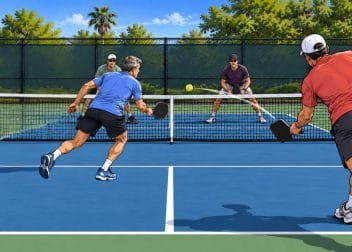
The single largest gap between a new player and a decent one is where they stand. Beginners drift back toward the baseline because there is more time to react there. Better players get to the kitchen line, because that is where a player gets to hit down at the ball instead of up at it.
The practical version: after you return serve, walk in. After your team hits the third shot, walk in. Stop moving when your opponent strikes the ball, split step, then continue toward the line. That pause costs half a second and keeps you balanced for whatever comes next.
If nothing else on this page sticks, this is the one habit that changes the most points.
Which habit should you break earliest?
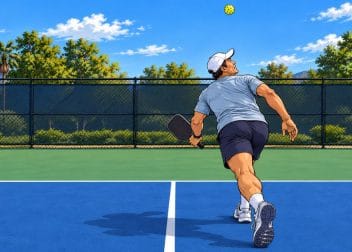
Hitting hard, especially from a low contact point.
The sport rewards patience in a way that feels wrong at first. A hard drive into two opponents standing at the net tends to come back faster than it left. A soft shot that gives them nothing to attack is far less satisfying to hit, and it wins the point more often anyway.
The rule worth learning first is about contact height. A ball met above net height can be driven down and attacked safely. A ball met below net height cannot: hitting it hard means lifting it, and a lifted ball at pace is one of the easiest putaways in the sport.
Beginners who learn that single distinction tend to improve faster than beginners who try to add three new shots, which is why the guide to pickleball shot selection is worth reading early rather than late.
What do beginners get wrong about the rules?
Scoring and the two-bounce rule, roughly in that order.
Scoring is the usual surprise. Under Rule 6.B.2 of the 2026 USA Pickleball rulebook, doubles play calls the score as three numbers: the serving team’s score, the receiving team’s score, then the server number. It takes several sessions before that stops requiring conscious effort. The guide to how pickleball scoring works breaks the sequence down step by step.
The two-bounce rule causes the second most confusion. Under Rule 10.A, the serve must bounce and the return of serve must bounce, and only after both bounces can either side volley the ball. Players coming from tennis violate this constantly in their first few sessions, since serving and then rushing the net is illegal here. The two-bounce rule guide covers the small exceptions worth knowing.
The kitchen is the third, and it is simpler than its reputation suggests. Under Rule 11.A, a player may stand in the non-volley zone at any time. The fault only happens when a player volleys a ball while touching that zone or its line. The guide to stepping in the kitchen covers exactly where that line sits. For the rest of the rulebook basics in one place, the five basic rules of pickleball is a fast reference.
What are the quick wins?
Five things that cost nothing and pay off immediately.
- Let out balls go. Beginners try to play everything. A ball landing past the baseline is a free point if it is left alone, and a lost rally if it gets rescued into the net.
- Keep the paddle up. Hold it in front of the chest between shots, not down near the knees. Reaction time at the kitchen line is short enough without giving an opponent a head start.
- Serve deep and safe. The serve starts the point rather than winning it outright. A serve into the net gives away a point with no rally at all. The guide to the pickleball serve for beginners covers a simple, repeatable motion.
- Return deep. A deep return pins the serving team back and buys the time needed to get to the net. Depth matters far more than pace on this shot.
- Call the ball. Say “mine,” “yours,” or “out” during rallies. Most beginner doubles points are lost to hesitation between two players, not to a bad shot.
None of these require learning a new skill. Every one of them is just a decision made a little earlier.
What should you not worry about yet?
Equipment, spin, and the shots that show up on highlight reels.
A mid-range paddle that fits the hand is enough for the first year of play. The beginner equipment guide covers what actually matters at this stage, which is less than most gear articles suggest. Chasing spin before there is a reliable dink is a common way to spend money without improving, and the advanced shots that look impressive on video are situational rather than foundational for a new player.
The other thing worth setting aside is a rating number. Playing more games against people at the same level builds comfort without necessarily building skill, which is the most common way a beginner plateaus. A few lessons and some games against stronger players compress that timeline far more, and the honest look at whether pickleball is hard to learn lays out what that timeline actually looks like. Once these fundamentals feel automatic, the guide to pickleball tips for intermediate players picks up where this one leaves off.
FAQ
What is the best tip for a pickleball beginner?
Get to the kitchen line and stay there. Where a player stands changes more points in the first month than any single stroke can.
Why do I keep losing points when I hit hard?
Usually because the ball is being contacted below net height. That requires lifting it, and a lifted ball hit with pace is an easy putaway for the other team.
What is the hardest rule for beginners to remember?
Calling the score, which uses three numbers in doubles, and the two-bounce rule required by Rule 10.A.
Can beginners stand in the kitchen?
Yes, at any time. Under Rule 11.A, the fault only occurs when a player volleys the ball while touching the non-volley zone or its line.
Do beginners need lessons to start?
No. Lessons tend to help most once the soft game starts deciding points, which is where many self-taught players plateau.
What paddle should a beginner buy?
A mid-range paddle that fits the hand comfortably. Fit and weight matter more than any premium feature at this stage of play.
Should beginners let balls go out?
Yes, and most new players rarely do. A ball landing past the baseline is a free point if it is left alone.
How long until a beginner can play a real game?
Most people play a real game in their very first session. Being genuinely competent takes months of regular play rather than weeks.
Pick one habit from this page and work on nothing else for a week. The coaches in the pickleball coaches directory can watch that habit form and correct it early, before it turns into something harder to unlearn.
Written by the Pickler Junction Team.