Is Pickleball Hard to Learn?
Quick Answer: No, and yes. Most people can rally within the first hour, since the court is small and the ball is slow. Getting genuinely good takes far longer, because the skills that decide points, soft touch and patience, run against a beginner’s instincts. The rules take longer to absorb than the strokes do.
Pickleball has an unusually flat entry and an unusually steep middle. Knowing which part you are in explains most of the frustration new players feel.
What can you learn in the first hour?
Enough to play a real game, which is unusual for a racquet sport.
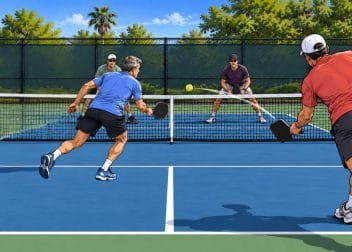
The court measures 20 by 44 feet, with a net 36 inches high at the sidelines and 34 inches at the center, under Section 3 of the 2026 USA Pickleball rulebook. A slow plastic ball and a short, light paddle mean contact happens far more often than it does in tennis. A complete beginner will rally on the first day.
Three things come almost free:
- Making contact. The slow ball and short paddle mean far fewer complete misses than in tennis or badminton.
- The serve. Underhand, below the waist, hit diagonally into the opposite service court, as Section 7 of the rulebook describes. Most people have it within minutes.
- Basic positioning. Stand beside your partner, move forward together, and stay out of the non-volley zone while volleying, which the guide to stepping in the kitchen covers in more detail.
That first hour helps explain why the sport has grown so fast. Participation reached 24.3 million players in the United States in 2025, up from 4.2 million in 2020, according to the Sports & Fitness Industry Association. For a structured plan instead of trial and error, the guide on how to learn pickleball covers those first sessions in more detail.
What actually takes time?
Scoring, the two-bounce rule, and the soft game, roughly in that order of early difficulty.
Scoring is the first surprise. Doubles play calls three numbers, the serving team’s score, the receiving team’s score, and the server number, and beginners often find that harder than any stroke. Under the rulebook, calling the score before each serve is covered in Section 6, and the guide to how pickleball scoring works breaks down the sequence. It is normal to need several sessions before the count stops requiring conscious effort.
The two-bounce rule is the second hurdle, especially for tennis players whose instinct is to serve and rush the net. Section 10.A of the rulebook requires the serve to bounce and the return to bounce before either side can volley. The guide to the two-bounce rule explains the sequence in full. It is simple to state and takes a while to stop violating, since the old serve-and-volley habit runs deep.
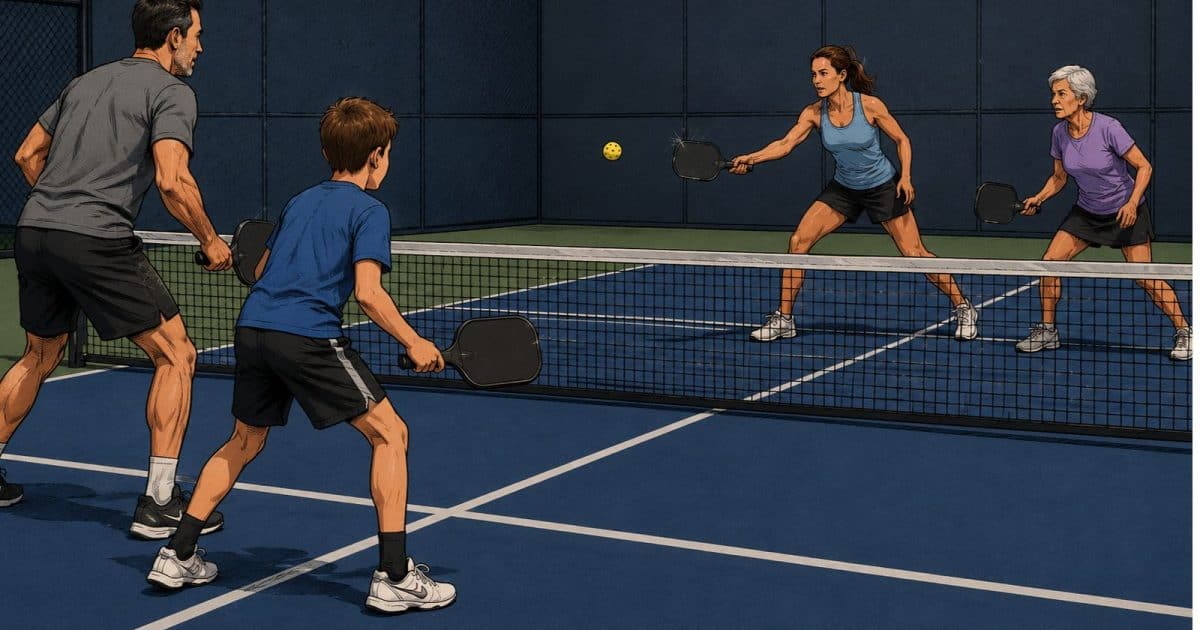
The soft game is the real learning curve. Dinking, resetting, and the third shot drop are the skills that separate playing levels, and all three run against the instinct to hit the ball hard. Many players who plateau, plateau here, stuck driving the ball into opponents who simply block it back and wait.
Where do beginners actually get stuck?
Not on technique. On the decision to stop hitting hard.
The sport rewards patience in a way that feels wrong at first. A hard drive into two opponents standing at the non-volley zone line often comes back faster than it left. The winning play is frequently a soft ball that gives them nothing to attack, a shot that feels unsatisfying to hit and is effective to play.
The kitchen is the other common sticking point. The non-volley zone rules are simple to state and easy to violate in practice, since momentum carries a player forward after a volley. Under the rulebook, Section 11.A holds that a player may stand in the non-volley zone at any time except while volleying or while carried in by momentum from a volley. The guide to stepping in the kitchen shows exactly where that line sits and when it applies.
Other racquet sports help with contact and complicate the transition in specific ways. Tennis players bring an oversized swing built for a heavier ball. Badminton players bring a wristy stroke suited to a much lighter shuttle. Table tennis players bring excellent touch and struggle covering a much larger court. None of these backgrounds is a disadvantage overall, but each one takes some unlearning before the soft game clicks.
How long until you are decent?
As a rough guide: playable in a session, comfortable in a month, competitive in six.
A loose timeline holds for most recreational players. One session is enough to play a full game. A few weeks of regular play is usually enough to stop thinking about the score out loud. A couple of months of dinking practice is enough to hold a short rally at the net without losing it. Half a year of regular play is enough, for most people, to compete evenly in casual social games.
Two things compress that timeline. Lessons front-load the corrections that otherwise take months to discover through trial and error, and coaches who teach beginners routinely tend to focus on the two-bounce rule and the soft game first, since those are the two spots where most players get stuck. Playing with stronger players is the other, since the soft game only sharpens against opponents who punish a ball left high over the net.
Group clinics typically run one to two hours and cost $20 to $50 per person as of September 2026, while private coaching runs $50 to $100 or more per hour over the same period. Both are ways to compress the learning curve, not requirements to start.
What does not compress the timeline is playing more games against players at the same level. That builds comfort without building skill, which is the most common way a beginner stalls right at the point where the sport starts to get genuinely interesting. The fundamentals worth locking in first are in the guide to the five basic rules of pickleball.
FAQ
Is pickleball hard to learn? The basic strokes are easy, and most people play a real game within the first hour. Getting good is considerably harder, because the deciding skills are touch and patience rather than power.
What is the hardest part for beginners? Scoring, which requires calling three numbers in doubles, and the two-bounce rule, covered in Section 10.A of the rulebook. Both take longer to absorb than any single stroke.
How long until you can play a game? Usually the first session. The slow ball and the small court, 20 by 44 feet under the rulebook, mean rallies happen almost immediately.
Do you need lessons to start? No. Lessons help most once the soft game starts deciding points, which is the stage where many self-taught players plateau.
Is pickleball easier to learn than tennis? To start, yes. The court is smaller, the ball is slower, and the paddle is shorter, all of which make contact far easier for a beginner.
Does tennis experience help? With contact and court sense, yes. It also brings an oversized swing and a serve-and-volley instinct that the two-bounce rule, Section 10.A in the rulebook, makes illegal.
How long until you are competitive in social play? As a rough guide, around six months of regular play, faster with lessons and games against stronger opponents.
What should a beginner learn first? The scoring sequence and the two-bounce rule under the rulebook, then the dink. Strokes tend to come faster than the rules and the patience needed to use them well.
Ready to shorten that timeline? The coaches listed in the Pickler Junction directory teach beginners routinely, and starting there is often the fastest route from a fun first hour to a genuinely competitive game. Even people cast to play the sport on screen had to learn it from nothing, as the piece on whether the Dink actors learned pickleball explains.
Written by the Pickler Junction Team.