Choosing Pickleball Shoes for Plantar Fasciitis
Quick Answer: Look for four things: firm arch support, generous heel cushioning, a stiff midfoot that resists twisting, and a removable insole for an orthotic. Court shoes are the right category, not running shoes, since Mayo Clinic warns against running shoes for court sports. Replace them before the midsole flattens, since a dead midsole undoes the rest.
Plantar fasciitis is one of the few conditions where footwear choice does real clinical work, not just comfort. The plantar fascia is the band of tissue running along the bottom of the foot from heel to toes, and Cleveland Clinic advises wearing sturdy, well-cushioned shoes and avoiding sandals, flip-flops, and flat shoes because they leave that tissue unsupported. A pickleball court adds lateral loading on top of daily wear, which is why the wrong shoe can undo weeks of careful treatment in a single session.
What should the shoe actually do?
Reduce strain on the fascia and control how the foot moves under lateral load. Four features do that work.
- Arch support that holds. A collapsing arch stretches the fascia with every step. Cleveland Clinic recommends shoes with built-in arch support specifically to keep the arch from flattening under load.
- Heel cushioning. Heel pain is where plantar fasciitis usually announces itself, and the heel takes the impact on every stop and split step. Cleveland Clinic favors sturdy, well-cushioned shoes over flat or flexible ones for this reason.
- Torsional stiffness. Hold the shoe at both ends and twist. A shoe that wrings out like a towel lets the midfoot deform under the lateral loading pickleball demands.
- A removable insole. If a podiatrist has prescribed a custom orthotic, or the plan is a supportive aftermarket insole, the stock insole has to come out to make room. The guide to what shoes to wear for pickleball covers the wider shopping list beyond this condition.
Heel-to-toe drop matters to some people and not others. The American Academy of Orthopaedic Surgeons’ OrthoInfo lists soft heel pads, heel cups, and heel lifts among the options that add cushioning right at the point of impact.
Why not running shoes?
Because they fail in the one direction pickleball loads them.
Running shoes are built for forward motion, and Mayo Clinic specifically flags the mismatch: court sports such as tennis and basketball should not be played in running shoes. Running shoes have soft, rounded outsoles and little lateral structure. On a pickleball court, that combination lets the foot roll under sideways pressure, which is both an ankle risk and a support failure at the exact moment the arch needs the shoe holding its shape.
Court shoes are built for the opposite job: flatter, wider platforms, reinforced sidewalls, and enough torsional rigidity to keep the foot stable through a direction change. The comparison of pickleball shoes and tennis shoes covers the category distinctions, and the guide to pickleball shoes with arch support goes deeper on the support question specifically.
The tradeoff is honest: court shoes are typically firmer than running shoes. Mayo Clinic also names worn-out shoes as a risk factor for plantar fasciitis on their own, since old shoes lose support and stability no matter the category. Cushioning is worth seeking out within the court category rather than solving the problem by switching categories.
How do insoles fit into this?
Often they do most of the work, and they change how you should shop.
Cleveland Clinic lists shoe inserts, either pre-made over-the-counter versions or custom orthotics molded to the foot, as a standard part of managing plantar fasciitis. A mid-priced court shoe paired with the right insert often does more than an expensive shoe with none. If a podiatrist has already prescribed custom orthotics, the shoe’s job narrows: it needs a removable stock insole, enough interior volume to accept the orthotic without cramping the toes, and a stable platform underneath. Wide feet complicate that fit further, and the guide to pickleball shoes for wide feet covers sizing around an orthotic in more detail.
Shop with the orthotic in hand and fit the shoe around it. Fitting the shoe first and adding the orthotic later is how people end up half a size too small. The American Podiatric Medical Association also runs a Seal of Acceptance program in which a Podiatric Seals Committee reviews footwear, insoles, and related products for evidence that they support normal foot function, which makes the seal a reasonable shorthand when comparing options in a store.
When do you replace them?
Earlier than the tread would suggest, because a flattened midsole removes the support the shoe was bought for.
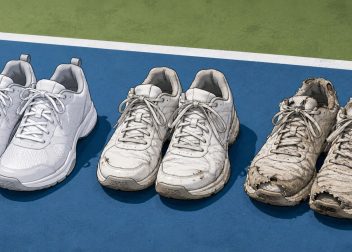
Cleveland Clinic recommends replacing athletic shoes every 6 to 9 months, or after 250 to 500 miles of use, regardless of how the outsole looks. For plantar fasciitis, that schedule matters more than usual: the outsole tread can be intact while the midsole foam has compressed to the point where the arch does little. The guide to how long pickleball shoes last covers the general replacement cycle for the sport.
Two practical checks. Press a thumb into the midsole: if it barely gives, the foam is spent. Set the shoes on a flat surface and look from behind: a visible lean means the platform has collapsed unevenly and is now working against the foot instead of for it.
Footwear is one part of managing the condition, not the whole of it. The American Academy of Orthopaedic Surgeons’ OrthoInfo reports that more than 90 percent of patients improve within 10 months of starting simple treatment such as stretching, rest, and supportive footwear, and that surgery is rarely needed. The broader picture, including loading and stretching, lives in the guide to playing pickleball with plantar fasciitis. Persistent heel pain deserves a podiatrist visit rather than another shoe purchase, since the American Podiatric Medical Association describes podiatrists as the specialists best positioned to treat plantar fasciitis and other causes of heel pain.
FAQ
What should I look for in pickleball shoes for plantar fasciitis? Firm arch support, generous heel cushioning, torsional stiffness through the midfoot, and a removable insole so an orthotic can go in. Cleveland Clinic recommends sturdy, well-cushioned shoes with built-in arch support as the baseline for anyone managing this condition.
Can I wear running shoes instead? Not on court. Mayo Clinic advises against playing court sports like tennis or basketball in running shoes, since they lack the lateral support pickleball’s side-to-side movement requires and can let the arch collapse when it most needs support.
Do I need custom orthotics? Not necessarily. Cleveland Clinic lists both pre-made over-the-counter inserts and custom orthotics as valid options. If a podiatrist has prescribed orthotics, shop with them in hand and fit the shoe around them.
Does heel drop matter? A slightly raised heel is often more comfortable than flat, since it reduces tension through the fascia. The American Academy of Orthopaedic Surgeons’ OrthoInfo lists heel lifts, heel cups, and heel wedges among the supports that ease that load.
How do I test torsional stiffness in a store? Hold the shoe at heel and toe and twist. If it wrings out easily, it will not hold the midfoot steady during a direction change.
How often should I replace them? Sooner than the tread suggests. Cleveland Clinic recommends replacing athletic shoes every 6 to 9 months or after 250 to 500 miles, and the midsole can lose its support well before the outsole looks worn.
Will the right shoes cure plantar fasciitis? No. They reduce strain and support recovery, but the American Academy of Orthopaedic Surgeons’ OrthoInfo notes that most cases improve with simple treatment such as stretching and rest, and that surgery is rarely needed.
Should I size up for an orthotic? Fit the shoe with the orthotic already inside rather than sizing by guesswork. Interior volume varies more between models than length does, so a half size that fit before an orthotic may not fit after.
Want a proper fitting rather than a guess? The pickleball gear and accessories retailers in the Pickler Junction directory carry court shoes and insoles in person, and a podiatrist can confirm whether plantar fasciitis needs more than a shoe change. This article is general information, not medical advice.
Written by the Pickler Junction Team.