What Is the 10-Second Rule in Pickleball?
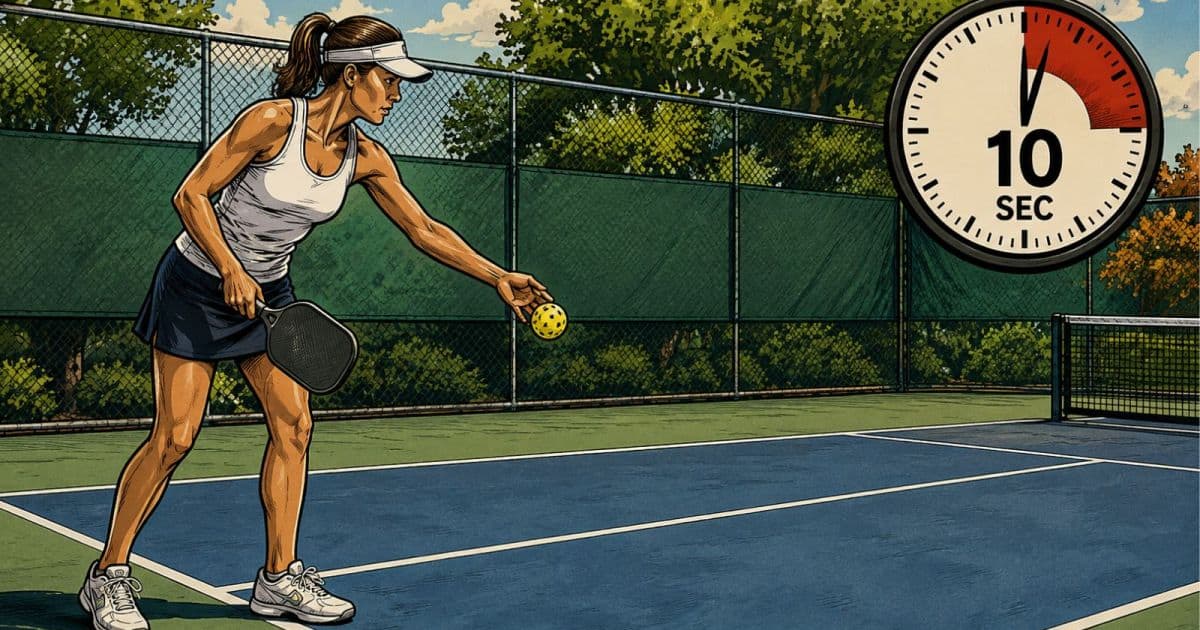
Quick Answer: The 10 second rule in pickleball gives the server 10 seconds to strike the serve once the score has been called in full. Run past it and the penalty is a fault, costing that server their turn. A corrected score call restarts the count, which is the detail that catches people out.
The 10-second rule is pickleball’s pace-of-play clock, and it cuts both ways: it stops servers from stalling and it stops receivers from endlessly delaying the return. Ten seconds sounds generous until the one time it is not.
How does the 10-second rule actually work?
The sequence is precise, and the precision matters in officiated play. First the score is called, by the referee in a refereed match or by the server in recreational play. The clock starts when the call is complete, not when the players arrive at their positions. From that moment the server has 10 seconds to put the serve in the air.
Two related requirements frame the rule. The server must not begin the service motion until the entire score has been called, so serving mid call is itself improper. And the receiver’s readiness is baked into the sequence rather than open ended: the score call is the signal that play is resuming, and a receiver cannot manufacture endless delay by claiming unreadiness after it.
In recreational games nobody stands with a stopwatch, and the rule mostly operates as an understood rhythm: call the score, serve promptly, keep the game moving. In tournaments with referees it is enforced exactly, and the players who never learned the clock existed discover it at the worst possible moment.
What happens if the server takes too long?
A fault, the same as serving into the net. The server loses that service turn, the ball moves to the partner or the other team per normal rotation, and play continues. There is no warning shot in the current rulebook language: the clock runs out, the fault is called.
Faults are the rulebook’s universal currency, and this one surprises people because nothing about the ball was ever wrong. If the fault system’s wider logic is fuzzy, our guide to what counts as a fault in pickleball puts this rule alongside its relatives, and the pattern becomes obvious: anything that violates the serve’s requirements, timing included, ends the serve.
The rule also protects servers in one underappreciated way. Because the receiver cannot impose indefinite delay after the score call, a server facing gamesmanship, the slow walk to position, the extended paddle raise, is entitled to the normal rhythm of play. Ten seconds is the whole negotiation.
What resets the 10-second clock?
A re-called score, and this is the piece worth actually memorizing. If the score was called wrong and gets corrected, the corrected call starts a fresh 10 seconds. If the serving team realizes it is misarranged and fixes its positions, prompting the receiving team to re-position too, the score is re-called and the clock starts over.
The practical version for a rec player, in the order it happens:
- Something is genuinely wrong: wrong score, wrong server, wrong court position.
- Stop before serving, not after. Fix the error.
- Re-call the corrected score out loud.
- Serve on the fresh 10 seconds the re-call just granted.
What you should not do is stop to think with the clock running. The common self-inflicted version of this fault is the server who calls the score, then pauses to remember whether they are the first or second server, then double-checks with their partner, and then serves at second eleven.
Position questions are the usual cause of that pause, and they are solvable before the call rather than after it. The scoring logic that tells you who serves from where is covered in our five basic rules guide, and teams that internalize it stop burning their serve clock on arithmetic.
Why does a 10-second limit exist at all?
Because dead time is contagious, and racket sports learned that lesson long ago. Without a clock, pre-serve routines expand, gamesmanship blooms, and a 15 minute game becomes 25 without a single extra rally.
Pickleball’s version keeps games moving at the tempo that makes the sport social: games to 11 that turn over quickly, courts that rotate, waiting players that actually get on. The rule also flattens a competitive tactic before it starts, since deliberate stalling to ice a server or disrupt momentum runs straight into the fault penalty.
The fault stung less than the lesson: the routines you build at open play are the ones you will run under a real clock. The fix is to make the score call and the serve one habit, a few seconds apart, so the count never becomes a factor.
The rulebook has other timing provisions for the gaps between points and games, but the 10-second serve clock is the one that shows up in ordinary play, and treating it as rhythm rather than threat is the entire skill.
FAQ
What is the 10-second rule in pickleball? After the score is called in full, the server has 10 seconds to hit the serve. Exceeding it is a fault and the server loses that serve.
When does the 10-second count start? When the score call is complete, referee’s call in officiated play, server’s call in recreational play. The motion may not begin until the full score is called.
What is the penalty for breaking the rule? A fault on the server, exactly as if the serve had gone out. Service passes on per normal rotation.
Does the clock reset if the score was called wrong? Yes. A corrected, re-called score starts a fresh 10 seconds, including when a positioning fix forces both teams to rearrange.
Can the receiver delay the serve indefinitely? No. The score call governs the resumption of play, and the rule prevents open-ended stalling on either side of the net.
Is the 10-second rule enforced in rec play? Rarely with any formality. It functions as shared rhythm: call, serve, play. Tournament referees enforce it precisely.
Can I bounce the ball or take a breath before serving? Yes, anything you like inside the 10 seconds. Routines are fine; routines that outlast the clock are faults.
Does the rule apply to the return too? The receiver must be ready within the flow the score call creates. The formal 10-second count binds the server, and the surrounding rules stop receiver stalling.
Want the whole rulebook to feel this manageable? Quirky cousins of this rule like the momentum rule fill in the corners, and the pickleball associations in our directory publish the official text. For practice under real conditions, the tournaments and events listings are where referees come standard.
Written by the Pickler Junction Team.