Six Zero Quartz Pickleball Paddle Review
JUNCTION SCORE 4.7 / 5
★★★★★ 4.7
Review Score: 4.7 / 5 based on 349 verified ratings (Six Zero 212; Amazon 57; Dick’s Sporting Goods 51; Pickleball Central 26; Pickleball Nation 2; JustPaddles 1)
Community Score: Well Regarded, based on Reddit and community threads
A strong entry-level paddle that punches above its price for control-oriented beginners and early intermediates, with the caveat that players who need power will hit a ceiling fast. At $89.99 MSRP, it delivers genuinely impressive spin and soft-game feel for the construction tier, but its Gen 1 build means it cannot match the power output of thermoformed rivals at similar price points.
Best for: Beginners and early intermediates who prioritize control, soft-game development, and maneuverability over raw power.
Skip if: You are an experienced player who needs put-away power or a large, forgiving sweet spot.
Price: $89.99
USAP Approved: Yes
The Review
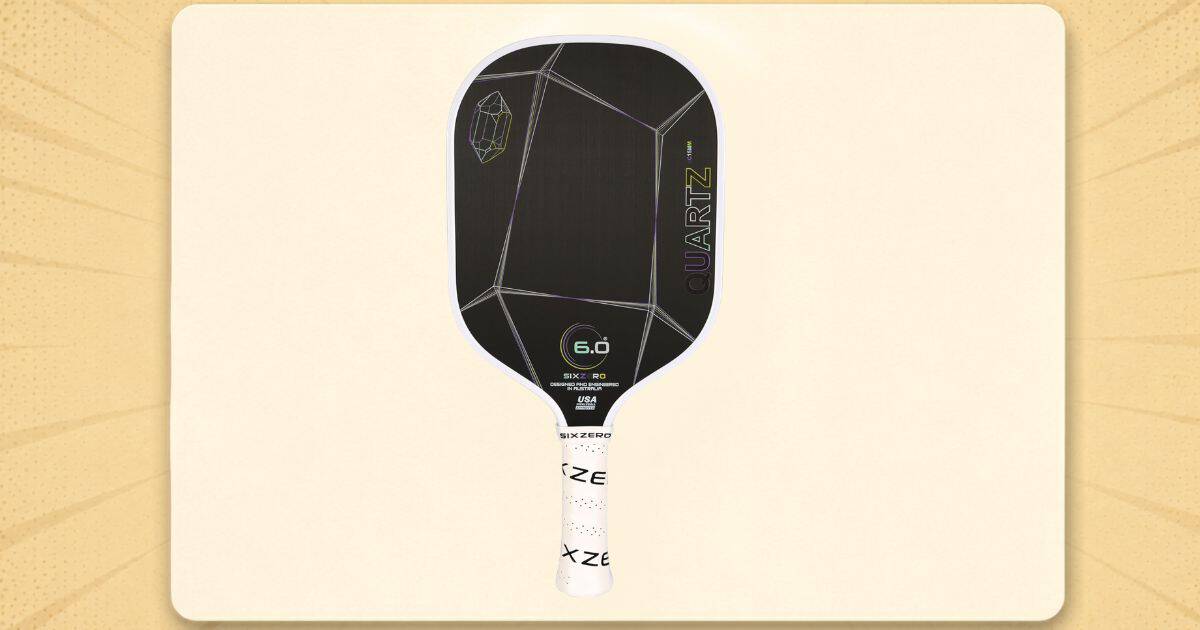
Yes, for the right player. The Six Zero Quartz is a standard-shaped, 15mm polypropylene honeycomb core paddle with a raw T300 carbon fiber face, built in a classic Gen 1 unibody construction without thermoforming or perimeter foam injection. It sits at the entry level of the Six Zero lineup, priced at $89.99 MSRP, and is aimed squarely at players building their soft game before investing in a premium paddle. See detailed review below.
Strengths
Spin generation that outperforms the price tier. For a paddle at this price point, the Quartz produces spin that consistently surprises players moving up from basic equipment. Measured spin output comes in at approximately 1,945 to 1,949 RPM in testing, a figure that places it at the high end of what raw carbon fiber paddles in this construction class typically deliver. Spin earns an 8 out of 10 in published testing, and the paddle is described as spinning the ball nearly as well as any model in the Six Zero lineup, which includes significantly more expensive options.
Control and soft-game feel that rivals paddles costing far more. The Quartz is classified as a control-oriented paddle, and the on-court feel backs that up. Control scores 8 out of 10 in published testing, and a separate evaluation rates control and feel at 95 percent, describing the face as very soft and comfortable at the kitchen line. Players who have handled premium control paddles in the $200-plus range report that the Quartz touch shots feel surprisingly close to those more expensive options, particularly for beginners who have not yet developed the sensitivity to detect the difference.
Exceptional maneuverability and fast hands at the net. The Quartz carries a manufacturer-specified swing weight of 108, which is notably low even for a standard-shaped paddle. That translates directly to quick hand speed at the kitchen line and easy paddle recovery between shots. Maneuverability is rated at 98 percent in published testing, and aerodynamics scores 8 out of 10 in separate published testing. Players switching from heavier paddles consistently note how much faster the Quartz feels in fast exchanges at the non-volley zone.
Durability that holds up without concern. Durability scores 9 out of 10 in published testing, with no expectation of delamination or structural breakdown under normal use. The Gen 1 unibody construction, while less performance-advanced than thermoformed builds, is straightforward and robust. No recurring structural complaints appear in the sources reviewed, and the paddle carries a 12-month limited structural warranty against manufacturer defects directly from Six Zero.
Outstanding value for money at the entry level. Buyers who have played with the Quartz consistently describe it as the best paddle they have encountered in the $90 price range. Club operators have purchased multiple units for beginner trial programs, which speaks to the paddle’s durability and approachability. The six gem-inspired color options, ranging from Crystal White to Amethyst Purple to Citrine Yellow, add genuine visual appeal that owners frequently mention as a purchase factor.
Reported Limitations
Power output is the paddle’s most significant weakness, and it is a real one. The Quartz sits at the 5th percentile for power and the 18th percentile for pop in published testing, which is a meaningful gap below most competitors at similar price points. This is a direct consequence of the Gen 1 construction: without thermoforming or perimeter foam injection, the paddle simply cannot generate the ball speed that more advanced builds produce. Players who have tried adding lead tape at the 3 and 9 o’clock and 10 and 2 o’clock positions report marginal improvement but describe the paddle as still falling short for put-away shots. Power scores 6.5 out of 10 in published testing, and pop is rated at 74 percent in separate published testing.
The sweet spot is smaller than the paddle’s shape suggests. A standard square shape typically implies a generous sweet spot, but the Quartz underdelivers on that expectation. The absence of perimeter foam injection and a twist weight of 6.4, which is lower than the typical 6.8-plus for standard-shaped paddles, means off-center hits lose more energy than players expect. Forgiveness scores 7 out of 10 in published testing, and multiple reviewers independently flag this as a notable miss for a paddle in this shape category.
The 5-inch handle limits two-handed backhand play. At 5 inches, the handle is on the shorter end for a standard paddle, and players with larger hands or a two-handed backhand game will find it restrictive. This is not a defect but a design choice that reflects the paddle’s positioning as an entry-level option suited to a wide range of hand sizes, including younger players. Anyone who relies on a two-handed backhand as a primary shot should factor this in before purchasing.
Rivals and Comparisons
Six Zero Quartz vs. Vatic Pro PRISM Flash. The Vatic Pro PRISM Flash uses T700 raw carbon fiber compared to the Quartz’s T300, and that difference shows in power output. Reviewers who have played both conclude that the PRISM is more forgiving and offers two thickness and handle-length options, giving players more room to dial in their fit. The Quartz holds its own on control and feel, but for players who need help generating pace, the PRISM is the stronger recommendation at a comparable price point.
Six Zero Quartz vs. 11SIX24 Jelly Bean. The Jelly Bean costs approximately $10 more than the Quartz’s MSRP and is described as the better choice for players who need assistance generating power. Reviewers who tested both place the Jelly Bean ahead of the Quartz for a broader range of skill levels, while the Quartz is reserved specifically for entry-level players focused on control and soft-game development. The Quartz’s color variety and brand aesthetic are noted as the primary reasons a player might choose it over the Jelly Bean.
Six Zero Quartz vs. Six Zero Double Black Diamond Control. The Double Black Diamond Control is Six Zero’s premium thermoformed option, using T700 carbon fiber, carbon fusion edge technology for an extended sweet spot, and a construction that addresses every limitation the Quartz has. Reviewers who play at a high level describe the upgrade as worth the additional investment for serious competitive play. The Quartz delivers a meaningful portion of the Six Zero feel and brand experience at a fraction of the price, making it a sensible starting point before committing to the premium tier.
Six Zero Quartz vs. Selkirk LUXX Control Air Invikta. The Selkirk LUXX Control Air Invikta sits in a significantly higher price bracket, and the gap in construction quality is real. That said, buyers who have handled both paddles report that the Quartz comes surprisingly close on touch shots and soft-game feel, and that beginners cannot reliably detect the difference in control between the two. For experienced players, the Selkirk pulls ahead, but for anyone still developing their game, the Quartz captures much of that feel without the premium price.
The Right Player for the Quartz
The Quartz is built for players at the beginning of their pickleball journey who want a paddle that teaches good habits. Its low swing weight encourages fast hands and proper technique at the kitchen line, its soft face rewards dinking and drop-shot precision, and its spin capability gives developing players a real tool to work with rather than a toy-grade surface. Players who are stepping up from a basic recreational paddle for the first time will notice an immediate improvement in their soft game, and the paddle’s durability means it will hold up through the learning curve without needing replacement.
The one core trade-off to understand before buying is power. Players who are already comfortable at the kitchen line and are starting to develop an aggressive third-shot drive or a hard reset game will find the Quartz limiting sooner rather than later. At that point, the Six Zero Double Black Diamond Control or a thermoformed alternative becomes the natural next step. The Quartz is best understood as a first serious paddle, not a long-term competitive tool for players with ambitions beyond the beginner stage.
Buy it if you:
- Are new to pickleball and want to develop soft-game fundamentals with a paddle that rewards control
- Prioritize maneuverability and fast hands at the kitchen line over raw power
- Want a USA Pickleball approved paddle with genuine spin capability at the entry-level price point
- Are drawn to the gem-inspired color options and want a paddle that looks as good as it plays at this tier
Skip it if you:
- Already play at an intermediate or advanced level and rely on power to finish points
- Use a two-handed backhand regularly and need a longer handle to accommodate it
- Want the largest possible sweet spot and maximum forgiveness on off-center hits
- Are comparing paddles at the same price point and need a model that suits a wider range of play styles
At a Glance
| Spec | Detail |
| Price | $89.99 MSRP |
| Weight | 7.9 oz (manufacturer spec) |
| Core Thickness | 15mm |
| Core Material | Polypropylene honeycomb |
| Face Material | Raw Carbon Fiber (T300) |
| Paddle Length | 16.0 inches |
| Paddle Width | 7.9 inches |
| Handle Length | 5 inches |
| Grip | 4.125 inch circumference, perforated leather |
| Swing Weight | 108 |
| Spin RPM | Approximately 1,945 to 1,949 RPM (measured) |
| Shape | Standard square with rounded corners |
| Construction | Gen 1 unibody, not thermoformed, no perimeter foam injection |
| USAP Approved | Yes |
| Warranty | 12-month limited structural warranty against manufacturer defects |
| Review Score | 4.7 / 5 based on 349 verified ratings |
| Community Sentiment | Well Regarded |
The Verdict
Yes, for a beginner or early intermediate player, the Quartz is worth the $89.99 MSRP. The spin output of approximately 1,945 to 1,949 RPM is genuinely impressive for a paddle at this construction tier, the control and feel scores of 8 out of 10 and 95 percent respectively place it well above basic recreational options, and the 108 swing weight makes it one of the more maneuverable standard-shaped paddles available at this price.
The honest caveat is that the Quartz asks players to accept a real power deficit. Sitting at the 5th percentile for power in published testing is not a minor gap, and the smaller-than-expected sweet spot compounds the issue for players who have not yet developed consistent contact. Competitors such as the Vatic Pro PRISM Flash and the 11SIX24 Jelly Bean address both of those weaknesses at a comparable price point, and players who need help generating pace will be better served by one of those options.
The decision framework is straightforward. If the priority is soft-game development, kitchen-line speed, and a paddle that rewards control-oriented play, the Quartz delivers all of that at a price that does not require a significant financial commitment. If the priority is power, forgiveness, or versatility across multiple skill levels, the budget is better spent on a thermoformed alternative or a paddle with perimeter foam injection.
Players who are new to the sport, stepping up from a basic recreational paddle, or looking for a lightweight control tool to develop their dinking and drop-shot game will get genuine value from the Quartz. It is not the right paddle for everyone, but for the player it is designed for, it is a well-executed, durable, and visually appealing entry point into serious pickleball equipment.
Frequently Asked Questions
Is the Six Zero Quartz good for beginners?
Yes, it is one of the more capable entry-level paddles available at this price point. Its low swing weight of 108 makes it easy to maneuver, its soft T300 carbon fiber face rewards the controlled, placement-focused play that beginners need to develop, and its spin capability gives new players a real performance tool rather than a basic recreational surface. Club operators have purchased multiple units specifically for beginner trial programs, which reflects how well the paddle suits players who are just getting started.
Is the Six Zero Quartz tournament approved?
Yes. The Six Zero Quartz was added to the USA Pickleball Approved Paddle List on February 10, 2024, and is confirmed approved across the manufacturer’s product page, multiple retailer listings, and community sources.
What is the spin rate of the Six Zero Quartz?
Measured spin output comes in at approximately 1,945 to 1,949 RPM, a figure that places the Quartz at the high end of what paddles in its construction class typically produce. A separate product listing cites 1,950 RPM. These figures reflect different measurement methodologies and should be understood as directionally consistent rather than directly comparable numbers. For a Gen 1 non-thermoformed paddle at this price, the spin performance is a genuine strength.
Are there durability problems with the Six Zero Quartz?
No recurring structural complaints appear in the sources reviewed. Durability scores 9 out of 10 in published testing, with no expectation of delamination or breakdown under normal use. The paddle carries a 12-month limited structural warranty against manufacturer defects from Six Zero directly. One note worth flagging: a retailer listing references a 6-month warranty period, which conflicts with the 12-month term stated on the manufacturer’s own page. The manufacturer’s page is the more authoritative source, but buyers should confirm current warranty terms directly with Six Zero before purchasing.
How does the Six Zero Quartz compare to the Six Zero Double Black Diamond Control?
The Double Black Diamond Control is a significant step up in construction and performance. It uses T700 carbon fiber compared to the Quartz’s T300, is thermoformed, and incorporates carbon fusion edge technology that extends the sweet spot to the paddle’s perimeter. Every limitation the Quartz has, including power output, sweet spot size, and forgiveness, is addressed in the Double Black Diamond. Reviewers who play at a high level describe the upgrade as worth the additional investment for competitive play. The Quartz is the right starting point; the Double Black Diamond is where players go when they have outgrown it.
Is the Six Zero Quartz good for doubles play?
Yes, with a specific caveat. Its low swing weight and fast feel make it well suited to the quick exchanges and kitchen-line battles that define doubles play, and its control-oriented character rewards the dinking, reset, and drop-shot game that wins points at the net. The limitation is power: players who need to drive the ball aggressively from the transition zone or generate pace on third-shot drives will find the Quartz underpowered for that role. In doubles, it performs best in the hands of a player who is comfortable letting their partner handle the power shots while they focus on soft-game execution.
Can lead tape fix the Quartz’s power problem?
Adding lead tape at the 3 and 9 o’clock or 10 and 2 o’clock positions provides some improvement, but players who have tried it describe the result as marginal rather than transformative. The power deficit is a function of the Gen 1 construction, and no amount of weight modification fully compensates for the absence of thermoforming or perimeter foam injection. Lead tape is worth experimenting with if the Quartz is already in hand, but it should not be the reason to purchase the paddle expecting a significant power upgrade.
| Written by The PJ Review Team. AI-assisted, human-verified research and analysis. |
| Sources: Six Zero manufacturer product page (212 ratings); Amazon (57 ratings); Dick’s Sporting Goods (51 ratings); Pickleball Central (26 ratings); Pickleball Nation (2 ratings); JustPaddles (1 rating, paddle lab measurements, product listing); Pickleheads (expert review with sub-scores); Pickleball Effect (expert review with sub-scores and measured spin and swing data); Pickleball Galaxy (product listing, spin RPM spec); Reddit r/Pickleball (community threads). |
| Aggregated from publicly available ratings, reviews, and measurements from the sources listed above, plus qualitative community discussion on Reddit r/Pickleball. Scores and sentiment reflect data available at the time of publication and may change. |
| No brand paid for, sponsored, or influenced this review. The sources cited are independent and are not affiliated with or endorsing Pickler Junction. |
Still narrowing down your next paddle? Browse every category in the Pickler Junction gear directory. Pickler Junction may earn a commission if you purchase through links in our directory.