
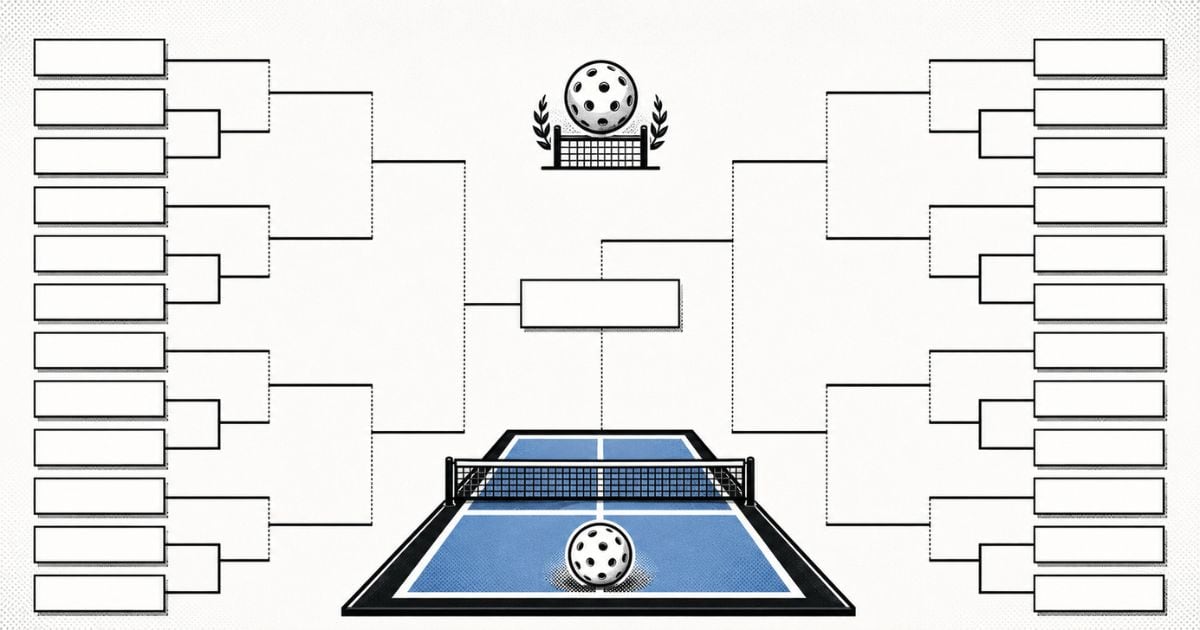
How Pickleball Tournament Brackets Work: Formats Explained for New Competitors
Quick Answer: Pickleball tournaments use a few bracket formats: round robin (everyone plays everyone), single elimination (lose once and you are out), and double elimination (lose once and you drop to a consolation bracket, where you can still win bronze). Double elimination is the most common amateur format, and matches are usually best of 3 games to 11.
If you are entering your first tournament, the bracket can look confusing. But the formats are straightforward once you know them. Here is how pickleball tournament brackets work, explained for new competitors.
What bracket formats are used in pickleball?
Round robin, single elimination, and double elimination. These three (plus pool play) cover almost every tournament. Which one you get depends on the field size and skill level.
The main formats:
- Round robin: everyone in the group plays everyone else, and winners are decided by record (matches won), then head-to-head and point differential. Common for small fields, often 5-6 teams or fewer.
- Single elimination: lose one match and you are out. Used for very large fields and pro main draws.
- Double elimination: lose once and you drop to a consolation bracket (also called a backdraw), where you can still win bronze. The most common amateur format.
- Pool play into a bracket: large fields split into pools (mini round robins), with top finishers advancing to a single-elimination playoff.
What I tell new competitors is that double elimination is your friend. Losing one match does not end your day, so you get more court time and a second chance at a medal.
What is a consolation bracket and “no come-around”?
A second-chance bracket, with one common limit. The consolation bracket (backdraw) is what makes double elimination forgiving. But many events use a rule called “no come-around” that caps how far you can climb back.
How it works:
- Win your matches and you stay in the winner’s bracket, playing for gold and silver.
- Lose a match and you drop to the consolation bracket.
- In the consolation bracket, you play for the bronze medal.
- “No come-around” means once you lose a main-draw match, the best you can finish is bronze. You cannot climb back to gold.
This setup, common at higher skill levels like 4.5 and 5.0, keeps the bracket fair while still giving everyone extra games. Lower divisions sometimes allow a full come-around.
How are matches played and players seeded?
Best of 3 to 11, seeded by rating. Beyond the bracket shape, two things shape your experience: the match format and how you are placed in the bracket.
What to expect:
- Match format: main-draw matches are usually best of 3 games to 11, win by 2. Consolation matches are often a single game to 15.
- Divisions: you compete within your age and skill group (like 3.5, 50+), and by event (singles, doubles, mixed).
- Seeding: organizers seed players using ratings such as DUPR, so similar players do not meet too early.
- Small fields: if too few register, a division may switch to round robin or be combined.
For how scoring works in each match, see our guides on how pickleball scoring works and what score you need to win. To find an event, see our guide on how to find tournaments, and browse our tournaments directory.
Frequently asked questions
How do pickleball tournament brackets work? Players are grouped by age and skill, then play in a format like round robin, single elimination, or double elimination. Double elimination with a consolation bracket, where you can still win bronze after a loss, is most common.
What bracket formats are used in pickleball? Round robin (everyone plays everyone), single elimination (lose once and out), double elimination (lose once and drop to a consolation bracket), and pool play feeding into a playoff bracket.
What is a consolation bracket? Also called a backdraw, it is the second-chance bracket in double elimination. After a loss, you drop into it and can still play for the bronze medal.
What does “no come-around” mean? It means once you lose a main-draw match, the best you can finish is bronze. You cannot climb back from the consolation bracket to win gold. It is common at higher skill levels.
How long are tournament matches? Main-draw matches are usually best of 3 games to 11, win by 2. Consolation matches are often a single game to 15, win by 2.
How are players seeded in brackets? Organizers seed by rating, commonly DUPR, so stronger players are spread out and similar players do not meet in early rounds, keeping the competition fair.
Once the bracket makes sense, tournaments are a lot less intimidating. Learn the full experience in our guide on how tournaments work, then find an event in our tournaments directory.
Written by the Pickler Junction Team.