
How Do Pickleball Tournaments Work? What to Expect From Registration to Final Match
Quick Answer: A pickleball tournament follows a set sequence. You register for a division based on age and skill, a USA Pickleball membership is typically required, and organizers often use a rating such as DUPR to seed players. On tournament day you check in, warm up, and play matches, usually best two of three games to 11, win by two.
If you have never competed, a tournament can seem mysterious. It actually follows a clear, predictable structure once you know the sequence. Here is how pickleball tournaments work, from registration to the final match.
What happens before tournament day
Registration decides everything that follows: your division, your opponents, and your schedule. Under the 2026 USA Pickleball rulebook, Rule 15.A.3.c sets an adult doubles team’s age division by the younger partner, and Rule 15.A.3.b sets the skill division by the higher rated partner. Rule 15.A.4 also lets players 18 and younger enter adult events when a junior division is not offered or the tournament director allows it.
Organizers also need a way to sort players by ability. According to DUPR, more than 2 million players carry a DUPR rating, and DUPR says its system syncs with major event and club registration platforms, which is how many tournaments place you into the correct skill bracket during signup.
Playing in a sanctioned event usually requires a current USA Pickleball membership. As of September 2026, a Challenger membership costs $12 a year and a Champion membership costs $60 a year, and both include sanctioned tournament eligibility, according to USA Pickleball. Entry fees are separate from membership costs. Pickle Geeks reports local club tournaments often charge $20 to $75 per event, while a major like the US Open charges a $150 amateur credential plus a $35 referee and technology fee, then $45 per doubles event and $50 per singles event, according to its 2026 registration page, and the USA Pickleball National Championships add their own registration fee plus a per-event fee on top.
The pre-tournament steps:
- Register online for your division, sorted by event, age, and skill level.
- Set or confirm your rating, such as DUPR, since organizers use it to seed and place you.
- Find a partner for doubles events. Under the rulebook, your team’s age and skill classification depends on both players.
- Pay your fees, which can include a membership charge, a registration fee, and a separate charge for each event you enter.
- Get your schedule, since the event posts when and where your matches play.
- Prepare your gear, paddles, court shoes, water, and snacks.
The organizing happens before you arrive. By tournament day, you already know your division, your partner, and your rough schedule.
What happens on tournament day
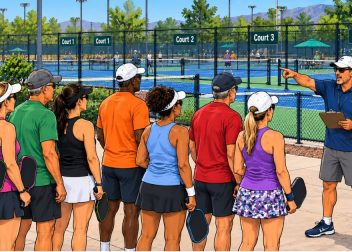
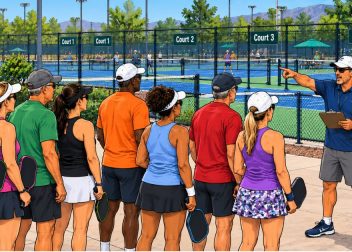
Check in, warm up, and play your format. The day itself is structured around your matches, and once you understand the rhythm it is easy to follow.
USA Pickleball recognizes six approved tournament structures: single elimination with consolation, double elimination, round robin, pool play, non-pool play, and team play. Round robin play suits small groups, since everyone plays everyone in the group. Double elimination suits larger fields, since a single loss will not end your day right away. For a full walkthrough of how the brackets slot you into matches, see the guide on how pickleball tournament brackets work, and for the round robin version specifically, see how pickleball round robin tournaments work.
Scoring follows the format USA Pickleball recommends for sanctioned play: best two of three games to 11 points, win by two. Some events use best three of five, or a single game to 15 or 21, and larger round robin brackets of six teams or more sometimes shorten play to one game to 11 to keep the schedule moving. Check your event’s posted format, since a tournament director can choose among the approved options.
The typical flow:
- Check in when you arrive, since many events now handle this electronically.
- Warm up before your first match.
- Play your format, round robin for small groups or an elimination bracket for larger ones.
- Play your matches, typically best of 3 games to 11, win by 2, unless the schedule says otherwise.
- Advance or move to a consolation bracket, depending on the result and the format.
- Play toward final placement. Single elimination with consolation and double elimination formats both keep a placement bracket running, so an early loss does not necessarily end your day.
There is often downtime between matches, so bring food, water, and a chair. The social side, talking with other players between games, is a real part of the day.
What to expect competing
Fair, appropriately matched competition. Because the USA Pickleball rulebook sorts entrants by age and skill under Rule 15.A, your opponents should be close to your level rather than far above or below it.
What to expect:
- Opponents at your level, thanks to the age and skill divisions set out in Rule 15.A.
- Multiple matches, especially in round robin or double elimination formats, which give you more court time than a single elimination bracket with no consolation round.
- A social atmosphere, with players chatting and supporting each other between matches.
- Some waiting, between matches and across the day, depending on the field size.
- A sense of accomplishment, regardless of the final result.
Your first tournament is mostly about the experience and learning the sequence. For the full sign up process, see the guide on how to sign up for a pickleball tournament. Age divisions run well past the standard adult brackets too; for older players, see US senior pickleball tournaments.
Frequently asked questions
How do pickleball tournaments work? You register for a division based on age and skill under the USA Pickleball rulebook, then on tournament day you check in, warm up, and play your matches in a round robin or elimination bracket, working toward final placement.
What scoring format do tournaments use? According to USA Pickleball’s approved formats for sanctioned play, the recommended format is best two of three games to 11 points, win by two, though a tournament director can post a different approved format such as best three of five.
Do I need a USA Pickleball membership to play? A sanctioned tournament typically requires a current USA Pickleball membership. A paid Challenger membership costs $12 a year and a Champion membership costs $60 a year, according to USA Pickleball, on top of the registration and event fees.
How much does it cost to enter a tournament? Costs vary by event. Pickle Geeks reports local club tournaments often run $20 to $75 per event, while the US Open charges a $150 amateur credential plus a $35 referee and technology fee and $45 to $50 per amateur event, according to its 2026 registration page, and the USA Pickleball National Championships charge a separate registration fee plus a per-event fee.
How does seeding work? Many organizers ask for a skill rating such as DUPR during registration. DUPR reports more than 2 million rated players worldwide and says its rating syncs with major event and club registration platforms, which is how organizers place you into a division.
Do I play against people at my level? Yes. Rule 15.A sets a doubles team’s age division by the younger partner and its skill division by the higher rated partner, which keeps matches from becoming lopsided.
How long does a tournament last? It varies. A single division might finish in a few hours, while a large multi day event runs all weekend, so plan for waiting between your own matches.
Is a tournament good for beginners? Yes. Most events run beginner skill divisions, and under the rulebook’s age and skill classifications, a first time competitor plays against similarly rated opponents rather than advanced players.
Tournaments are more organized and welcoming than first timers expect. Get the bracket mechanics in the guide on how pickleball tournament brackets work, and when you are ready to find an event near you, browse the Pickler Junction tournaments and events directory.
Written by the Pickler Junction Team.