
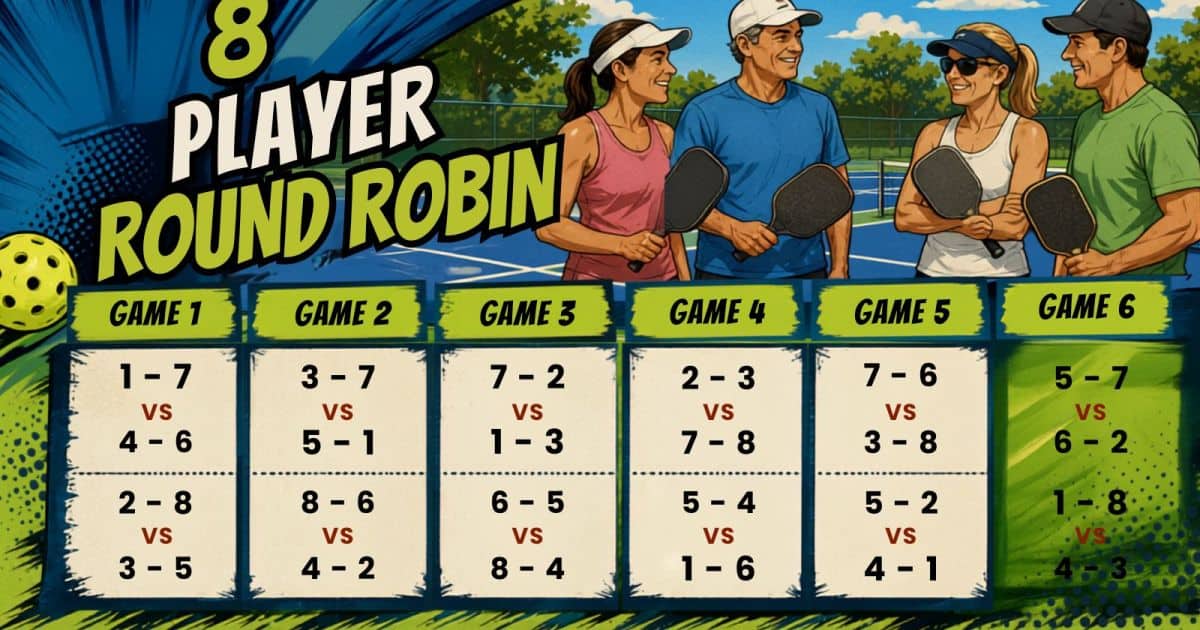
How Pickleball Round Robin Tournaments Work: Format, Rules, and How to Run One
Quick Answer: A pickleball round robin has every player or team play every other one, then ranks results by match wins instead of eliminating anyone after a loss. Under the USA Pickleball rulebook, ties go to head to head record, then point differential. To run one, set your group size, build a schedule, pick partners, and track results.
A round robin is a format where everyone plays everyone, so one loss does not end your day. It is the workhorse format for club play and social events. Here is how it works and how to run one.
What is a round robin in pickleball?
A round robin schedules each player or team against every other entry, unlike a knockout bracket where one loss ends your day. Under Rule 15.B.4 of the 2026 USA Pickleball rulebook, a round robin ranks players by the highest number of matches won, not by survival. When two or more teams finish with the same number of wins, that rule breaks the tie in order: head to head record among the tied teams first, then point differential across all games, then head to head point differential, then point differential against the next ranked team, and finally total points scored.
You rarely need to go past the first two steps of that list.
The core idea:
- Everyone plays everyone once, or in set rotations if the group is large.
- No elimination, so every player gets the same number of games.
- Ranking by wins first, then the tiebreakers above.
- Works well for mixed levels, since one bad game does not end your session.
Round robins reward steady play over one hot or cold game, and nobody heads home after a single quick loss. That is the main reason clubs run them so often.
What are the formats and scoring?
Round robins come in a few variations depending on whether partners stay together and how you keep score. Pick what fits your group.
Common variations:
- Fixed partner round robin: teams stay together and play every other team once.
- Individual round robin with rotating partners: you switch partners each round, common at social play and club nights.
- Ranking by match wins: the standard method under the rulebook, with point differential breaking ties.
- Ranking by total points: short, informal round robins sometimes add up every point scored instead of tracking wins and losses, which keeps a quick session simple to rank.
- Game length: USA Pickleball’s tournament format guidance recommends best two of three games to 11 points, win by two. Round robin brackets may shorten this to a single game to 11, win by two, once the bracket has six or more teams.
Rotating partners is the more social option, since you end up teaming with many different players. Fixed partners suits competitive or league settings better, where consistent chemistry matters. For a knockout style event instead, see the guide on how pickleball tournament brackets work or the broader look at how pickleball tournaments work.
How do you run a round robin?
Running a round robin takes a little prep, but a schedule and a results chart do most of the work after that.
The steps:
- Count your players or teams, since that sets the number of rounds you need.
- Build a rotation schedule, using a round robin chart or a free bracket generator app.
- Decide on partners and scoring, fixed or rotating, wins or total points.
- Set game length, shorter games keep larger groups moving on schedule.
- Track results on a chart, updating it after every round is played.
- Break ties with the order above, head to head record first, then point differential.
When the field is large, pool play replaces one big round robin. Under Rule 15.B.5 of the rulebook, pool play means dividing entries into two or more pools, with each pool playing an internal round robin before the top finishers advance into a single or double elimination playoff. Round robins are also a staple of ladder leagues; see what a pickleball ladder league is for a format that runs all season instead of in one day.
Frequently asked questions
What is a round robin in pickleball? A round robin is a format where every player or team plays every other one, with no elimination. Under the USA Pickleball rulebook, the winner is the player or team with the most match wins, with point differential settling ties.
How do you run a pickleball round robin? Count your players or teams, build a rotation schedule with a chart or generator app, decide on fixed or rotating partners and a scoring method, set the game length, and track results on a chart as rounds finish.
How is a round robin scored? Under the USA Pickleball rulebook, sanctioned round robins score by match wins, with ties broken by head to head record first, then point differential. Short, informal round robins sometimes score by total points across every game instead.
What is the difference between a round robin and a bracket? A round robin has everyone play everyone with no elimination, so every player gets equal games. A bracket is single or double elimination, so a loss knocks you out or drops you into a consolation bracket.
How many games does each player get in a round robin? One game against each other player or team, so the count equals your group size minus one. That guaranteed number of games is why round robins suit clubs and social events so well.
Is a round robin good for mixed skill levels? Yes. Since no one is eliminated, a mixed level group keeps everyone playing the full session. For more competitive play, split entries into separate pools or flights by skill level instead.
What game length should a round robin use? USA Pickleball’s tournament format guidance recommends best two of three games to 11 points, win by two, as the standard scoring option. Round robin brackets of six or more teams may shorten to a single game to 11, win by two, to fit more rounds into the day.
Can a round robin lead into a bracket? Yes, and that combination is called pool play. Under the USA Pickleball rulebook, each pool plays an internal round robin, then the top finishers move into a single or double elimination playoff.
A round robin keeps everyone playing and rewards steady results over one big swing, which is why clubs return to it again and again. Compare it with tournament brackets and ladder leagues, or find a certified coach who can help you prepare for one in the Pickler Junction coaches directory.
Written by the Pickler Junction Team.