Can You Play Pickleball Barefoot or in Sandals?
Quick Answer: Playing pickleball barefoot or in sandals is a genuine safety mistake, and the answer stays no even for casual games. The sport’s constant lateral movement on abrasive hard courts needs closed, supportive court shoes, and many facilities ban open or bare feet outright. The lone exception is soft lawn play.
This is the one apparel question in pickleball where the answer has no taste component. Feet, hard court, lateral force: the physics votes no before style gets a say.
Why is barefoot pickleball a bad idea?
Because everything about the sport’s movement works against an unprotected foot. Pickleball is played in bursts of side to side push, sudden stops, and lunges, on a surface engineered for grip.
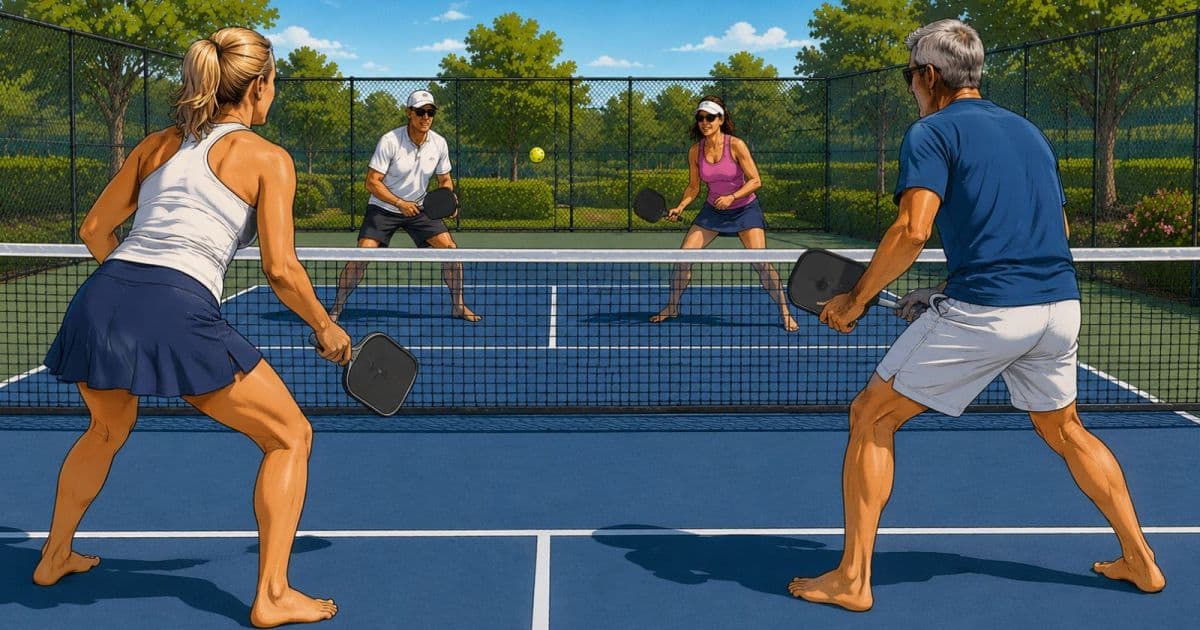
Barefoot, each of those elements becomes its own problem across all 20 by 44 feet of the court. The abrasive acrylic surface that gives shoes traction works like sandpaper on skin during any slide or drag, and a toe stubbed or dragged during a lunge, something shoes absorb weekly without your noticing, becomes an injury. The grip itself turns hostile: skin grips the court unevenly, sticking where you expect slide, and the ankle takes lateral loads with no structure around it. Add dropped paddles, stray balls underfoot, sun heated summer courts, and the everyday grit on public surfaces, and the barefoot experiment collects hazards faster than rallies.
None of this is theoretical toughness talk. The specific pattern, lateral push on an unsupported foot, is exactly how ankle rolls happen, and the court’s abrasiveness is why even indoor barefoot sports stay on smooth wood, never on acrylic.
Are sandals any better than barefoot?
Worse in the way that matters most. Sandals add a platform without adding attachment, and a foot that can slide off its own shoe mid push is carrying a new hazard, not a protection.
Sort the footwear people actually show up in:
- Flip flops: the worst option on the list. No attachment, no lateral anything, and a tripping flap at the toe.
- Sport sandals with straps: sturdier underfoot and still open at the toe with no lateral wall. The strap holds the sandal on; nothing holds the foot on the sandal sideways.
- Slides: functionally flip flops with better marketing.
- Casual sneakers: protected but slick soled and soft sided. Acceptable for a few driveway rallies, below the job for real games.
- Running shoes: protected, attached, and still wrong, for the lateral support reasons covered in our full guide to what shoes to wear for pickleball.
The pattern in that list is the lesson: coverage, attachment, and lateral structure are three separate requirements, and the sport needs all three at once. Only court shoes deliver the full set.
Do courts actually ban bare feet and sandals?
Commonly, yes. Footwear rules are among the most ordinary regulations at organized facilities, and they run in two flavors.
Indoor venues, gyms, and clubs typically require closed athletic shoes, usually with non marking soles, and enforce it at the door: it is a floor protection rule and a liability rule at once. Outdoor public courts post rules less often and organized play fills the gap, with leagues, clinics, and many club sessions requiring proper footwear as a condition of playing. Behind both versions is the same insurance logic: facilities carry the liability for injuries, and open footwear on a court is the kind of preventable risk their policies and waivers are written around.
So even the player unmoved by the safety argument meets the practical one: show up to organized pickleball in sandals and there is a decent chance you will be watching. A cheap pair of court shoes in the trunk solves the problem permanently, and the sock half of the system, covered in our guide to pickleball socks, rides along at almost no cost.
Is there ever a time bare feet are fine?
One, and it is not really pickleball: soft lawn play. A portable net on grass, the family volley game, the barbecue rally, all fine barefoot, because grass is forgiving, the ball barely bounces, and nobody is making hard lateral cuts on a surface without traction. Our guide to pickleball on grass covers why that setting is its own separate, gentler game.
The line to hold is the surface: the moment play moves to any hard court, driveway included, the footwear rules of the real sport apply. A driveway is the same abrasive concrete as a public court, and casual games produce the same lunges, just with worse warmups.
FAQ
Can you play pickleball barefoot? On hard courts, no. The lateral movement, abrasive surface, and impact hazards make it a genuine injury risk, and many facilities prohibit it.
Can you play pickleball in sandals? No. Sandals add a sliding platform without lateral support or toe protection, and organized venues commonly ban open footwear.
What happens if you show up without court shoes? At casual public courts, you risk your ankles and skin. At gyms, clubs, and organized sessions, you will often be asked to sit out.
Are casual sneakers okay for pickleball? For a few driveway rallies, tolerably. For real games, they lack the traction and lateral structure the sport loads on every point.
Why do gyms require non marking shoes? Wood and multi sport floors scuff, and closed athletic shoes are also the facility’s liability baseline. Both halves of the rule get enforced.
Is barefoot okay on grass pickleball? Yes, for soft lawn volley games. Grass play is its own gentler activity, and the hard court footwear rules begin the moment the surface hardens.
Whats the minimum acceptable shoe? A true court shoe, entry level is fine: closed toe, lateral support, court outsole. Price matters far less than category.
Do kids need real shoes for pickleball too? Yes. Smaller bodies make the same lateral movements, and youth court shoes exist for exactly this reason.
Getting shoes sorted before the next session? The pro shops and retailers in our directory fit court shoes at every price, and the rest of the setup lives in our gear and accessories listings.
Written by the Pickler Junction Team.