How to Store Pickleball Paddles
Quick Answer: Paddle storage comes down to protecting the glued core from heat, cold, and pressure. Keep paddles out of hot cars, away from direct sun, and off cold garage floors. Selkirk’s paddle care guide says heat can soften the face and cold makes it brittle, so a padded cover in a room-temperature closet protects the bond the longest.
Storage is inexpensive paddle maintenance, and it is easy to overlook between games. A paddle kept in a hot trunk between sessions can age faster than one played twice as often and stored well.
Why does paddle storage matter?
A pickleball paddle is a glued sandwich, not a solid slab. A thin face is bonded to a honeycomb or polymer core, and that bond is what heat and cold attack first. According to Selkirk’s paddle care guide, cold air can increase a paddle’s brittleness and make it more prone to breakage, while excessive heat can soften the paddle face and lead to delamination.
The damage rarely shows up right away. It builds in a few places:
- The core and the bond, where repeated heat exposure can start the separation that becomes delamination. Pickler Junction’s guide to paddle delamination covers what that looks and feels like.
- The face texture, which collects grit and residue that dull its grip on the ball.
- The grip, which hardens and turns slick after too many damp storage cycles.
- The edge guard, whose adhesive can lift in heat and let dirt and moisture work under the perimeter.
None of this announces itself after one hot afternoon. A paddle just slowly stops feeling like the one you bought. Pickler Junction’s guide to choosing a pickleball paddle covers what to look for if it is time to replace one.
How to store pickleball paddles day to day
Treat a paddle more like a musical instrument than a garden tool. Bring it inside after every session and give it a few minutes to reach room temperature before it goes back in the bag.
A short after-play routine covers most of it:
- Wipe the face with a slightly damp cloth to lift ball residue and court dust, then let it air dry.
- Let the grip air out instead of sealing a sweaty handle inside a closed bag.
- Store it flat or on edge in a padded sleeve, with nothing stacked on the face.
- Keep it indoors at normal room temperature, away from windows that get direct sun.
- Check the edge guard occasionally for lifting, since that is where damage starts quietly.
Selkirk’s guide makes a similar point about placement, recommending a dry, room-temperature closet over a car or garage and a spot where the paddle will not get stepped on or buried under something heavy. A closet shelf by the door works better than a garage hook, and a padded pickleball bag with a dedicated paddle sleeve makes the daily routine close to automatic.
Is it bad to leave a paddle in the car?
Yes, and leaving a paddle in a hot car is a common habit that shortens its life. A closed car sitting in summer sun heats up far faster than the outside air, and that range is exactly where paddle adhesives soften. Selkirk’s paddle care guide specifically names cars and garages as places to avoid, recommending a dry, room-temperature closet instead.
A trunk is worse than the cabin, since it has no airflow and no shade from the glass. Winter creates the opposite problem. A paddle left overnight in freezing temperatures gets brittle, and playing with it cold, before it has time to warm up, adds stress to a stiff core and face. If early morning games are the norm, bring the paddle inside and let it sit at room temperature before it goes on the court.
If a paddle has to ride in the car between back-to-back sessions, the cabin beats the trunk. Keep it on the floor behind a seat, out of direct sun, and bring it inside at the end of the day. That is a compromise, not a long-term plan.
How should you store paddles long term?
For an off-season break, store a paddle indoors, flat or upright in a case, at stable room temperature and moderate humidity. Skip attics, garages, basements that flood, and any spot against an exterior wall that swings with the weather outside.
Remove moisture first. Wipe the face and the grip, then let the paddle air out for a few hours before it goes into a case. If the paddle carries tungsten tape or lead tape for extra weight, check that the tape is still firmly stuck. Adhesive backing can loosen in storage and leave residue on the face, and lifted edge tape lets moisture and dirt work under the perimeter.
Avoid cleaning products that were not made for paddles. Solvents and abrasive cleaners can strip the surface texture and, on a paddle that carries USA Pickleball approval, can affect that approval status.
For a household with more than one paddle, store them in a case with individual slots so nothing rests on a hitting face.
What about travel?
Air travel is straightforward, since paddles are allowed in carry-on luggage. Carrying it on is also better for the paddle, because a checked bag can sit on a hot tarmac and inside unpressurized, unheated cargo holds. Pickler Junction’s guide to pickleball paddles on a plane covers what TSA allows through the checkpoint.
For road trips, the same car rules apply, just for longer. Bring the paddle into the hotel room instead of leaving it in a parked car overnight, especially in summer heat or a hard freeze. A padded bag with a rigid paddle compartment adds a layer of protection that a soft duffel does not.
FAQ
Can you leave a pickleball paddle in a hot car? It is not a good idea. Closed cars in direct sun heat up quickly, and Selkirk’s paddle care guide points to that heat as a cause of a softened face and delamination.
Does cold weather damage pickleball paddles? Cold makes the face and core more brittle, according to Selkirk’s paddle care guide. A paddle usually recovers once it warms back up, but playing hard with a very cold paddle adds stress to the bond.
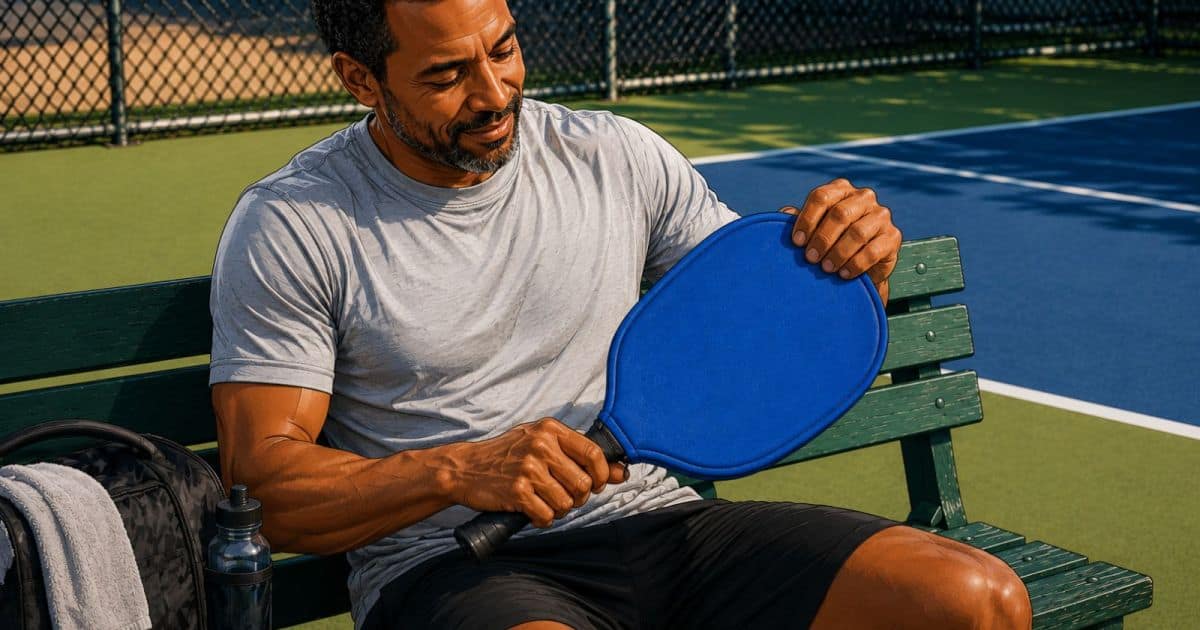
Should a paddle be stored in a cover? Yes. A padded cover protects the face from scratches and pressure, and Selkirk’s guide recommends one for that reason. Make sure the paddle is dry before it goes in, since sealing in moisture invites mildew on the grip.
How do you clean a pickleball paddle before storing it? Wipe the face with a damp microfiber cloth and let it air dry. Skip solvents and abrasive cleaners, which can damage the surface texture.
Is it bad to store a paddle in a garage? Usually. Garages swing with the outdoor temperature and humidity, which is the combination paddle adhesives handle poorly, according to Selkirk’s paddle care guide.
How should a paddle with tungsten or lead tape be stored? The same as any other paddle, with an extra check that the tape is still firmly attached. Heat can loosen tape adhesive over time and leave residue on the face.
Does storage affect how long a grip lasts? It does. A damp grip sealed inside a closed bag hardens and turns slick much faster than one that gets a chance to air out between sessions.
What is one simple storage habit to start with? Bringing the paddle inside after every session. It takes a few seconds and removes both heat and cold exposure at the same time.
Good storage costs nothing, and it is easy to overlook. A paddle kept out of hot trunks, away from direct sun, and in a padded cover will outlast one that gets played less but stored carelessly. For a wider look at covers, grips, and other equipment, Pickler Junction’s gear and accessories directory lists local shops that carry them.
Written by the Pickler Junction Team.