How Long Do Pickleballs Last and Why Do They Crack?
Quick Answer: Outdoor pickleballs typically last from a few sessions to a few weeks of regular play, and a hard hit on a cold court can crack one in a single game. Indoor balls usually last longer and go soft and out of round instead of cracking. Temperature, surface, swing speed, and ball quality drive most of the wear.
A pickleball is a single piece of molded plastic with holes drilled through it, so it has no way to absorb repeated impact except by flexing until it fails. Under the USA Pickleball Equipment Standards Manual, a tournament-legal ball weighs between 0.78 and 0.935 ounces, measures 2.87 to 2.97 inches across, and carries 26 to 40 circular holes in one uniform color. Every ball built to that standard still wears out. Knowing why helps you decide when to retire one and how to get more games out of the next.
How long do pickleballs last in normal play?
There is no official figure for how many games a pickleball lasts, because too many variables affect the answer. A recreational group playing at a moderate pace on a warm day might get several weeks out of one outdoor ball. A group hitting hard on a cold morning might crack two in an hour.
The variables that matter most:
- Temperature. Cold plastic is more brittle than warm plastic, so cracking is more common on cold days.
- Swing speed. Harder contact means more flex per impact, which shortens the ball’s life.
- Surface. Rough asphalt scuffs a ball faster than smooth acrylic or a gym floor.
- Ball quality. Balls built to the same 26-to-40-hole standard still vary in wall thickness and plastic grade, and cheaper balls tend to go out of round sooner.
- Out-of-bounds hits. Balls that hit fences, benches, and curbs take abuse that has nothing to do with rallies.
Why do pickleballs crack?
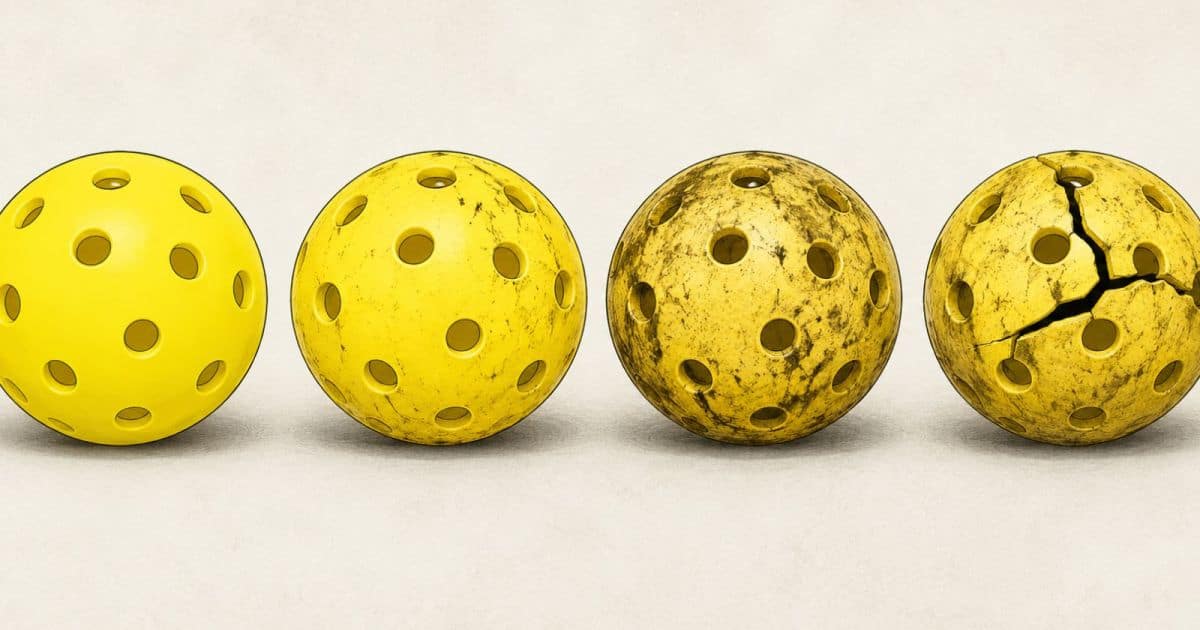
Pickleballs crack because the plastic fatigues at its thinnest points, the edges of the holes. Each impact flexes the shell slightly, and after thousands of impacts a hairline split opens, usually running from one hole toward another.
Cold weather speeds up that process. Plastic that flexes and recovers at room temperature is more likely to fracture once the air turns cold, which is why outdoor winter play tends to go through more balls. Keeping a spare ball in a pocket between games, rather than leaving it on a cold bench, keeps it warmer and less likely to crack on the next serve.
Seam failure is the other common failure mode, though newer designs are built to remove it. Many outdoor balls were historically molded in two halves and fused together, and a weak bond splits along that seam first. Franklin’s X-40 outdoor ball uses a no-seam, one-piece polyethylene construction, according to Franklin Sports, and Selkirk’s Pro S1 uses what the company calls seamless rotomolding technology, both aimed at removing that weak point.
Do indoor and outdoor balls wear differently?
Yes, and the difference starts with the hole pattern and the plastic. Franklin’s X-40 outdoor ball uses 40 machine-drilled holes and a harder polyethylene shell built to cut through wind and resist scuffing on asphalt, according to Franklin Sports. Onix’s Fuse Indoor ball uses a larger hole pattern designed for indoor courts, according to Onix, paired with a softer plastic that grips the paddle face and produces less bounce on a gym floor.
That design difference changes how each ball dies. Outdoor balls tend to crack. Indoor balls soften and go slightly out of round instead, and they rarely announce their retirement with an obvious crack, so they often get played past their useful life.
Using the wrong ball for the surface shortens life on both ends. An indoor ball played outdoors gets scuffed by rough concrete and pushed around by wind. An outdoor ball played indoors skids on a gym floor and feels harsh on contact. For a closer look at how the two are built, see the guide to indoor vs. outdoor pickleballs.
How do you know when to replace a pickleball?
Three quick checks tell you when a ball is done.
- Look for a crack. Hold the ball to the light and rotate it slowly. Hairline cracks start near the holes and are easy to miss at a glance.
- Listen to the bounce. A cracked ball sounds dull compared with the sharp pop of a good one.
- Roll it and bounce it. A ball that wobbles when rolled, or bounces off line, has likely gone out of round past the Equipment Standards Manual’s maximum variance of plus or minus 0.020 inch.
Retire a cracked ball immediately. It flies short and dies on contact, turning clean drives into unforced errors and changing how the point plays out.
How can you make your pickleballs last longer?
Keep balls out of temperature extremes. A ball left on a car dashboard all summer can soften and deform, and one left in a freezing trunk overnight turns brittle before the first serve. Store balls at room temperature with the rest of your gear, the same way storing your paddles properly keeps them from warping.
Rotate two or three balls through a session instead of hitting one until it fails, and once a ball is scuffed or out of round, retire it to practice duty rather than throwing it away. A smoother court surface and a well-set net cut down on wasted impacts too, a topic the comparison of portable and permanent pickleball nets covers in more depth. Wet courts add their own wear, covered in can you play pickleball in the rain.
For tournament play, the ball has to come from the official list of approved balls posted on the USA Pickleball website, the same requirement that applies to USA Pickleball approved paddles, under Section 3.C of the 2026 USA Pickleball rulebook. Recreational play carries no such requirement, so a group can use whichever ball the regulars prefer. Cost still factors in: as of September 2026, a 3-pack of Franklin’s X-40 outdoor balls runs $12.99, while Selkirk’s Pro S1 sells for $15, or $10 on sale, with a one-year no-crack warranty that can offset the higher price over a season of outdoor play.
FAQ
How many games does a pickleball last? There is no set number. A ball can last from one game to several weeks, depending on temperature, swing speed, and surface. Cold outdoor play burns through balls the fastest.
Why do pickleballs crack in cold weather? Cold plastic is more brittle than warm plastic, so it is more likely to fracture on impact instead of flexing. Keeping a spare ball warm in a pocket between games can reduce cracking.
Can you still play with a cracked pickleball? You can, but it plays dead and flies unpredictably short. Pull a cracked ball from play immediately, since it changes how every rally plays out.
Do indoor pickleballs crack? Rarely. Indoor balls, such as Onix’s Fuse Indoor, tend to soften and go out of round instead, which is harder to notice and often means they get played past their prime.
Are pricier pickleballs worth the extra cost? It depends on use. Selkirk’s Pro S1 sells for $15, or $10 on sale, with a one-year no-crack warranty, while a 3-pack of Franklin’s X-40 outdoor balls costs $12.99 with no warranty. The pricier option can pay off over a season of outdoor play.
How do you know if a pickleball is out of round? Roll it slowly on a flat surface. A ball that tracks straight is still round. Under the USA Pickleball Equipment Standards Manual, a legal ball allows a variance of plus or minus 0.020 inch, so a visible wobble has likely exceeded that limit.
Does a pickleball have to be on an approved list to use in a tournament? Yes. Under the USA Pickleball rulebook, Section 3.C, the complete list of approved balls is posted on the USA Pickleball website, and Rule 16.G directs tournament directors to pick the tournament ball from that list. Recreational play carries no such requirement.
Need a fresh supply of balls, or a look at the rest of your gear? Browse the pickleball gear and accessories directory to compare balls, paddles, and nets near you, and check the guide to how long pickleball shoes last if the rest of your gear is due for a look too.
Written by the Pickler Junction Team.