Is the Honolulu J2CR Worth It?
| JUNCTION SCORE 4.8 / 5 | |
| Expert Consensus | Highly Recommended across independent lab testing, expert review, and hands-on shop testing |
| Buyer Ratings | 4.8 / 5 (4 verified ratings; the paddle released in 2026 and store ratings are still accumulating) |
| Community Score | Highly Recommended, based on community threads |
| The Honolulu J2CR Crystal Blue is a genuinely impressive hybrid paddle that earns its price for offensive players who want elite spin retention and explosive pop in a lightweight package. The main catch is its UPA-A only certification, which limits use at USAP-sanctioned events. | |
| Best for | Intermediate to advanced players who prioritize spin, speed, and offensive pop over soft, dwell-heavy control |
| Skip if | You play primarily USAP-sanctioned tournaments or prefer a slower, touch-oriented paddle |
| Price | $195 | USAP Approved: No (UPA-A approved) |
Is the Honolulu J2CR Worth It?
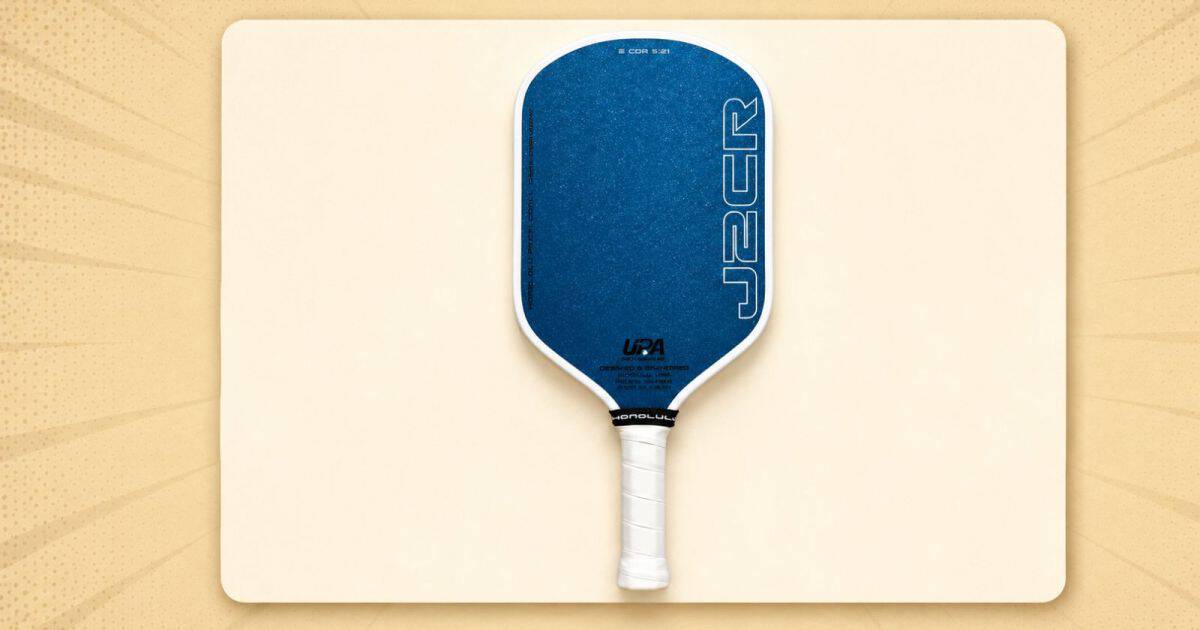
Yes, for the right player. This Honolulu J2CR review covers a hybrid-shape pickleball paddle built around a multi-density all-foam floating core interlaced with EVA perimeter foam, a CFC (carbon fiber-fiberglass-carbon fiber) face, and Honolulu’s Crystal Blue Endurance Surface grit designed to hold spin-generating texture far longer than standard peel-ply carbon. It sits at the intersection of lightweight maneuverability and explosive offensive output, making it a compelling option for players who want to generate heavy spin without sacrificing hand speed. See detailed review below.
What Reviewers Agree On
Spin generation is the headline feature. The Crystal Blue Endurance Surface produces spin numbers that rank among the best measured across any paddle in independent lab testing, landing at the 97th percentile in spin rate at 1,577.60 RPM. Independent expert review assigns spin a perfect 10 out of 10, and performance testing scores it at 100% on spin metrics. What separates this paddle from standard carbon-face competitors is not just peak spin output but how long that output holds up: lab grit durability testing places the Crystal Blue surface second among all surfaces tested, retaining 97% of its Ra roughness value and 92% of its Rz value after extended use.
One honest clarification the durable-grit marketing skips: durable grit does not increase your top-end spin. A fresh raw carbon face spins the ball just as hard for its first month or two. What Crystal Blue buys you is that the spin stays level for months instead of fading as the grit wears. Hands-on shop testing puts it plainly: the value is the same spin six months from now, which matters most to players logging four or five sessions a week. Once-a-week recreational players may never notice the difference before they would have replaced the paddle anyway.
Pop and explosive offense define the paddle’s personality. Independent performance testing places the J2CR at the 93rd percentile for pop in a broad paddle database, and exit velocity testing confirms it at the 84th percentile. Expert review scores power at 9 out of 10. Community feedback from players who have demoed multiple foam paddles consistently describes the pop as effortless and immediate, with a carry-through from the baseline that punches above what the paddle’s swing weight would suggest. This is a paddle built to attack.
Lightweight feel and maneuverability are exceptional. The J2CR’s swing weight lands at the 16th percentile, meaning it is lighter and faster through the air than the vast majority of paddles in the market. Expert review scores both aerodynamics and weighting at 10 out of 10, and independent performance testing rates maneuverability at 98%. Verified buyers consistently describe a paddle that feels quick in the hand without sacrificing stability at center contact, a combination that is difficult to achieve at this weight class.
The sweet spot is elite, and shop testers rank it with the best on the market. Expert review scores forgiveness at 9 out of 10, all four verified buyers gave sweet spot a perfect 5 stars, and hands-on testing that compared the CR line directly against the Gherkin Draco line, widely considered the sweet-spot benchmark, could not separate the two, calling them the two best sweet spots tested, stock, with no added weight. The multi-density foam core, an EPP center interlaced with EVA perimeter foam, appears to contribute meaningfully to that off-center stability.
The feel gives real feedback. The J2CR carries a slightly stiff, hollow feel, one of the two dominant feel profiles in the current market, and testers consistently praise how clearly it telegraphs where you caught the ball on the face. Compared head-to-head against the Draco’s NCP foam, the J2CR’s Core Reactor core dwells a touch longer, letting the ball sit on the face a hair more, which testers credit for easier shot shaping than its power profile would suggest.
Build quality and durability hold up under real use. Expert review scores durability at 10 out of 10, with no visible wear reported after extended testing. The 1-year warranty against defects in materials and workmanship backs the construction, and verified buyers rate durability at 4.5 out of 5 stars. The CFC face and foam core combination is consistently described across sources as a durable platform, and the Crystal Blue grit’s lab-confirmed retention numbers support confidence in long-term spin performance.
Reported Limitations
This is an offensive paddle, and control-first players will feel that tradeoff. Expert review scores control at 8 out of 10, and independent performance testing places control at 76%, which is notably lower than the paddle’s spin and pop metrics. The reactive, poppy nature of the CFC face and foam core means the ball leaves the paddle quickly, giving players less dwell time to shape touch shots. This is a design choice, not a defect, but it is a meaningful one: players who prioritize soft resets, precise drops, and dwell-heavy dinking will find the J2CR pushes back harder than they want. Expert commentary explicitly notes that newer players should look elsewhere. The consolation, per hands-on testing, is that the CR line’s huge sweet spot and feedback make it one of the friendlier on-ramps into a power paddle, closer to all-court territory than most elite-firepower options.
Early production batches had grit consistency problems, and buyers should know the history. Prominent reviewers flagged inconsistent grit on the original CR line, and one shop tester’s original-batch J2CR showed noticeably weaker grit than the sibling paddles bought alongside it. The encouraging parts of the story: Honolulu’s customer service replaced the unit quickly, and newer batches are reported as clearly more consistent, though no source has yet confirmed the issue is fully solved. If your unit’s surface feels smoother than expected out of the box, contact Honolulu rather than assuming that’s normal.
The factory grip degrades with use. Independent expert testing found the grip breaking down and becoming slick after extended play, which is the basis for a grip score of 9 out of 10 rather than a perfect mark. Players who sweat heavily or play frequently should plan to add an overgrip from the start.
UPA-A only certification is a real limitation for competitive players. The J2CR Crystal Blue carries UPA-A approval but is not USAP approved, and the reason is technical: USAP currently tests paddle surfaces with a friction test, while UPA-A caps measured RPM, and the Crystal Blue surface passes the second standard but not the first. In practice, some USAP-sanctioned events have been reported to allow UPA-A paddles anyway, and enforcement is inconsistent, so the practical rule is to ask your tournament director before you buy, not after. If USAP-sanctioned play is your competitive home, Honolulu’s standard raw-carbon CR versions carry USAP approval with the same core performance.
Arm comfort concerns have been raised in connection with the extended handle variant. One community member reported arm discomfort and attributed it to the elongated handle and swing weight combination. Worth knowing alongside it: the 6-inch handle is achieved with a sharper taper, and its twist weight measures slightly lower (6.5 versus 7.0 for the standard handle), so the two variants do not feel identical. This is an isolated report and not echoed by expert sources, but players with existing arm sensitivity who are considering the extended handle should be aware of it.
How Reviewers Compare It to Rivals
Versus the 11SIX24 Vapor Power 2 (HexGrit): These two paddles are consistently described as the top options in the durable grit category around the $200 price point. The J2CR is lighter, faster, and poppier, with slightly stronger carry-through from the baseline despite its lower swing weight. The Vapor Power 2 offers more control and a less explosive feel, making it better suited to players who want offensive capability with a softer touch profile. Grit durability lab testing ranks HexGrit first and Crystal Blue second, with both surfaces well ahead of the field. Community feedback from players who own both suggests the choice comes down to whether you prioritize raw power or controlled spin.
Versus the Gherkin Draco line: The closest performance rivalry in the review pool. Hands-on testing that ran both lines side by side for months calls them neck and neck on power and sweet spot, with two separations: the J2CR’s core dwells slightly longer, aiding shot shaping, and the Draco’s updated raw-carbon surface matched Crystal Blue’s spin through two months of play, reinforcing that the durable-grit advantage is about longevity rather than peak output. Players choosing between them are choosing between feel profiles and certification needs more than performance tiers.
Versus the Selkirk Boomstik (InfiniGrit): The J2CR outperforms the Boomstik on spin durability by a significant margin in lab testing, with Crystal Blue retaining 97% Ra versus InfiniGrit’s 90%. Expert review also credits the J2CR with better spin and a lower price point. The Boomstik carries higher power and pop in the other direction, and it holds USAP approval where the J2CR does not, making it the better choice for players who compete in USAP-sanctioned events. Community members who own all three advanced-grit paddles consistently rank Crystal Blue first for spin and durability.
Versus the Spartus P1 Hybrid (PermaGrit): The J2CR is stiffer, lighter, and more explosive offensively than the P1 Hybrid. The P1 grabs the ball better on softer touch shots and delivers a more controlled overall feel. Players who want to push into aggressive offense will prefer the J2CR; players who want a more balanced offensive and defensive profile will find the P1 more accommodating. Grit durability testing places Crystal Blue second and PermaGrit fifth among the eight surfaces tested.
Versus the Bread and Butter Loco Hybrid: The J2CR is slightly stiffer and poppier than the Loco Hybrid, with better long-term spin durability and a stronger ball grab. The Loco is more controlled relative to its offensive profile. For players who want maximum spin retention and explosive offense, the J2CR is the stronger choice; for players who want a more measured offensive paddle with softer characteristics, the Loco offers a different feel at a comparable performance tier.
Who Is the Honolulu J2CR Best For?
The J2CR is built for intermediate to advanced players who want to generate heavy spin, attack from the baseline, and move quickly through the kitchen without sacrificing pop. Its 16th-percentile swing weight means it rewards players with fast hands and aggressive mechanics, and its 97th-percentile spin rate means those mechanics translate directly into ball movement that opponents have to respect. Players who already have solid fundamentals and want a paddle that amplifies their offensive game will get the most out of what the J2CR offers. Players who are still developing consistency or who rely heavily on soft touch and dwell time will find the paddle’s reactive nature works against them.
Within Honolulu’s own CR lineup, shop testing lands on the J2CR hybrid as the default recommendation for undecided buyers: it blends elite widebody-class sweet spot and hand speed with some elongated-style reach, on the J2 shape that has become one of the most popular hybrid platforms in the sport. The standard 5.5-inch handle suits most players; the 6-inch extended handle adds leverage for two-handed backhands at the cost of a sharper taper and slightly lower twist weight, and community feedback suggests players with arm sensitivity approach that variant with some caution.
Buy it if you:
- Prioritize spin generation and want grit that holds up over months of regular play
- Play an aggressive, attack-oriented game from the baseline and at the transition zone
- Want a lightweight, fast paddle that still delivers meaningful pop and a forgiving sweet spot
- Compete in UPA-A sanctioned events or recreational play where USAP certification is not required
Skip it if you:
- Compete primarily in USAP-sanctioned tournaments where the J2CR cannot be used
- Prefer a dwell-heavy, touch-oriented paddle with softer control characteristics
- Are a newer player still building consistency and looking for a more forgiving learning tool
- Have existing arm sensitivity and are considering the extended handle variant
At a Glance
| Spec | Detail |
|---|---|
| Price | $195 |
| Weight | 8.0 to 8.3 oz (approximately 8.1 oz average) |
| Core Thickness | 16 mm |
| Core Material | Multi-density all-foam floating core; EPP core interlaced with EVA perimeter foam |
| Face Material | CFC (carbon fiber-fiberglass-carbon fiber) with Crystal Blue Endurance Surface grit |
| Paddle Length | 16.2 inches |
| Paddle Width | 7.8 inches |
| Handle Length | 5.5 inches (standard); 6 inches (extended, sharper taper) |
| Grip Circumference | 4.125 inches |
| Swing Weight | approximately 110 (16.55th percentile) |
| Twist Weight | 7.0 (standard handle); 6.5 (extended handle) |
| Spin RPM | 1,577.60 RPM (97.07th percentile) |
| Shape | Aero Hybrid Plus / hybrid |
| USAP Approved | No (UPA-A approved only) |
| Warranty | 1 year against defects in materials and workmanship |
| Expert Consensus | Highly Recommended (lab, expert, and shop testing) |
| Buyer Ratings | 4.8 / 5 (4 verified ratings, early in the paddle’s retail life) |
| Community Sentiment | Highly Recommended |
Is It Worth the Money?
Yes, at $195, the Honolulu J2CR Crystal Blue justifies its price for the right player. The three strongest data points are its 97th-percentile spin rate at 1,577.60 RPM, its second-place finish in independent grit durability testing with 97% Ra retention, and its 93rd-percentile pop score in a broad paddle database. These are not marketing claims; they are lab-measured figures that place the J2CR among the top performers in its category on the metrics that matter most to offensive players, and hands-on shop testing that ran the paddle against the market’s benchmark power paddles reached the same verdict.
The honest caveats are three. Control scores of 76% in performance testing and 8 out of 10 in expert review reflect a genuine tradeoff: explosive offense and elite spin at the cost of dwell time and soft-shot precision. The UPA-A only certification is a real cost for USAP tournament players regardless of how well the paddle performs. And the early-batch grit consistency history means buyers should check their unit’s surface on arrival, even though newer batches are reported as improved and the company’s replacement service earned praise.
The decision framework is straightforward. If your game is built around spin, speed, and aggressive ball-striking, and if your competitive context allows UPA-A certified equipment, the J2CR is priced competitively against comparable grit paddles and outperforms several of them on the metrics you care about most. If your game is built around touch, resets, and soft-hand play, or if USAP certification is non-negotiable, the money is better spent elsewhere, starting with Honolulu’s own USAP-approved standard CR versions.
The Honolulu J2CR Crystal Blue is a well-built, high-performing paddle for offensive players who are ready to use it. Its spin numbers, grit longevity, and lightweight pop profile are among the best available at this price point, and lab data, expert review, shop testing, and early buyers all point the same direction. Buy it if you play the kind of game it was designed for.
Frequently Asked Questions
What is the spin rate of the Honolulu J2CR?
The J2CR produces a measured spin rate of 1,577.60 RPM in objective lab testing, placing it at the 97.07th percentile across all paddles in that database. Independent expert review scores spin at a perfect 10 out of 10. The Crystal Blue Endurance Surface grit is engineered for long-term spin retention, holding 97% of its surface roughness after extended use in lab durability testing, second among all grit surfaces tested. Worth understanding: durable grit preserves spin over months rather than raising peak spin, so a fresh raw-carbon paddle will match it early on.
Is it tournament approved?
The J2CR Crystal Blue carries UPA-A approval but is not approved by USA Pickleball (USAP), because USAP uses a surface friction test while UPA-A caps measured RPM, and Crystal Blue passes the latter standard. Some USAP-sanctioned events have been reported to allow UPA-A paddles anyway, but enforcement is inconsistent, so competitive players should confirm with their tournament director before buying. Honolulu’s standard raw-carbon CR versions are USAP approved if sanctioned play is your priority.
Is it good for beginners?
No. Independent expert review explicitly notes that newer players should look elsewhere. The J2CR’s reactive, poppy character and shorter dwell time reward players who already have solid mechanics and can control the pace of the ball. The one soft landing: its sweet spot and feedback make it friendlier than most elite power paddles, so improving intermediates stepping up to a power paddle have an easier on-ramp here than with the category’s harshest options.
Are there durability problems?
The construction itself tests clean: durability scores 10 out of 10 in expert review with no visible wear after extended testing, and verified buyers rate it 4.5 out of 5. The honest asterisk is the early-batch grit consistency issue: original production units drew complaints of uneven grit, including from a shop tester whose unit was noticeably smoother than its siblings. Honolulu replaced flagged units quickly, and newer batches are reported as more consistent, though not yet confirmed fully resolved. The factory grip also degrades with heavy use; plan on an overgrip.
How does the J2CR compare to the 11SIX24 Vapor Power 2?
These two paddles are consistently described as the leading options in the durable grit category around the $200 price point. The J2CR is lighter, faster, and more explosive, with stronger pop and carry-through from the baseline. The Vapor Power 2 is more controlled and less reactive, suiting players who want offensive capability with a softer feel. Grit durability lab testing places HexGrit first and Crystal Blue second, with both surfaces well ahead of the competition.
How does the J2CR compare to the Gherkin Draco?
Hands-on testing that ran both for months calls them neck and neck on power and sweet spot, the two best sweet spots in the current market. The J2CR’s core dwells slightly longer, which aids shot shaping, while the Draco’s updated raw-carbon surface matched Crystal Blue’s spin through two months of play. The choice comes down to feel preference and certification needs rather than a performance gap.
Is it good for doubles?
Yes, particularly for players who play an aggressive doubles game. The J2CR’s lightweight swing weight and 98% maneuverability rating make it fast through the kitchen, and its large sweet spot helps on quick exchanges at the net. The tradeoff is that its reactive pop and lower dwell time make soft resets and precise drops more demanding than on a control-oriented paddle.
What handle length options are available?
A standard 5.5-inch handle and an extended 6-inch handle. The extended version achieves its length with a sharper taper and measures a slightly lower twist weight (6.5 versus 7.0), so the variants feel meaningfully different. One community member reported arm discomfort with the extended variant; players with arm sensitivity should factor that in.
| Reviewed By | The PJ Review Team. AI-assisted research and analysis, reviewed by a human editor before publication. |
| Sources | JustPaddles, Matt’s Pickleball, Spinwave Pickleball, Pickleheads, Pickleball Effect, Reddit (r/Pickleball). |
| Disclosure | No brand paid for or influenced this PJ review. |
Still narrowing down your next paddle? Browse every paddle category in the Pickler Junction gear directory. Pickler Junction may earn a commission if you purchase through links in our directory.
Written by the Pickler Junction Review Team.