Is the 11SIX24 Pegasus Jelly Bean Worth It?
| JUNCTION SCORE 4.7 / 5 | |
| Review Score | 4.7 / 5 based on 272 verified ratings |
| Community Score | Well Regarded, based on community threads |
| The 11SIX24 Pegasus Jelly Bean earns its reputation as the best wide-body paddle at the $100 price point, delivering control, spin, and forgiveness that rival paddles costing two to three times as much. The main catch is power: players who rely on hard drives and baseline aggression will find its ceiling lower than they want. | |
| Best for | Beginners to intermediate players (4.5 and under) who prioritize control, soft-game precision, and net play |
| Skip if | You are a banger or singles player who needs reach and explosive baseline pop |
| Price | $99.99 | USAP Approved: Yes |
Is the 11SIX24 Pegasus Jelly Bean Worth It?
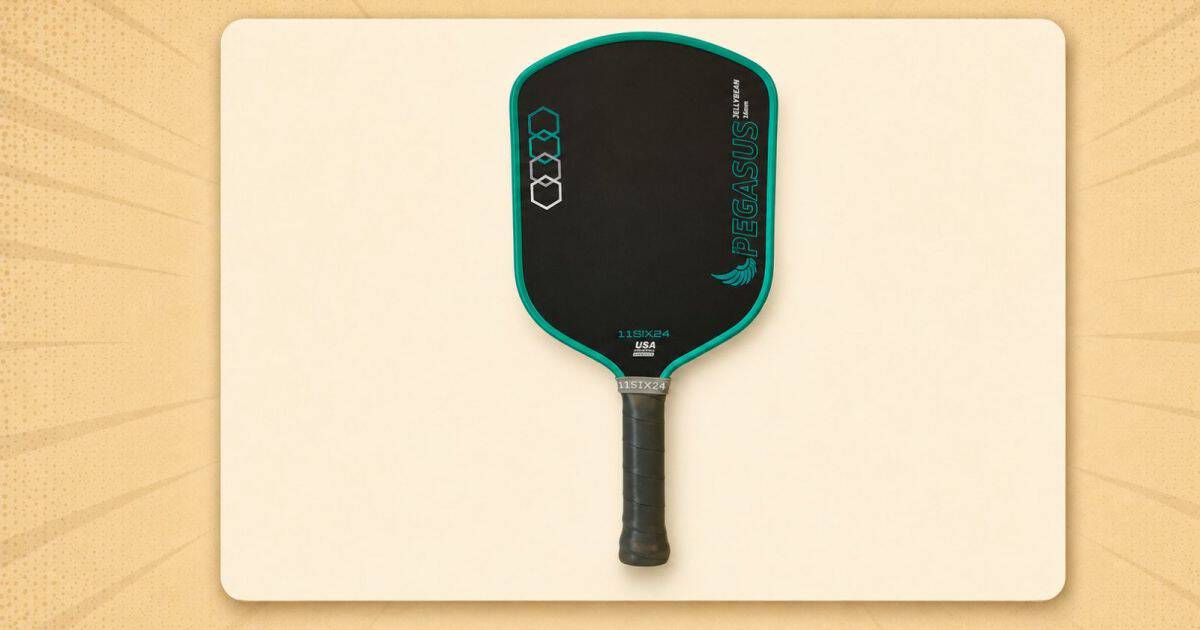
Yes, for the right player. This Pegasus Jelly Bean review covers a wide-body pickleball paddle built around a 16mm honeycomb polymer core, a three-layer CFC face combining two layers of raw Toray T700 carbon fiber with one layer of fiberglass, and foam-reinforced wall construction that produces one of the most forgiving response profiles in its price class. It sits at $99.99 and holds USA Pickleball approval. See detailed review below.
What Reviewers Agree On
Control is the defining strength of this paddle. The Jelly Bean earns a control score of 9.5 out of 10 in independent expert testing, and that finding is consistent across every source reviewed. Third-shot drops, dinks, and resets land with a precision that players typically associate with paddles in the $150 to $200 range. Verified buyers repeatedly single out the soft game as the reason they chose this paddle and the reason they kept it.
The sweet spot is genuinely large. Independent testing describes the Jelly Bean’s sweet spot as among the largest encountered at any price point, and community feedback echoes that assessment directly. The foam-reinforced edges and a twist weight of 7.14 (lab-measured) work together to keep off-center hits playable rather than punishing. Forgiveness scores 9.5 out of 10 in expert evaluation, and players at the 4.5 level report relying on that sweet spot as a tactical asset rather than a safety net.
Spin output is competitive with paddles that cost far more. Objective lab measurements place the 16mm version at 1,958 RPM, and spin scores 9 out of 10 in expert testing. That figure puts the Jelly Bean in the same conversation as paddles priced around $275, which is a meaningful result for a $100 option. The three-layer CFC surface, with its carbon fiber and fiberglass combination, generates the texture and bite needed to produce heavy topspin and dipping returns.
Maneuverability stands out in fast exchanges. The paddle is described as quick in the hand in independent testing, and community feedback consistently highlights how easy it is to redirect shots at the kitchen line. Aerodynamics scores 8.5 out of 10 in expert evaluation. Players who favor counter-punching, hand battles, and put-aways at the net find the Jelly Bean particularly well-suited to that style of play.
Build quality and value hold up under scrutiny. The Jelly Bean ships with a neoprene paddle cover, carries a one-year warranty, and includes a unique serial number. No recurring complaints about delamination, cracking, or surface breakdown appear in the sources reviewed. At $99.99, verified buyers consistently describe the price-to-performance ratio as one of the best they have encountered, with multiple reviewers noting that the paddle performs well above what its price tag would suggest.
Reported Limitations
Power is a real and consistent trade-off, not a minor footnote. Expert testing rates power at 8 out of 10, and multiple independent sources describe the paddle as underpowered on hard, deep drives and overhead smashes. Community feedback frames baseline aggression as the paddle’s weakest context, with players noting that generating pace requires noticeably more effort than with higher-swing-weight options. This is a design consequence of the paddle’s control-first tuning and relatively modest swing weight of 108 (lab-measured); players who rely on power as their primary weapon should treat this limitation as a genuine disqualifier.
The paddle length limits reach, particularly for singles play. At 15.82 inches total length, the Jelly Bean is short even by standard-shape standards. Players who cover a lot of court in singles or who depend on reach to compensate for positioning will feel that constraint. The wide-body shape optimizes the sweet spot at the cost of the extended reach that a hybrid or elongated shape would provide.
The stock balance skews head-light for some playing styles. Independent testing found the 16mm version too head-light out of the box for certain play styles, with the reviewer adding tungsten tape at 3 and 9 o’clock to reach a preferred feel. This is not a universal complaint, and the adjustment is straightforward, but players who prefer a more head-heavy setup should factor in that the paddle may need modification before it feels optimal. Our tungsten tape guide covers exactly how to do it.
One isolated review out of 270 reported no perceptible performance difference from a budget paddle. That assessment is not echoed by any other verified buyer or expert source and stands as a clear outlier. It is included here for completeness, not as a representative finding.
Which Should You Choose: 14mm or 16mm?
The 16mm version is the clear recommendation. Independent lab testing found the 14mm variant gets pushed around more on contact and delivers lower spin output (1,943 RPM versus 1,958 RPM for the 16mm). The 16mm is the version that earns the Jelly Bean its reputation. Note that the 14mm variant does not currently appear as an active option on the manufacturer’s product page.
| 14mm | 16mm (Recommended) | |
|---|---|---|
| Best for | Players wanting a livelier, slightly less stable feel | Players wanting maximum control, forgiveness, and spin |
| Weight | 7.9 to 8.2 oz (measured range) | 7.9 to 8.2 oz (measured range) |
| Spin RPM | 1,943 | 1,958 |
| Who it suits | Intermediate players comfortable adding weight | Beginners to intermediates prioritizing soft-game precision |
How Reviewers Compare It to Rivals
Vatic Pro Prism Flash. The Jelly Bean is widely described as having displaced the Vatic Pro Prism Flash as the top value pick at the $100 price point. The Jelly Bean’s fiberglass layer produces more pop at the net and a denser, more responsive feel, while the Prism delivers a more cushioned, muted sensation that some players prefer. The Prism’s hybrid shape also provides more reach, and certain Prism configurations edge out the Jelly Bean in raw power due to higher swing weights. For players who prioritize the soft game and sweet-spot size, the Jelly Bean wins; for players who want more reach or a softer feel, the Prism remains a legitimate alternative at the same price.
Gearbox Pro Ultimate Power. Independent expert testing places the Jelly Bean’s spin output on par with this paddle, which retails for around $275. The Jelly Bean does not match it in power or the feel profile that a higher-end build delivers, but the spin comparison alone is a meaningful data point for budget-conscious players who want serious spin generation without a premium price.
Pickleball Apes Pro Line Energy S. The Jelly Bean’s control and spin are described as on par with this paddle, which retails for around $120. Players who want a slight step up in budget for a different feel profile may find the Energy S worth considering, but the Jelly Bean closes the gap considerably for $20 less.
PIKKL Hurricane Pro. Expert testing places the Jelly Bean just below this paddle in control, which retails for around $160. The Hurricane Pro is the logical next step for players who want the Jelly Bean’s general profile but need a higher control ceiling and are willing to pay for it.
Who Is the 11SIX24 Pegasus Jelly Bean Best For?
The Jelly Bean is built for players at 4.5 and under who want to improve their soft game without spending on a premium paddle. Its control, forgiveness, and spin output make it particularly well-suited to net-oriented doubles play, where third-shot drops, dinks, and quick counter-exchanges define points. Players transitioning from a beginner paddle to their first serious option will find the learning curve forgiving, and intermediate players who have been playing on a budget paddle will notice an immediate improvement in touch and precision.
The 16mm version is the right choice for the overwhelming majority of buyers. Players who find the stock balance too head-light can add tungsten tape at 3 and 9 o’clock to dial in the feel, which is a minor and inexpensive adjustment. Players who need more power than the Jelly Bean provides should look at the Six Zero DBD Control as an upgrade path, or the Bread and Butter Filth for a power-oriented alternative at a similar price point.
Buy it if you:
- Prioritize control, dinking, and soft-game precision over baseline power
- Play doubles and spend most of your time at the kitchen line
- Want spin output that competes with paddles costing significantly more
- Are a beginner or intermediate player looking for a forgiving, high-value first serious paddle
Skip it if you:
- Rely on hard drives and aggressive baseline play as your primary game
- Play singles and need the reach of a hybrid or elongated shape
- Want explosive pop on overheads and smashes
- Prefer a head-heavy balance straight out of the box
At a Glance
| Spec | Detail |
|---|---|
| Price | $99.99 |
| Weight | 8.0 to 8.3 oz (manufacturer); 7.9 to 8.2 oz (lab-measured) |
| Core Thickness | 16mm |
| Core Material | Honeycomb polymer |
| Face Material | 11SIX24 CFC Surface: 2 layers Toray T700 carbon fiber + 1 layer fiberglass |
| Paddle Length | 15.82 inches |
| Paddle Width | 8.04 inches |
| Handle Length | 5.75 inches (manufacturer); approximately 5.5 inches (lab-measured) |
| Grip | 4.125 inches circumference |
| Swing Weight | 109 to 111 (manufacturer); 108 (lab-measured) |
| Spin RPM | 1,958 (16mm, lab-measured) |
| Shape | Wide/Standard |
| Construction | Foam-reinforced walls |
| USAP Approved | Yes |
| Warranty | 1 year |
| Review Score | 4.7 / 5 based on 272 verified ratings |
| Community Sentiment | Well Regarded |
Is It Worth the Money?
Yes, the 11SIX24 Pegasus Jelly Bean is worth $99.99 for control-oriented players. Three data points anchor that conclusion: a control score of 9.5 out of 10 in expert testing, a spin RPM of 1,958 that matches paddles at two to three times the price, and a forgiveness score of 9.5 out of 10 backed by one of the largest sweet spots in its class. At $100, those numbers are difficult to argue with.
The honest caveat is power. A power score of 8 out of 10 is not a failure, but it is a real ceiling, and players who generate pace as their primary weapon will hit that ceiling regularly. The paddle’s 15.82-inch length also limits its appeal for singles play.
The decision framework is straightforward. Doubles players who live at the kitchen line and want to sharpen their soft game get the most out of this paddle. Beginners who want a forgiving, high-performance first serious option get excellent value. Intermediate players who have outgrown a budget paddle but are not ready to spend $150 or more will find the Jelly Bean a meaningful upgrade. Power players and singles specialists should look elsewhere.
The Pegasus Jelly Bean earns its reputation as the best wide-body value paddle at the $100 price point. For its intended player, a beginner to intermediate doubles player who wants control, spin, and forgiveness without a premium price tag, it is a confident buy.
Frequently Asked Questions
Is the 11SIX24 Pegasus Jelly Bean good for beginners?
Yes, it is one of the stronger beginner options available at this price. The paddle’s large sweet spot, high forgiveness score, and control-first design make it forgiving of the timing and positioning errors that beginners make most often. The manufacturer describes it as best suited for players at 4.5 and under, and verified buyers at the beginner level consistently report that the paddle gave them confidence rather than frustration. The $99.99 price point is accessible without being a throwaway investment.
Is the 11SIX24 Pegasus Jelly Bean tournament approved?
Yes. The Pegasus Jelly Bean holds USA Pickleball (USAP) approval and PBCoR approval, making it legal for sanctioned tournament play. One note from the research: early production units may not carry the PBCoR stamp physically on the paddle, so players competing in events that require visual verification of that stamp should confirm their specific unit before competing.
How does the 16mm compare to the 14mm version?
The 16mm version is the stronger performer and the one that earned the Jelly Bean its reputation. Independent lab testing measured the 16mm at 1,958 RPM versus 1,943 RPM for the 14mm, and testers found the 14mm version gets pushed around more on contact, requiring added weight to feel stable. The 14mm variant does not currently appear as an active option on the manufacturer’s product page, so most buyers will be purchasing the 16mm by default.
Are there durability problems with the Pegasus Jelly Bean?
No recurring complaints about delamination, cracking, handle separation, or surface breakdown appear in the sources reviewed. Out of 270 verified ratings on the manufacturer’s site, nine are two-star or one-star, representing approximately 3.3 percent of total reviews, and those reviews do not cluster around a specific defect. One practical note: the paddle face accumulates dust with use, and a paddle eraser is recommended to maintain surface texture over time.
What is the spin rate of the Pegasus Jelly Bean?
Objective lab measurements place the 16mm version at 1,958 RPM. Expert testing scores spin at 9 out of 10. That output is described as comparable to paddles priced significantly higher, including options in the $275 range, which makes it one of the more compelling spin-per-dollar propositions in the $100 paddle category.
Is the Pegasus Jelly Bean good for doubles?
Yes, it is particularly well-suited to doubles. The paddle’s strengths of control, forgiveness, maneuverability, and spin align directly with what doubles play demands: precise dinks, reliable third-shot drops, and quick exchanges at the kitchen line. Community feedback specifically highlights the paddle’s flicky, maneuverable feel as an asset in hand battles. Players who spend most of their time at the net in doubles will get more out of this paddle than those who play primarily from the baseline.
How does the Jelly Bean compare to the Vatic Pro Prism Flash?
The Jelly Bean is the stronger pick for most players at the $100 price point. It produces more pop at the net via its fiberglass layer and offers a larger sweet spot with a denser, more responsive feel. The Vatic Pro Prism Flash counters with a more cushioned, muted sensation that some players prefer, a hybrid shape that provides more reach, and certain configurations that edge out the Jelly Bean in raw power. Players who prioritize the soft game and sweet-spot size should choose the Jelly Bean; players who want more reach or a softer feel have a genuine reason to consider the Prism.
| Reviewed By | The PJ Review Team. AI-assisted research and analysis, reviewed by a human editor before publication. |
| Sources | 11SIX24 website (Judge.me), Amazon, Pickleheads, Pickleball Studio, Reddit (r/Pickleball). |
| Disclosure | No brand paid for or influenced this PJ review. |
Still narrowing down your next paddle? Browse every paddle category in the Pickler Junction gear directory. Pickler Junction may earn a commission if you purchase through links in our directory.
Written by the Pickler Junction Review Team.