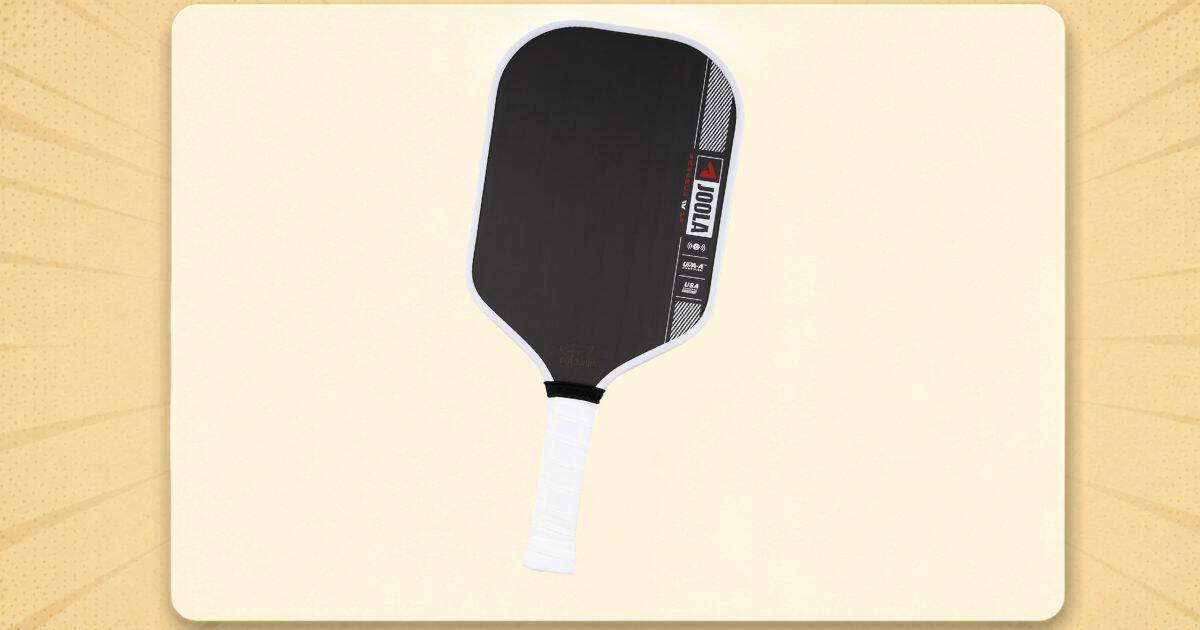
JOOLA Ben Johns Perseus Pro IV Review
JUNCTION SCORE 4.2 / 5
★★★★★ 4.2
Review Score: 4.2 / 5 based on 793 verified ratings (Amazon 372; JOOLA 340; Pickleball Central 52; Dick’s Sporting Goods 11; Pickleball Warehouse 8; Matt’s Pickleball 5; Scheels 4; JustPaddles 1)
Amazon combines ratings for all versions of this paddle.
Community Score: Divided, based on Reddit and community threads
A genuinely powerful, tournament-legal elongated paddle that delivers elite-level pop and improved feel over its predecessor, but it demands a player who can tame it. The biggest catch is that it rewards aggressive, technically sound players and punishes everyone else.
Best for: Intermediate to advanced players who prioritize power, drives, and speed-ups over touch-first play
Skip if: You rely on soft resets, third-shot drops, or are still building your fundamentals
Price: $249.95
USAP Approved: Yes
The Review
Yes, for the right player. The JOOLA Ben Johns Perseus Pro IV is a thermoformed, elongated pickleball paddle built around a polypropylene honeycomb core reinforced with an EVA foam edge wall and a textured carbon fiber face, all tied together by JOOLA’s patent-pending Tech Flex Power technology. It is one of the most powerful dual-certified paddles currently on the market, and for aggressive baseliners and doubles attackers who can control that power, it delivers a genuinely elite experience. See detailed review below.
Strengths
Explosive, top-tier power that stands out even in a crowded field. The Perseus Pro IV earns some of the highest power marks of any legal paddle reviewed across multiple testing sources. Measured serve speed comes in at the 83rd percentile of paddles measured, and the Propulsion Core design is credited with delivering explosive output on drives, counters, and speed-ups without sacrificing the feel needed for resets and dinks. Power scores reach 10 out of 10 in published testing, and a percentage-based breakdown puts power at 98 percent for the 16mm variant and 96 percent for the 14mm. Players who switched from other elongated paddles consistently describe the difference as immediate and significant.
Meaningfully improved feel and maneuverability compared to the paddle it replaced. The Perseus 3S was widely criticized for a harsh, stiff response and an awkward grip size on the 16mm version. The Pro IV addresses both issues directly. The 16mm now ships with a properly sized 4.25-inch grip, and the Tech Flex Power foam construction produces a noticeably more dampened, smoother feel through contact. Despite carrying a higher static weight than the 3S, the Pro IV’s lower swing weight makes it easier to accelerate through the ball, and buyers who made the switch describe the improvement in hand speed as one of the paddle’s most welcome upgrades.
A sweet spot and forgiveness level that outperform most elongated paddles. Elongated shapes typically sacrifice forgiveness for reach and power, but the Hyper-Foam Edge Wall and TFP throat foam work together to expand the effective hitting area. Forgiveness scores 8.5 out of 10 in published testing, and lab measurements rate it at 84 percent for the 16mm. A physical teardown of the paddle’s construction revealed a healthy, uncompressed core, and the foam placement is credited with reducing vibration on off-center hits. Players who logged extended hours with the paddle describe the sweet spot as noticeably larger than what they expected from an elongated power frame.
Solid spin generation backed by a textured carbon face. The Carbon Friction Surface adds meaningful grit to ball contact, and spin scores reach 9 out of 10 in published testing. Lab measurements rate spin at 91 percent for both the 14mm and 16mm variants. Measured spin RPM figures across testing sources range from the low 1,900s to the mid-2,000s depending on the instrument and session, placing it solidly in the competitive range for a power-oriented paddle. Owners describe the topspin on serves and drives as one of the paddle’s genuine strengths, and the slice response on defensive shots earns consistent praise as well.
A long handle that opens up two-handed options. The 5.5-inch handle is long enough to accommodate a two-handed backhand without feeling cramped, and buyers who use that shot describe the grip length as one of the paddle’s most practical advantages. The handle is wrapped in JOOLA’s Feel-Tec grip material, and players using the paddle in extended sessions report that it holds up well through sweat and extended play. For doubles players who want the reach of an elongated shape combined with two-handed stability on the backhand side, the handle geometry is a genuine asset.
Dual tournament certification for competitive play at every level. The Perseus Pro IV carries both USAP PBCoR .43 certification and UPA-A pro certification, making it legal for sanctioned tournament play across both governing bodies. That dual approval is not guaranteed on every high-performance thermoformed paddle, and buyers who compete regularly describe the peace of mind as worth noting. The certification also confirms the paddle meets current power and surface standards, which is particularly relevant given that its predecessor was delisted by USA Pickleball for exceeding legal power thresholds.
Reported Limitations
This paddle is built for aggressive players and actively works against everyone else. The same power that makes the Perseus Pro IV exceptional for drives and speed-ups makes it genuinely difficult to manage for players who rely on touch, finesse, or soft resets. Multiple published evaluations state explicitly that the paddle is not recommended for beginners or players whose game centers on the soft game. Third-shot drops and resets require meaningful technique adjustment, and the consensus across reviewers is that shorter strokes and disciplined footwork are prerequisites for keeping the ball in play. Players who have not yet developed consistent mechanics will find the paddle’s power working against them far more often than for them.
Durability remains an open and documented concern. JOOLA’s Gen 3 paddles developed a well-documented reputation for core crush, and multiple published reviewers flag that concern directly in their Pro IV coverage. The Tech Flex Power foam construction is new enough that long-term durability data is limited, and several reviewers state that JOOLA’s track record with previous generations makes them unwilling to give the brand the benefit of the doubt without more time in the field.
Spin performance, while solid, is not class-leading. The Carbon Friction Surface generates respectable spin, but surface roughness measurements place the paddle at the 3.9th percentile of paddles measured, meaning it is smoother than the vast majority of paddles in the database. Reviewers who prioritize spin above all else note that other paddles on the market deliver more grit. The dual-certification version is also constrained by USAP’s stricter surface tolerance requirements, meaning the version available to recreational and competitive players carries less grit than the UPA-A-only version used by touring professionals. For players whose game depends heavily on heavy topspin or aggressive slice, that gap is worth factoring into the decision.
The paddle benefits from customization and has a real adjustment period. Multiple published evaluations suggest adding lead tape to the throat and sides to improve stability and control, which implies the paddle as shipped is not fully optimized for all play styles. There is also a documented break-in period, though reviewers describe it as subtle rather than dramatic, with the 16mm in particular developing a softer, more settled feel over time. Players expecting to pick it up and immediately perform at their best may find the first several sessions frustrating, and the customization recommendations add both cost and effort to the ownership experience.
Choosing a Core: 14mm or 16mm
The 16mm is the recommended starting point for most players, offering more dwell time and a more forgiving response that the majority of testers found easier to use consistently.
| Spec | 14mm | 16mm (Recommended) |
| Best for | Faster, poppier feel; lower launch angle | More control; softer, more forgiving response |
| Weight | 7.9 oz avg | 8.1 oz avg |
| Spin RPM | 1,964 to 2,018 RPM | 1,971 to 2,170 RPM |
| Who it suits | Players who want maximum hand speed and a stiffer response | Players who want easier access to power with more dwell time |
Rivals and Comparisons
Versus the JOOLA Perseus 3S (predecessor). The Pro IV is a direct improvement in nearly every category that the 3S was criticized for. The 16mm’s swing weight drops from 121 to 118, making the Pro IV more maneuverable despite a higher static weight. The feel is meaningfully less harsh, the grip size is corrected, and the sweet spot is larger. The 3S measured slightly higher in spin on some instruments, but the overall package of the Pro IV is considered a clear step forward by reviewers who tested both. The predecessor was also delisted by USA Pickleball for illegal power levels, which the Pro IV avoids entirely.
Versus the Paddletek Bantam ESQ-C. The Bantam ESQ-C offers more spin and better all-court control than the Perseus Pro IV, according to reviewers who tested both. The trade-off is that the Bantam has less forgiveness, a smaller sweet spot, and a more hollow feel through contact. The Bantam is also noted for very consistent performance over its lifespan, which is a meaningful advantage for players who prioritize long-term reliability. The Perseus Pro IV holds the edge in raw power and sweet spot size; the Bantam holds the edge in spin and control precision.
Versus the Gearbox Pro Ultimate Power Elongated. The two paddles are closely matched for power and pop, though the Gearbox requires a break-in period before reaching its full output. The Gearbox carries a softer feel through contact but is less forgiving on off-center hits and runs heavier than the Perseus Pro IV. Players who prefer a softer, more muted response may gravitate toward the Gearbox; players who want maximum forgiveness alongside top-tier power will generally prefer the Perseus Pro IV.
Versus the 11SIX24 Power Series. The 11SIX24 Power Series is described as more consistent and easier to use than the Perseus Pro IV, with a stiffer feel and less raw power. It comes in at a meaningfully lower price point, and reviewers recommend it specifically for intermediate players who want a power-oriented paddle without the demanding learning curve of the Perseus Pro IV. The Perseus Pro IV is the stronger choice for advanced players who have the technique to unlock its ceiling; the 11SIX24 is the more practical option for players still developing that consistency.
The Right Player for the Perseus Pro IV
The Perseus Pro IV is designed for players who have already built a technically sound game and want a paddle that rewards aggressive, offensive play. It performs at its best in the hands of someone who can shorten their strokes on resets, generate power efficiently without over-swinging, and use the paddle’s explosive output intentionally rather than fighting against it. Players who compete in sanctioned tournaments and need a dual-certified paddle that can handle the full range of shots at a high level will find it well-suited to that context. Doubles players who rely on drives, speed-ups, and counters at the transition zone and kitchen line will get the most out of what the paddle offers.
The 16mm variant is the better starting point for most players in this range, offering more dwell time and a more forgiving response that makes it easier to manage across a full match. The 14mm is the right call for players who specifically want a faster, poppier feel and are comfortable with a stiffer response and a slightly smaller grip. Both variants share the same elongated shape, 5.5-inch handle, and carbon fiber face, so the choice comes down to how much forgiveness and dwell time a player wants to trade for additional snap and hand speed.
Buy it if you:
- Play an aggressive, power-first game built around drives and speed-ups
- Compete in USAP or UPA-A sanctioned tournaments and need dual certification
- Have the technique to control a high-powered elongated paddle
- Want a meaningful upgrade in feel and maneuverability over the Perseus 3S
Skip it if you:
- Are still building your fundamentals or rely primarily on touch and soft-game shots
- Want a paddle that is immediately consistent out of the box without customization
- Prioritize maximum spin above all other performance characteristics
- Are concerned about long-term durability given JOOLA’s history with thermoformed core longevity
At a Glance
| Spec | Detail |
| Price | $249.95 |
| Weight | 7.9 oz avg (14mm); 8.1 oz avg (16mm) |
| Core Thickness | 14mm or 16mm |
| Core Material | Polypropylene honeycomb with EVA foam edge wall (Propulsion Core + Hyper-Foam Edge Wall) |
| Face Material | Textured Carbon Fiber / Carbon Friction Surface (CFS) |
| Paddle Length | 16.5 in |
| Paddle Width | 7.5 in |
| Handle Length | 5.5 in |
| Grip | Feel-Tec; 4.125 in circumference (14mm); 4.25 in circumference (16mm) |
| Swing Weight | 116 (14mm); 118 (16mm) |
| Spin RPM | 1,964 to 2,018 RPM (14mm); 1,971 to 2,170 RPM (16mm) |
| Shape | Elongated (Perseus) |
| Construction | Thermoformed |
| USAP Approved | Yes (USAP PBCoR .43 certified; UPA-A pro certified) |
| Warranty | 12 months from date of receipt (registration on JOOLAUSA.com required within 14 days of purchase) |
| Review Score | 4.2 / 5 based on 793 verified ratings |
| Community Sentiment | Divided |
The Verdict
At $249.95 MSRP, the Perseus Pro IV sits at the top of the paddle market, and the performance data justifies that position for the right buyer. Serve speed lands at the 83rd percentile of paddles measured, power scores reach 10 out of 10 in published evaluations, and the dual USAP and UPA-A certification means it is legal for sanctioned competition at every level. The Tech Flex Power construction represents a genuine engineering step forward from the Gen 3 paddles, and the improvements in feel, maneuverability, and sweet spot size are documented across multiple sources rather than marketing claims.
The honest caveat is that the price buys a paddle with a demanding learning curve, an unresolved durability question, and spin performance that lands in the middle of the pack by surface roughness measurements. Players who need a soft-game-first paddle, or who are not yet playing at a level where the power ceiling is relevant, are paying for capability they will not use. The dual-certification version also carries less grit than the UPA-A-only version used by touring professionals, which is a meaningful trade-off for players who prioritize spin generation.
The decision framework is straightforward. If your game is built around drives, counters, and offensive pressure, and you play at a level where you can control a high-powered thermoformed paddle, the Perseus Pro IV is one of the strongest options available at this price. If your game centers on touch, resets, and soft-game construction, the Paddletek Bantam ESQ-C offers better all-court control at a comparable price point. If you want similar power at a lower cost and are still building consistency, the 11SIX24 Power Series is the more practical choice.
For the player this paddle is designed for, it is worth the money. The combination of explosive power, dual tournament certification, a corrected grip, and meaningfully improved feel over its predecessor makes it a legitimate top-tier option for competitive players who play an aggressive, offense-first game and have the technique to back it up.
Frequently Asked Questions
Is the JOOLA Ben Johns Perseus Pro IV good for beginners?
No. Multiple published evaluations explicitly state that this paddle is not recommended for beginners or players who rely on touch and finesse. The power output is high enough that players who have not yet developed consistent mechanics will struggle to keep the ball in play, and the learning curve for resets and third-shot drops is steeper than on more forgiving paddles. Players who are still building their fundamentals will be better served by a paddle with a lower power ceiling and more inherent forgiveness.
Is the JOOLA Ben Johns Perseus Pro IV tournament approved?
Yes. The Perseus Pro IV carries both USAP PBCoR .43 certification and UPA-A pro certification, making it legal for sanctioned tournament play under both governing bodies.
How does the 14mm compare to the 16mm?
The 14mm delivers a faster, poppier, stiffer response with a lower launch angle and a smaller grip circumference of 4.125 inches. The 16mm offers more dwell time, a softer and more forgiving feel, easier access to power, and a larger grip circumference of 4.25 inches. Measured spin RPM figures are comparable across both variants, though the 16mm edges slightly higher on some instruments. Most testers found the 16mm easier to use consistently, making it the recommended starting point for the majority of players.
How does it compare to the Paddletek Bantam ESQ-C?
The Perseus Pro IV holds the advantage in raw power, sweet spot size, and forgiveness on off-center hits. The Bantam ESQ-C delivers more spin and better all-court control, and it is noted for very consistent performance over its lifespan. Players who prioritize power and reach will prefer the Perseus Pro IV; players who want more spin precision and a more balanced all-court tool will find the Bantam ESQ-C the stronger choice.
Are there durability problems with the Perseus Pro IV?
Durability is a documented concern rather than a confirmed widespread failure. Multiple published reviewers flag JOOLA’s history of core crush on Gen 3 paddles and note that the Pro IV’s long-term durability is not yet fully established at the time of their reviews. Players who are sensitive to this risk should factor it into their decision.
What is the spin rate?
Measured spin RPM figures vary by instrument and testing session. For the 14mm, figures range from approximately 1,964 to 2,018 RPM across sources. For the 16mm, figures range from approximately 1,971 to 2,170 RPM. Surface roughness measurements place the paddle at the 3.9th percentile of paddles measured, meaning it is smoother than the majority of paddles in the database, which is consistent with the dual-certification version being constrained by USAP’s stricter grit tolerance requirements.
Is the Perseus Pro IV good for doubles?
Yes, particularly for players who play an aggressive doubles game built around drives, speed-ups, and counters at the transition zone and kitchen line. The 5.5-inch handle accommodates two-handed backhands comfortably, and the elongated shape provides additional reach at the net. Players who rely on soft resets and patient dinking as their primary doubles strategy will find the power output harder to manage in the close-quarters exchanges that define high-level doubles play.
Does the Perseus Pro IV have an NFC chip?
Yes. An NFC chip is embedded in the handle and can be scanned through the JOOLA Connect app to verify paddle authenticity. Community discussion confirms the feature works as described, though some users found the app interface initially unclear before locating the scanning function.
| Written by The PJ Review Team. AI-assisted, human-verified research and analysis. |
| Sources: JOOLA manufacturer product page (joola.com, 340 ratings); Amazon product listing, ASIN B0F1ZB6YTJ (372 ratings, all versions); Pickleball Studio (expert review with lab measurements); Pickleheads (expert review with sub-scores); Pickleball Effect (expert review with lab measurements, both variants); Matt’s Pickleball (expert review with lab measurements, 5 ratings); JustPaddles (retailer product page with Paddle Lab data, 1 rating); Pickleball Central (retailer product page, 52 ratings); Dick’s Sporting Goods (11 ratings); Pickleball Warehouse (8 ratings); Scheels (4 ratings); Reddit r/Pickleball (community discussion threads). |
| Aggregated from publicly available ratings, reviews, and measurements from the sources listed above, plus qualitative community discussion on Reddit r/Pickleball. Scores and sentiment reflect data available at the time of publication and may change. |
| No brand paid for, sponsored, or influenced this review. The sources cited are independent and are not affiliated with or endorsing Pickler Junction. |
Still narrowing down your next paddle? Browse every category in the Pickler Junction gear directory. Pickler Junction may earn a commission if you purchase through links in our directory.