How Pickleball Tournament Brackets Work: Formats Explained for New Competitors
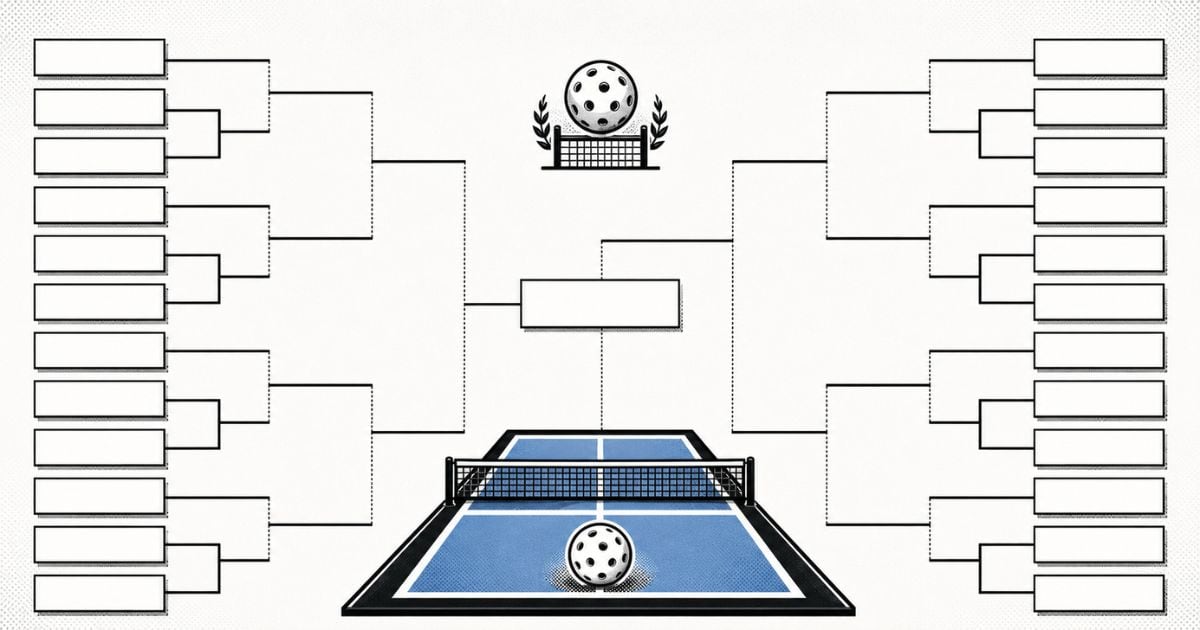
Quick Answer: Pickleball tournaments run on a handful of bracket formats. Round robin has everyone play everyone. Single elimination ends your event after one loss. Double elimination sends you to a backdraw instead, and it is the most common format at USA Pickleball events, per The Dink Pickleball. Some brackets cap that backdraw at bronze, a setup known as no come-around.
If this is your first tournament, the bracket sheet can look like a maze. The formats behind it are simple once you know the pattern. Here is how pickleball tournament brackets work, explained for new competitors.
The bracket formats used in pickleball
USA Pickleball lists six approved tournament formats on its sanctioning page: single elimination with consolation, double elimination, round robin, pool play, non-pool play, and team play. Most club and regional events for everyday players use one of the first four.
- Round robin: Every player or team in the group plays every other entrant, and standings come from match record, then head to head result and point differential. It works best for small fields, often five or six teams.
- Single elimination: Lose one match and the event is over for you. Very large fields and pro-level main draws use this format because it moves fast.
- Single elimination with consolation: A loss in the main draw drops you into a separate consolation bracket, but according to Pickleball.com’s guide to tournament formats, that bracket only plays for a secondary placement, not the title.
- Double elimination: A loss sends you to the loser’s bracket instead of ending your day. Pickleball.com’s guide explains that a player can still win the whole event by winning out of the loser’s bracket and then beating the winner’s bracket finalist in the final.
- Pool play into a bracket: Large fields split into pools, essentially mini round robins, and the top finishers from each pool move into a single-elimination playoff.
Whichever format your event uses, it will be printed on the bracket sheet or listed in the tournament app before your first match.
The consolation bracket and “no come-around”
A consolation bracket, sometimes called a backdraw, gives a player who lost a match more court time instead of sending them home. What that bracket is actually playing for depends on which format the event chose.
In true double elimination, the loser’s bracket feeds back into the final, and a player who fought through it can beat the winner’s bracket champion to take the title, according to Pickleball.com. In single elimination with consolation, the backdraw only plays for third place. This setup is often called no come-around: once you lose in the main draw, there is no route back to the gold medal match.
This capped-consolation setup is common at competitive divisions, including many 4.5 and 5.0 events, because it keeps the main draw meaningful while still giving everyone a shot at a bronze medal. Recreational and lower-rated divisions sometimes run a true double-elimination bracket instead, where a strong run through the backdraw can still end in gold.
Check the rules sheet at your own event before you play, since the two structures look similar on paper but decide very different things. One loss either ends your shot at gold or just moves you to a different bracket.
How matches are played and players seeded
Match length and seeding shape your day as much as the bracket format itself.
- Match format: Under USA Pickleball’s approved tournament formats, the standard main-draw match is the best two of three games to 11 points, win by two. Some events use best three of five games to 11 instead, or shorten matches to a single game to 15 or 21 points, still win by two, to keep a large draw on schedule.
- Divisions: You compete inside your own age and skill group, such as 3.5 or 50-plus, and inside your event type, whether that is singles, doubles, or mixed doubles.
- Seeding: Organizers commonly seed the bracket using a rating system such as DUPR, which runs from 2.000 to 8.000, so closely matched players do not meet in the first round. PickleballBrackets.com and Pickleball.com both built DUPR into their bracket software so organizers can seed by rating directly, according to a DUPR announcement about the integration.
- Small divisions: If too few players register for a division, tournament directors sometimes fold it into round robin or combine it with a neighboring skill level.
Age divisions add another layer on top of skill rating. See how age brackets work in pickleball for how the two combine. For how scoring inside each game works, see how pickleball scoring works and what score you need to win. Many tournaments now build and publish these brackets with dedicated pickleball tournament software, which is also where you can usually check your matchups and court assignments as they update.
Frequently asked questions
How do pickleball tournament brackets work? Players are grouped by age and skill, then compete inside a format such as round robin, single elimination, or double elimination. USA Pickleball’s sanctioning page lists six approved formats, and double elimination with a consolation bracket is the most common setup at amateur tournaments, according to The Dink Pickleball.
What bracket formats are used in pickleball? USA Pickleball’s sanctioning page names six approved formats: single elimination with consolation, double elimination, round robin, pool play, non-pool play, and team play. Most weekend tournaments for recreational and mid-level players use round robin, double elimination, or pool play feeding into a single-elimination bracket.
What is a consolation bracket? Also called a backdraw, a consolation bracket lets a player who lost a match keep competing instead of going home. In true double elimination the backdraw can lead all the way back to the title match, according to Pickleball.com’s tournament formats guide, while in single elimination with consolation it only plays for third place.
What does “no come-around” mean? It describes a bracket where a main-draw loss caps a player at third place, with no path back to the gold medal match. The restriction shows up in single elimination with consolation brackets and is common at higher-rated divisions like 4.5 and 5.0.
How long are tournament matches? Under USA Pickleball’s approved tournament formats, main-draw matches are typically the best two of three games to 11 points, win by two. Some events shorten backdraw or pool-play matches to a single game to 15 or 21 points to keep the schedule moving.
How are players seeded in brackets? Organizers commonly seed using a rating system such as DUPR, which runs on a 2.000 to 8.000 scale, so top-rated players are spread across the bracket and do not meet each other in the first round.
What happens if a division does not fill? Tournament directors sometimes combine a small division with a neighboring skill level or switch it to round robin so everyone still gets enough matches for the entry fee.
Where can new competitors find brackets and event schedules? Most tournaments post brackets through dedicated tournament software before or during the event, and organizers typically update court assignments and scores as matches finish. Check the event listing or see how to find pickleball tournaments before you register.
Once you know the format, the bracket sheet stops looking like a maze and starts working like a schedule you can plan around. Read the full rundown in how pickleball tournaments work, then browse local events in the Pickler Junction tournaments and events directory to find one near you.
Written by the Pickler Junction Team.