Pickleball Court Rules: Lines, Foot Faults, and Out of Bounds
Quick Answer: Under the 2026 USA Pickleball rulebook, a ball touching any baseline or sideline is in and a ball landing outside those lines is out. The exception is the serve, which is out if it touches the non-volley zone line. A server needs one foot behind the baseline, and volleying while touching the kitchen or its line is a fault.
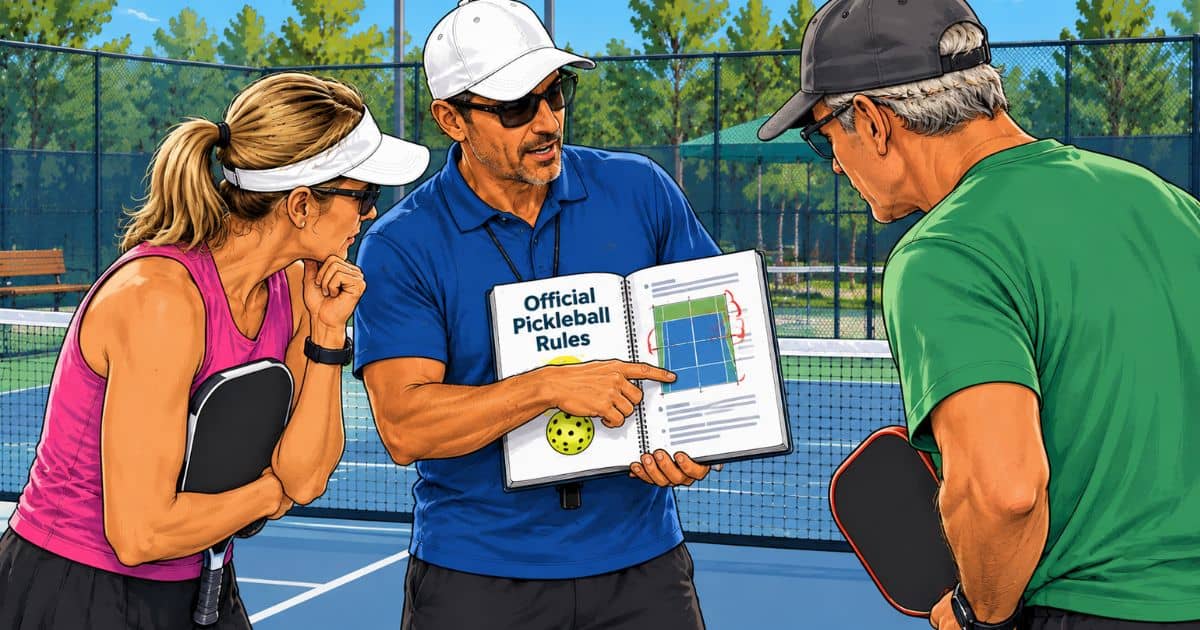
The 2026 USA Pickleball Official Rulebook spells out which lines count as part of the playing area, where a server’s feet may be, and what happens when the ball clips a post. The separate guide on how to make a line call in pickleball covers who calls the line and how to handle a dispute.
Which lines are in and which are out in pickleball?
The 2026 rulebook defines the court as the area inside the outer dimensions of the baselines and sidelines, and 2026 rule 3.A.2 says measurements run to the outside edge of the lines. The lines are therefore part of the court. Rule 8.B of the 2026 edition confirms that a returned ball landing on the opponent’s end of the court is in, and 2026 rule 8.C says any other ball landing outside the court is out.
The serve is the exception. Under 2026 rule 8.B, a served ball is in only when it clears the opponent’s non-volley zone line and lands in the correct service court, and 2026 rule 8.C states that a serve landing on the non-volley zone line is out. The reason sits in 2026 rule 3.A.4.c, which says all lines that bound the non-volley zone are part of the zone. A serve that touches the kitchen line has landed in the kitchen.
The other three lines are good for a serve: rule 3.A.4.f of the 2026 rulebook states that the service courts include their adjacent baseline, sideline, and the centerline. The guide to pickleball court dimensions covers the measurements.
What is a foot fault in pickleball?
A foot fault happens in two places: at the baseline during the serve, and at the non-volley zone line during a volley. Under 2026 rule 9.B.3, these are the only two faults a player may call on an opponent.
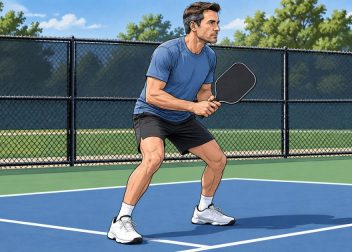
Under 2026 rule 11.A, all volleys must be initiated outside the non-volley zone, and a player may contact the zone at any time except during the act of volleying. Rule 11.A.1 of the 2026 edition states that when a volleying player, or anything in contact with that player, including the partner, contacts the non-volley zone, it is a fault. Since the line is part of the zone under 2026 rule 3.A.4.c, a toe on the line during a volley is a fault.
Two related 2026 rules extend the fault past the moment of contact. Rule 11.A.2 in the 2026 rulebook covers momentum: a volleying player carried into anything in contact with the zone, even after the ball is dead, has faulted. Rule 11.A.3 of the 2026 edition covers the exit: after touching the zone, a player who volleys before both feet are completely outside it has faulted. The guide to the pickleball momentum rule covers the first in depth, and the guide to pickleball kitchen rules covers the full set, including the point in 2026 rule 3.A.4.c that the zone is two-dimensional, so a paddle reaching over it is legal.
Where do the server’s feet have to be?
The service foot fault has three parts under 2026 rule 7.A. Rule 7.A.1 of the 2026 edition requires at least one of the server’s feet to be in contact with the correct serving area when the serve is hit, and 2026 rule 7.A.1.a makes it a fault when both feet are off the playing surface at contact. A jump serve that leaves the ground entirely is illegal.
Rule 7.A.2 in the 2026 rulebook says neither of the server’s feet may be in contact with the court when the serve is hit, and because the court includes its lines, a foot on the baseline is a fault. Rule 7.A.3 of the 2026 edition adds that neither foot may touch the playing surface outside the correct serving area.
That serving area is defined in 2026 rule 3.A.4.g as the area behind the baseline, bounded by the imaginary extensions of the adjacent sideline and centerline. A server standing wide of the sideline extension has stepped outside it. The foot rules apply to both the volley serve under 2026 rule 7.C and the drop serve under 2026 rule 7.D, and the guide to pickleball serving rules covers both in full.
What counts as out of bounds in pickleball?
Rule 10.C.1 of the 2026 rulebook states the core fault: when a player hits a ball that first lands outside the opponent’s end of the court, it is a fault against that player. The word “first” matters. A ball that lands in and then rolls past a line has already landed in.
Under 2026 rule 10.C.4, a ball that contacts a permanent object before bouncing on the court is a fault against the player who hit it, and the 2026 rulebook’s definition of permanent object includes ceilings, walls, fencing, lighting fixtures, and net posts. A lob off an indoor ceiling is out under the 2026 rules even if it would have landed in.
Under 2026 rule 10.C.3, a ball that contacts a player, or anything worn or carried by the player, is a fault against that player, with the exception of the paddle and the hand below the wrist while holding it. The guide to whether the ball can hit your body in pickleball goes into the details. The serve carries one more standard: under 2026 rule 8.C, a serve landing in the wrong service court is out even if it lands well inside the lines.
What happens when the ball hits the net or the posts?
Under 2026 rule 13.A, a ball that contacts the net, or the cable at the top of the net between the posts, remains in play. A serve that clips the net cord and lands in is legal under the 2026 rules, with no let replay.
The posts are different. Under 2026 rule 13.B, a served ball must not contact the net support system, and a returned ball must not contact it on the hitter’s side before crossing, with 2026 rule 13.B.1 making either a fault.
Rule 13.C of the 2026 rulebook allows a ball to be returned around the outside of the net post, while 2026 rules 13.D and 13.E make it a fault to hit the ball between the net and the post or under the net. Under 2026 rule 13.G, a player must not contact the net or its support system while the ball is live.
The net must measure 36 inches at the sidelines under 2026 rule 3.B.6 and 34 inches at the center under 2026 rule 3.B.7. The guide to the height of a pickleball net explains how to check a net before play.
How the court is measured and marked
The 2026 rulebook sets the court at 20 feet wide and 44 feet long under rule 3.A.1, and under 2026 rule 3.A.4.e all lines should be 2 inches wide and clearly contrasting with the playing surface. Public courts painted over tennis courts or gym floors sometimes use taped or faded lines, and the 2026 rules do not change on such a court.
Frequently Asked Questions
Is the ball in if it lands on the line in pickleball?
Yes, for every shot except the serve. Under the 2026 rulebook, the court includes its baselines and sidelines, so a rally ball touching any part of a line is in.
Is the kitchen line in or out on a serve?
Out. Rule 3.A.4.c of the 2026 rulebook makes all lines bounding the non-volley zone part of the zone, and rule 8.C of the 2026 edition says a serve landing on that line is out.
Can a server’s foot touch the baseline?
No. Under 2026 rule 7.A.2, neither of the server’s feet may be in contact with the court when the serve is hit, and the baseline is part of the court.
Is a jump serve legal in pickleball?
Not if both feet leave the ground at contact. Rule 7.A.1.a of the 2026 rulebook makes it a fault when both of the server’s feet are off the playing surface when the serve is hit.
Is it a foot fault if only the toe touches the kitchen line during a volley?
Yes. Under 2026 rule 11.A.1, any contact with the non-volley zone by the volleying player is a fault, and 2026 rule 3.A.4.c makes the line part of the zone.
Is a ball that hits the net post in or out?
It depends on when the post is hit. Under 2026 rule 13.B a served ball must not touch the net support system, and a returned ball must not touch it on the hitter’s side before crossing, so those are faults. Under 2026 rule 10.C.5 a ball that bounces in the opponent’s court and then hits the post has already landed in. Under 2026 rule 13.A, contact with the net itself keeps the ball in play.
Is the ball out if it bounces in and then goes out of bounds?
No. Rule 10.C.1 of the 2026 rulebook defines the fault as a ball that first lands outside the court, so a ball that lands in and then rolls out stays in play.
Does hitting the ceiling on an indoor court count as out?
Yes. Under 2026 rule 10.C.4, a ball that contacts a permanent object before bouncing on the court is a fault, and the 2026 rulebook names ceilings as permanent objects.
Who is allowed to call a foot fault on an opponent?
Under 2026 rule 9.B.3, players may call non-volley zone faults and service foot faults on their opponents, and no other faults.
Knowing the lines is half of playing by the rules. The other half is finding a court marked the way the 2026 rulebook describes. The Pickler Junction directory of public pickleball courts lists local venues so a player can check surface, line markings, and net setup before showing up.
Written by the Pickler Junction Team.