How to Set Up a Temporary Pickleball Court on a Tennis Court
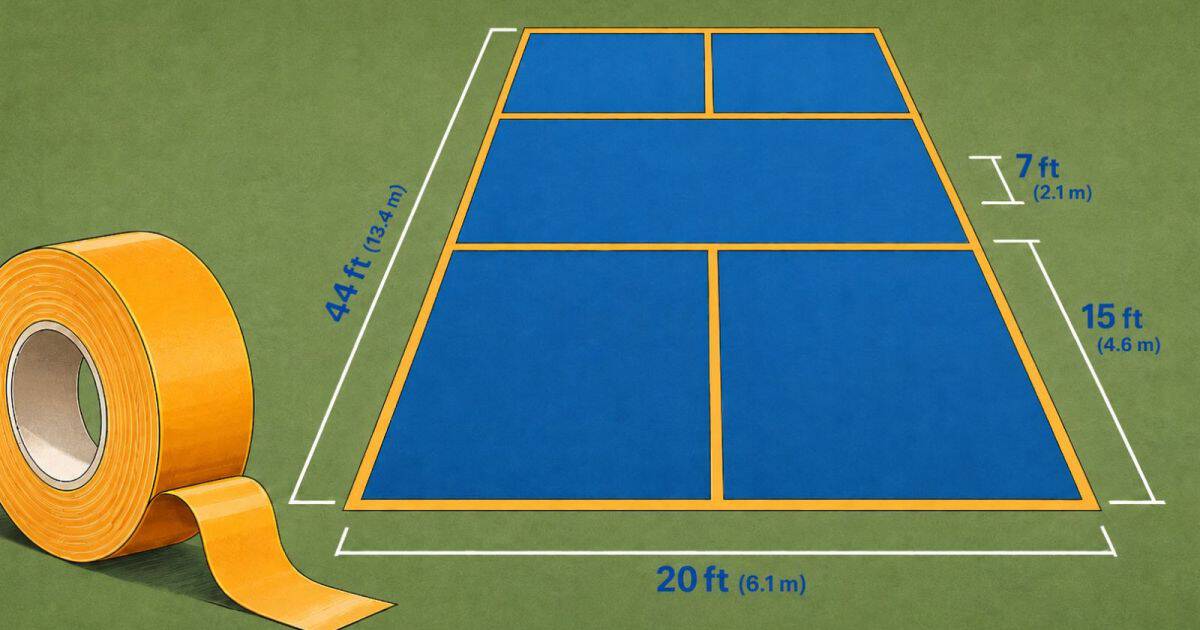
Quick Answer: Set your portable net first, then measure a 20 by 44 foot rectangle around it. Mark the non-volley zone 7 feet from the net on each side, then tape or place markers on every line. Set the net to 36 inches at the posts and 34 inches at center. Plan for about twenty minutes.
This is the temporary version, tape or markers you take home the same day. If you want lines that stay for good, see the guide on how to convert a tennis court into a pickleball court. Setups like this one are common for club nights, camps, and a one-day pickleball pop-up event.
What do you need before you start?
Less than you would guess, and a tape measure is the item people forget.
- A portable net. Regulation width with an adjustable center strap.
- A 50 foot tape measure. Anything shorter turns a quick job into a long one.
- Line marking supplies. Painter’s tape, throw-down corner markers, or thick sidewalk chalk all work.
- A chalk line or string. For keeping long lines straight.
- Permission. The item that actually stops most setups before they start.
What are the dimensions you are marking?
A 20 by 44 foot rectangle, with the non-volley zone 7 feet deep on each side.
Under Section 3 of the 2026 USA Pickleball rulebook, the court is 20 feet wide and 44 feet long, including the lines, and every line is 2 inches wide. The non-volley zone extends 7 feet back from the net across the full width of the court. The remaining space on each side is split by a centerline into two service courts, each 10 feet wide and 15 feet deep. The guide to pickleball court dimensions has the full diagram, and if orientation matters on your court, what direction a pickleball court should face covers that separately.
What is the fastest way to lay it out?
Start at the net and work outward.
Place the net first and center it on the tennis court, because every other measurement starts from there. From the center of the net, measure 22 feet in each direction to find the baselines, and 10 feet in each direction to find the sidelines. Mark the four corners before you commit any tape, then check both diagonals. Matching diagonals mean the rectangle is square. If they do not match, adjust before taping.
Then measure 7 feet from the net on each side for the non-volley zone line, and run the centerline from that line to the baseline on each side.
Can you use the tennis lines that are already there?
Partly, and it saves real time.
A tennis court will not hand you a finished pickleball court, but its lines give you a reliable straight reference and a known center point. You can align a pickleball baseline with an existing tennis line where the geometry allows, then tape only the lines you cannot borrow. A standard tennis court typically fits four pickleball courts, covered in the guide to how many pickleball courts fit on a tennis court. If you just want to know whether pickleball works on tennis lines with no taping at all, can you play pickleball on a tennis court answers that directly.
What tape should you use?
Blue painter’s tape for a single session, dedicated court tape if the lines need to last longer.
Painter’s tape is inexpensive, visible against most court colors, and lifts cleanly the same day. It will not survive rain or a week of play. Dedicated court line tape is stickier and more durable, which makes it the better choice for a multi-day setup such as a camp or a pickleball pop-up event, though it can pull at older surfaces when removed.
Two cautions apply either way. Never use duct tape or any construction adhesive on an acrylic court surface. And lay tape flat with no ridges, since a raised edge is a trip hazard and changes how the ball bounces.
How do you set the net correctly?
36 inches at the posts, 34 inches at the center.
Portable nets sag in the middle by design, and the center strap is what corrects it. Under Section 3, net height is set at 36 inches at the sidelines and 34 inches at the center point, with a small tolerance either way. Measure at both ends and at the center, then adjust the strap. A net that reads 36 inches everywhere plays harder on crosscourt dinks, and one that sags to 32 inches makes drives too easy.
Do not try to play over a tennis net without adjusting it. A tennis net sits noticeably higher than a pickleball net at both the center and the posts, which changes the game.
What are the etiquette rules on a shared court?
Ask first, take up less than you think you need, and clean up completely.
Public tennis courts are usually run by a parks department or a private club, and either one may have a policy on temporary lines. Some allow tape, some do not. Confirm before you arrive rather than after a complaint. When you finish, remove every piece of tape, including the small corner scraps. A few pieces of tape left behind a baseline are enough to get tape banned outright at a shared facility, so treat cleanup as part of the setup, not an afterthought.
How long does it take?
About twenty minutes for the first court, roughly ten for each one after that.
Measuring is the slow part, and it gets faster with practice. Two people work considerably faster than one, mostly because holding a tape measure taut across 44 feet alone is awkward. Once the first court is marked, a second or third court on the same tennis court goes much quicker, since you already have a working corner and a square reference to build from.
Frequently asked questions
How big is a temporary pickleball court? Under Section 3 of the rulebook, a court measures 20 feet by 44 feet including the lines, with a 7 foot non-volley zone on each side.
What tape works best for a temporary court? Blue painter’s tape for a single session. Dedicated court line tape for a setup that needs to last several days.
What net height is correct? Under Section 3, net height is set at 36 inches at the sidelines and 34 inches at the center, adjusted with the center strap.
Can pickleball be played on a tennis court without taping new lines? Not to official specifications, since a tennis net and tennis lines do not match the pickleball rulebook dimensions. The guide to playing pickleball on a tennis court covers what does work without any setup.
Is permission needed to tape lines on a public court? Usually yes. Policies on temporary lines vary by parks department and by club, so confirm before you arrive.
Will tape damage the court surface? Painter’s tape and dedicated court tape generally lift cleanly. Adhesives built for construction, like duct tape, can pull at acrylic surfaces.
How many pickleball courts fit on one tennis court? Typically four, depending on run-off space, covered in the guide to how many pickleball courts fit on a tennis court.
Is a temporary setup right for a one-day pop-up event? Temporary tape or portable lines are the standard approach for a one-day pickleball pop-up event, since nothing has to stay behind once play ends.
Measure from the net, check your diagonals, and take everything home with you. To find courts that already have permanent lines nearby, browse the public pickleball courts directory.
Written by the Pickler Junction Team.