Does Pickleball Paddle Handle Length Matter?
Quick Answer: Yes, handle length matters most if you hit a two-handed backhand or came from tennis. A longer handle adds room for a second hand and more leverage for power. The tradeoff: paddle length is capped at 17 inches under the rulebook, so extra handle removes hitting surface.
Handle length is the spec buyers notice last and feel first. It is also the one place where paddle design forces a genuine either-or, because the rulebook does not let manufacturers add handle length without taking away face.
Why is handle length a tradeoff?
Because the paddle’s total size is fixed by rule, not by manufacturer choice. Under Section 3 of the 2026 USA Pickleball rulebook, the combined length and width of a paddle, including any edge guard and butt cap, cannot exceed 24 inches, and length alone cannot exceed 17 inches (Rule 3.D.2). Within that shared envelope, every inch given to the handle is an inch taken from the hitting surface.
That is the whole tension. A long handle buys grip room and swing leverage and costs face area, usually from the bottom of the paddle where mishits already happen. A short handle maximizes hitting surface and leaves a two-handed grip crowded or impossible.
Manufacturers publish handle length separately from total paddle length for exactly this reason. Comparing the two numbers on a spec sheet tells you more about how a paddle will feel in hand than the marketing copy does. Before a paddle can be sold for sanctioned play, it has to appear on the USA Pickleball Approved Paddle List, which confirms it meets the Rule 3.D dimensions under Rule 18.A.
Who actually needs a long handle?
Three groups tend to benefit. Outside them, a standard handle is usually the better buy.
- Two-handed backhand players. The second hand needs somewhere to go. A cramped grip forces the top hand onto the paddle face, which is uncomfortable and cuts into control.
- Tennis crossovers. Players carrying a two-handed backhand over from tennis want familiar grip room, and a longer handle preserves the stroke they already own.
- Players chasing more pace on serves and drives. A longer handle acts as a longer lever, which can add swing speed at the cost of maneuverability. That tradeoff suits a baseline-oriented game more than a net-rushing one.
Players outside those three groups generally get more value from extra face area. Net-focused players especially, since the fast exchanges that decide points at the kitchen line reward a big forgiving surface and quick hands over lever length.
What does a longer handle cost at the net?
Sweet spot and reaction speed, in that order.
Face area lost to a longer handle comes off the lower part of the paddle, which is exactly where hurried volleys and low blocks tend to land. More shanks on defensive shots after switching to a longer handle usually reflect that lost real estate rather than a flaw in the player’s form.
Maneuverability suffers slightly too. More mass sitting further from the hand makes for a marginally slower paddle in a fast hands battle, an effect closely tied to swing weight rather than handle length on its own.
Handle length also tends to travel with paddle shape. Longer handles cluster on elongated paddles, so the two decisions usually get made together. The shape half of that choice is covered in the comparison of elongated and standard paddles.
How do you find the right handle for your hand?
Try one with your actual grip. If you play two-handed, try it with both hands on.
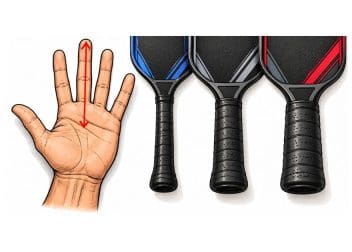
The test is simple. Take a normal grip and check that your whole hand sits on the handle without spilling onto the face. If you hit two-handed, both hands should fit with a little room to spare, not stacked to the edge. Anything that forces a hand onto the face is too short for that stroke.
Grip circumference is a separate spec from handle length, and mixing the two up is common. Circumference is how thick the handle is around; length is how far it extends. A handle can be long and thin or short and thick, and the two dimensions move independently. Circumference can be built up after purchase with an overgrip, covered in the guide to pickleball paddle grip tape; handle length cannot be changed at all once the paddle is made.
That asymmetry is the practical rule worth remembering: grip thickness is adjustable, handle length is permanent. Buy the length the stroke needs first, then tune thickness later. The wider decision framework, including weight and shape, lives in the guide to choosing a pickleball paddle.
FAQ
Does pickleball paddle handle length matter? Yes, particularly for two-handed backhand players and tennis crossovers. A longer handle adds grip room and swing leverage while removing hitting surface from the same fixed paddle size.
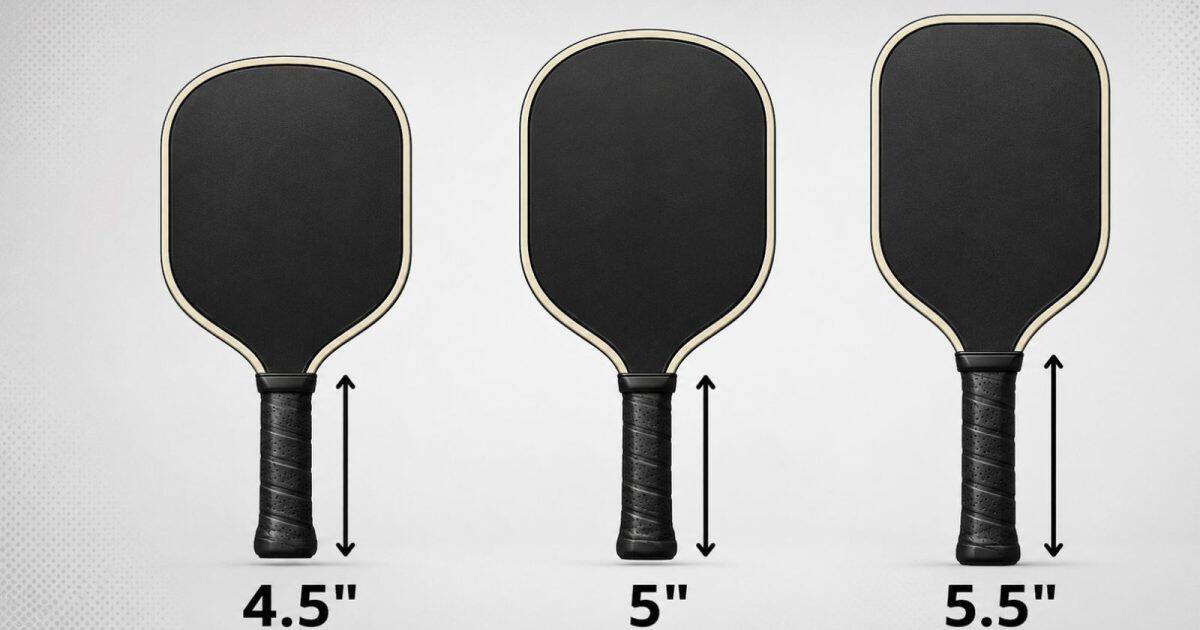
What is a standard handle length? Commercial paddles generally run from about 4 to 6 inches of handle, with most clustering between 5 and 5.5 inches. Manufacturers list handle length separately from total paddle length on their spec sheets.
Does the rulebook limit handle length directly? Not on its own. The USA Pickleball rulebook caps combined length and width at 24 inches and total length at 17 inches under Rule 3.D.2, so handle length is set by manufacturers within that shared limit rather than by a separate handle rule.
Do I need a long handle for a two-handed backhand? In most cases, yes. A short handle forces the second hand onto the paddle face, which costs comfort and control on that shot.
What do I lose with a longer handle? Hitting surface, since total paddle size is fixed by rule. The loss comes off the lower face, where defensive shots and low volleys often land.
Is handle length the same as grip size? No. Grip size refers to circumference, how thick the handle is around. Handle length is how far the handle extends. Both matter, and only circumference is adjustable after purchase.
Can I change handle length after buying a paddle? No. An overgrip changes thickness only. Length is fixed at manufacture, which is why it deserves attention before purchase rather than after.
What handle should a beginner choose? A standard handle in most cases, unless the player already hits a two-handed backhand. The larger hitting surface is worth more while contact skills are still developing, similar to the reasoning behind paddle weight recommendations for beginners.
Handle length is a permanent choice, so it is worth testing before buying rather than guessing from a spec sheet. Paddles across a range of handle lengths are available to compare in the Pickler Junction gear and accessories directory.
Written by the Pickler Junction Team.