Is Pickleball Bad for Your Knees?
Quick Answer: Pickleball is not inherently bad for your knees. AAOS OrthoInfo recommends exercise, including lower-impact activity, for people managing knee arthritis. Mayo Clinic notes that pickleball injuries tend to involve falls and overuse in unconditioned players rather than gradual joint wear, so protecting your knees starts with balance and a gradual buildup.
Knees come up in almost every conversation about whether pickleball is worth taking up later in life. The honest answer separates what the sport actually demands from what sends people to a clinic.
What does pickleball actually ask of your knees?
Repeated stopping, lateral pushing off, and low crouching, held over an hour or more.
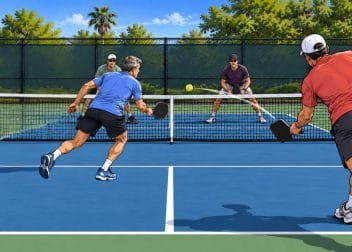
Pickleball is not a running sport. The court measures 20 by 44 feet and rallies are short, so total distance covered in a game is modest. What the knees absorb instead is braking: stopping, changing direction, and pushing off sideways, often from a semi-crouched stance near the net.
Under Section 11 of the 2026 USA Pickleball rulebook, the non-volley zone extends 7 feet from the net on each side, and that strip is where most of the crouching and lateral movement happens. AAOS OrthoInfo, the patient education site of the American Academy of Orthopaedic Surgeons, groups tennis together with jogging as higher-impact activity for an arthritic knee, and recommends exercise in general because it improves pain and function. Pickleball’s smaller court and shorter points make it comparatively gentler than a full tennis court, though the knee still takes on real load every time a player stops short or plants to change direction.
The problem is not the load itself. It is the load arriving faster than the legs are ready for it.
Where does the real knee risk come from?
Falls and overuse, more than gradual wear, drive most of the injuries that involve the knee.
According to Mayo Clinic Sports Medicine, older players face a higher risk of fracture when they fall, sometimes tied to undiagnosed osteoporosis, and overuse injuries such as tendinitis turn up in players who take on the sport without conditioning their bodies for it first. A knee injury in pickleball often follows a similar pattern: the joint is asked to brake or twist at the exact moment balance is already compromised.
Three situations create most of that risk:
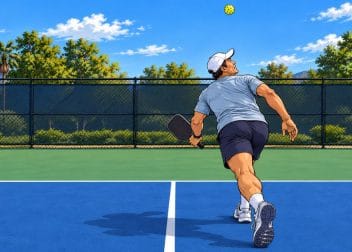
- Backpedaling for a lob, which turns a controlled step into an off-balance scramble.
- Reaching wide for a ball, so the plant leg takes the whole load at an awkward angle.
- Lunging forward into a dink with the weight ahead of the knee instead of over the foot.
Each of these loads the knee while balance is already weak, which is why Mayo Clinic’s core prevention advice centers on warming up, using appropriate equipment, and using correct form, not on any single fix aimed at the knee alone.
Does pickleball cause arthritis or wear out the joint?
There is no evidence that recreational pickleball wears out a healthy knee. If anything, the orthopedic guidance points the other way.
AAOS OrthoInfo recommends exercise for people who already have knee osteoarthritis, and notes that switching from high-impact activities to lower-impact ones lets someone stay active while putting less stress on the joint. The same source adds that balance, agility, and coordination work, combined with regular exercise, can improve function and walking speed. None of that describes activity that damages a healthy knee. It describes activity used to manage a knee that already has a problem.
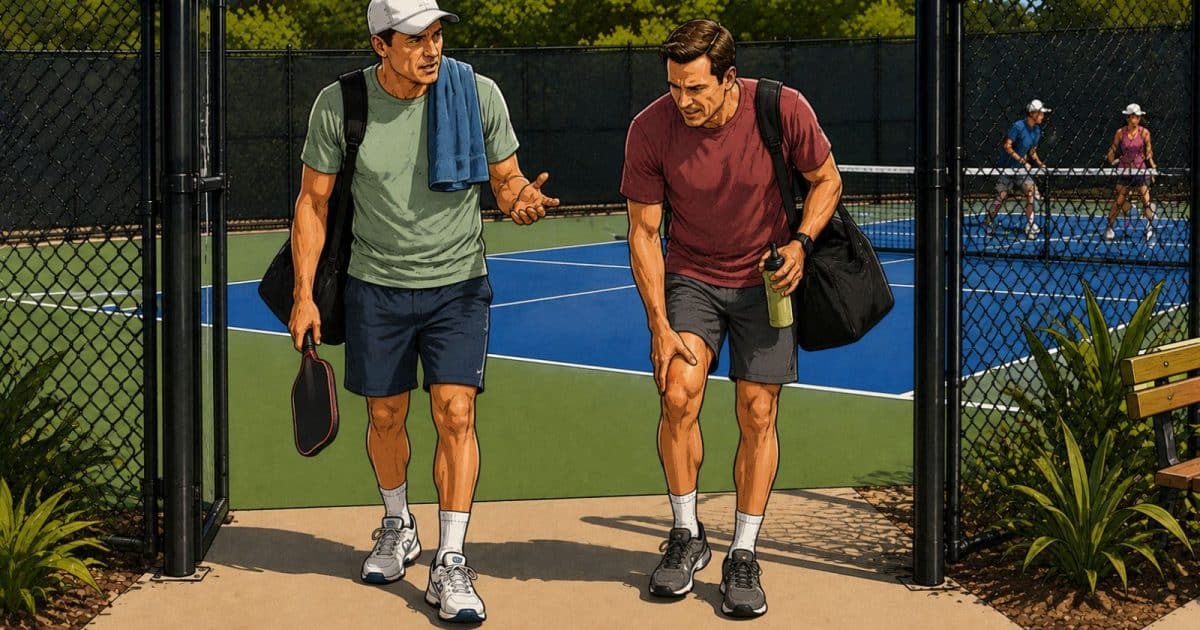
What pickleball can do is reveal a knee issue that was already there. A player who has not moved laterally in years can feel pain in the first few weeks and assume the sport caused damage. Often it is deconditioning meeting an unfamiliar demand rather than a new injury.
That distinction changes the response. Deconditioning is answered by building capacity gradually. Existing joint disease is answered by managing load and involving a clinician, which the guide to playing pickleball with bad knees covers in more detail.
How do you protect your knees?
Train the legs off the court, and stop backpedaling.
Strength and balance work protects the knee because it addresses the fall risk behind many pickleball injuries, rather than working on the joint directly. The guide to off-court workouts for pickleball players covers a routine built around that kind of training.
A few habits handle most of the rest:
- Turn and run for lobs, rather than backpedaling. This removes one of the more common ways players lose their balance.
- Warm up before playing with five to ten minutes of dynamic movement rather than static stretching, covered in the guide to dynamic stretches for pickleball.
- Stop when fatigued. Mayo Clinic’s prevention advice centers on conditioning and form, and tired legs are where both tend to break down first.
- Wear court shoes, not running shoes. Running shoes are built for forward motion and offer little lateral support, as the comparison of pickleball shoes and tennis shoes explains.
A brace can help a player manage existing instability, and it does nothing to protect a healthy knee on its own, which the guide to knee braces for pickleball covers in more detail. Anyone with a diagnosed knee condition, a previous surgery, or knee pain that lasts beyond a couple of sessions should talk to a clinician before adding more volume, since risk changes with age and history. Players sorting out lower back soreness alongside knee concerns can also check the guide to whether pickleball is bad for your back.
FAQ
Is pickleball bad for your knees? Not inherently. AAOS OrthoInfo recommends exercise, including lower-impact activity, for people managing knee arthritis, and pickleball’s smaller court makes it gentler than a full tennis court. Risk concentrates in falls and sudden direction changes rather than gradual wear.
What causes most knee injuries in pickleball? Falls and overuse in players who have not conditioned their bodies for the sport, according to Mayo Clinic Sports Medicine. Backpedaling for a lob, reaching wide for a ball, and lunging into a dink are the movements most likely to load the knee while balance is already compromised.
Is pickleball harder on the knees than tennis? AAOS OrthoInfo groups tennis with jogging as a higher-impact activity for an arthritic knee. Pickleball’s smaller court and shorter points generally mean less total impact, though the joint still absorbs load on every stop and direction change.
Can pickleball cause arthritis? There is no evidence that recreational pickleball wears out a healthy knee. AAOS OrthoInfo recommends exercise, including lower-impact activity, as part of managing existing knee osteoarthritis rather than describing something that causes it.
Why do your knees hurt after playing? Often it is deconditioning meeting an unfamiliar lateral demand, especially in the first few weeks of play. Pain that lasts beyond a few sessions is worth a clinician’s opinion.
What matters most for protecting your knees? Stop backpedaling for lobs and turn to run instead. Pair that with the off-court strength and balance training Mayo Clinic lists as core injury prevention.
Do knee braces help? A brace can help a player manage existing instability. It does not protect a healthy knee on its own and is not a substitute for strength and balance work.
Should you play if you already have knee problems? Many players do, with modifications. AAOS OrthoInfo recommends lower-impact activity and balance-focused exercise for people managing knee osteoarthritis, but the right adjustment depends on the specific condition, so a clinician’s input matters first.
Want the movement taught properly instead of learned the hard way? The coaches listed in the Pickler Junction directory work on the footwork and balance that keep knees out of trouble, and a physical therapist or physician is the right call for pain that does not resolve on its own. This article is general information, not medical advice.
Written by the Pickler Junction Team.