How Many People Do You Need to Play Pickleball?
Quick Answer: Two players make a full singles match, and four make doubles, which is the sport’s default format under the USA Pickleball rulebook. Three players work well with skinny singles. Larger groups rotate through open play using a paddle queue. One person can still practice productively against a wall or a ball machine.
Doubles is the format built into most pickleball courts and clubs, and almost every question about player counts is really a question about what to do when the number is not four.
The standard formats
Two formats cover nearly every game you will find.
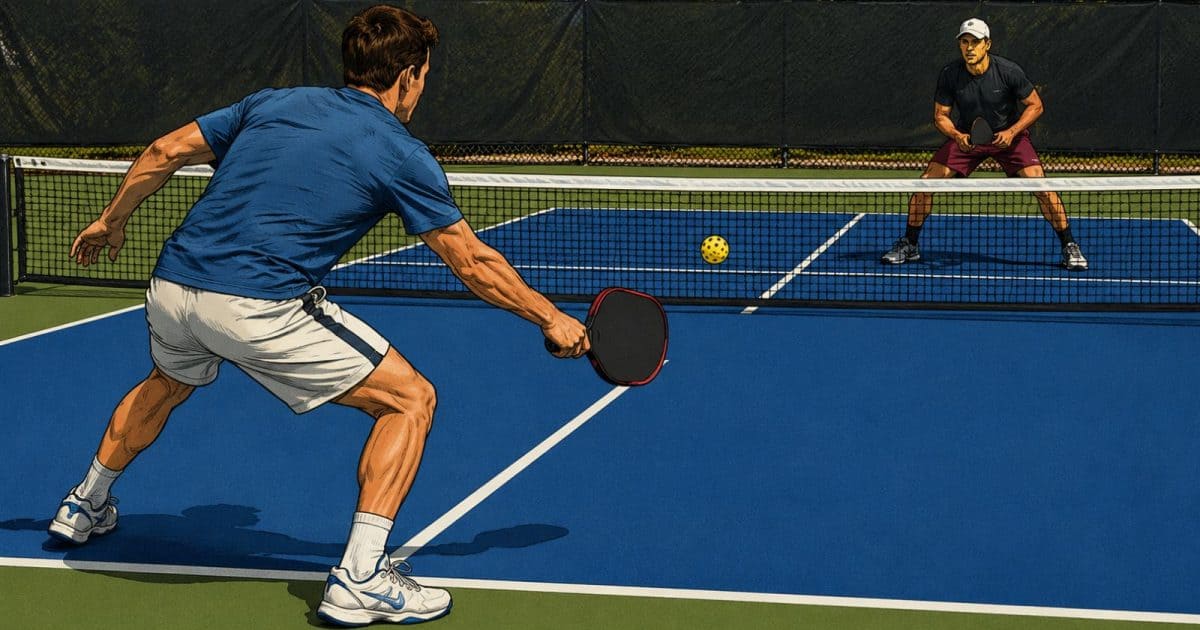
- Doubles: four players, two per side, used at recreational open play and in tournament events.
- Singles: two players, one per side, on the same court used for doubles.
Under the 2026 USA Pickleball rulebook, Section 3 sets the court at 20 feet wide by 44 feet long for both formats, so singles players cover the same ground with a partner. The two-bounce rule in Section 10.A works the same way in either format: the receiving side must let the serve bounce, and the serving side must let the return bounce before anyone volleys. Games are played to 11 points, win by 2, under Section 4, in both.
Score calling is where the formats split. Section 6 of the rulebook has singles call two numbers, the server’s score then the receiver’s score, while doubles calls three: the serving team’s score, the receiving team’s score, and which of the two partners is serving. That third number is why a doubles score sounds like “four, two, one” instead of a simple pair.
Everything else people play with an odd number, or an oversized group, is a variation built to solve an attendance problem, not a separate sport.
With only three players
Two options exist, and one is a real format rather than a workaround.
Skinny singles is the better fit. Two players use only half the court lengthwise, cross-court or straight ahead, so rallies stay realistic without excessive running. The rulebook lists a close cousin of this under Section 14, called Mini-Singles, where only the right or left side of the court is live for each rally. The full guide to skinny singles covers the scoring variations.
A three-player rotation is the other path: one player takes the singles side against a pair, or players swap in after each game. It keeps everyone moving, but it produces uneven competition since one side always outnumbers the other. The complete set of three-player arrangements is in how to play pickleball with three players.
For practice specifically, skinny singles suits three players better. It drills placement and footwork under real pressure, while a rotation mostly drills waiting for a turn.
How large groups play
On a rotation, off a paddle queue. That system is what makes open play work at almost any group size.
The mechanics are simple. Waiting players line their paddles up on a rack or a fence. When a court clears, the next four paddles form the game. Some sessions keep winners on the court, others rotate everyone off after one game, and knowing which convention a session uses is most of open play’s etiquette. The full system is explained in what is open play in pickleball.
Group size turns into a wait-time problem, not a rules problem, once a session runs past roughly eight players per court. Splitting players by skill level, or capping games at 11 points played straight through instead of stopping at win-by-2, keeps a queue moving. Pickleheads, the official court finder for USA Pickleball, is one way to locate an open play session near a given court. For a sense of the numbers behind that queue, how many people play pickleball in the US covers national participation.
Playing alone
Yes, productively, though not as a full game. Wall practice is the real solo option: dinks, volleys, and resets against a flat wall build touch and reaction speed that carry directly into kitchen-line play.
A ball machine expands the solo menu further, and serve practice needs nothing beyond a bucket of balls and an empty court. The specific routines are covered in can you practice pickleball by yourself.
What solo work cannot replace is decision-making against a live opponent who is trying to beat you. Pairing wall sessions with real matches, instead of swapping one for the other, is what actually moves a player’s game forward.
How the player count changes the rules
Barely. The court stays 20 by 44 feet under Section 3 no matter the format, the two-bounce rule in Section 10.A applies to every serve, and the non-volley zone stays 7 feet deep regardless of how many people are standing near it.
Two things do shift with format. Serving execution is governed by Section 7, and the score-calling format in Section 6 reflects who is serving: two numbers in singles, three in doubles, as covered above. Games still finish at 11 points win by 2 under Section 4 in either format, and tournament matches can also run to 15 or 21 points under the scoring options in Section 15, always win by 2.
Skinny singles and other half-court variants sit outside the official rulebook, so their scoring is whatever the players agree on before the first serve. Settling that detail before starting, rather than mid-game, prevents most disputes at open play, which matters more there than deep rules knowledge does.
FAQ
How many people do you need to play pickleball? Two for singles, four for doubles. Under the rulebook, both are official formats played on the same court size.
Can you play pickleball with three people? Yes. Skinny singles, using half the court lengthwise, suits three players better. A three-player rotation also works and is more social than instructive.
Can you play pickleball with two people? Yes, that is singles. Same 20 by 44 foot court under the rulebook, same two-bounce rule, and considerably more running than doubles.
Can you play pickleball alone? Not as a full game, but wall practice, serve practice, and ball machine drills are all productive solo sessions.
How many people can play on one court at open play? Four at a time, with everyone else rotating through a paddle queue. Past about eight players per court, waits get long enough to justify splitting into more sessions.
Does the court change size for singles? No. Section 3 keeps it at 20 by 44 feet for both formats, which is part of why singles is more demanding physically.
Do the rules change with the number of players? Only serving and score calling. Under the rulebook, the two-bounce rule, the non-volley zone, and the win-by-2 target in Section 4 stay the same across formats.
What is the best format for an odd number of players? Skinny singles for three, close to the Mini-Singles format in Section 14. For five or more, a paddle-queue rotation keeps everyone playing on a regular cycle.
Finding four consistent partners, or even three, is often harder than learning any rule in this article. A pickleball coach can turn a beginner into a reliable fourth for doubles faster than trial and error at open play, and can also build a solo wall session into a structured practice plan. Once the group is set, what score do you need to win in pickleball covers how a game actually ends.
Written by the Pickler Junction Team.