Can You Hit the Ball Twice in Pickleball?
Quick Answer: Yes, sometimes. Under the 2026 USA Pickleball rulebook, Rule 10.D allows a double hit when the stroke stays continuous, moves in a single direction, and comes off one player’s paddle. The rule does not ask whether the second contact was on purpose. Break either condition, or let two players touch the ball, and it is a fault.
A double hit is exactly what it sounds like: the ball contacts the paddle more than once on the same shot. Newer players often assume any repeated contact loses the rally. The rulebook is more forgiving than that, and the conditions are worth knowing before the next argument at the kitchen line.
What makes a double hit legal?
A double hit is legal when it meets the test in Rule 10.D: the stroke has to stay continuous and travel in a single direction, and both contacts have to come off the same player’s paddle.
- Continuous stroke. The paddle moves through the shot without stopping or restarting between the two contacts.
- Single direction. The paddle travels one way through the swing. A stroke that changes direction between contacts fails the test.
- One player. Both contacts land on the same paddle.
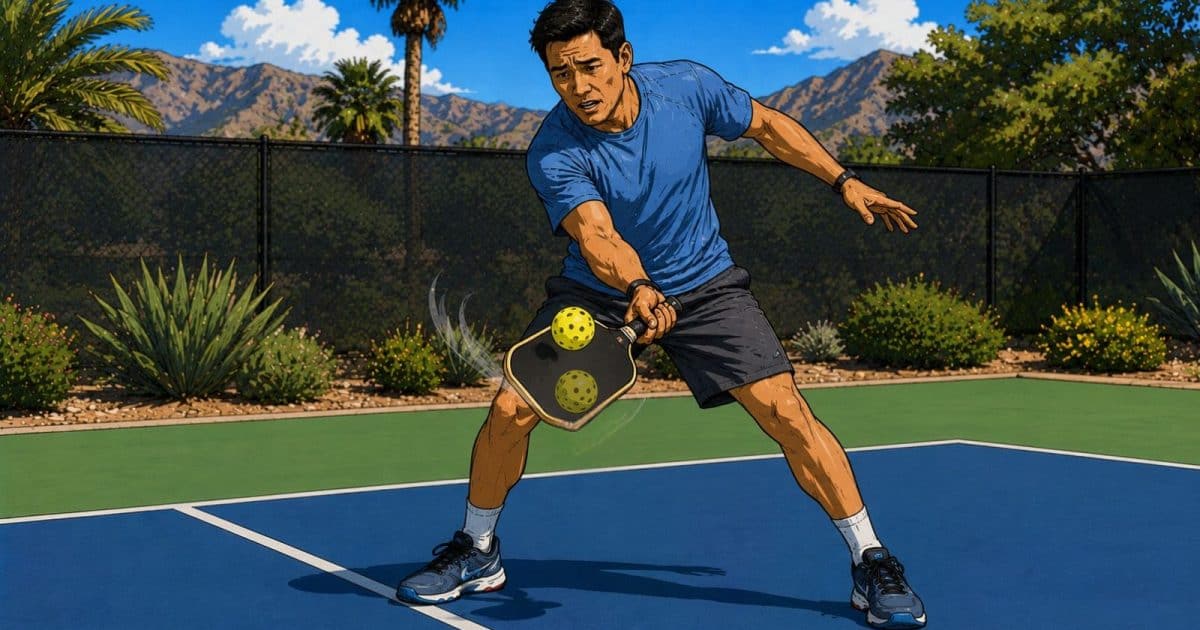
Rule 10.D.1 calls it a fault when a player hits the ball more than once using a stroke that is not continuous and single-direction. Meet the test and play continues as though nothing happened. The rule judges the shape of the stroke, not the player’s intent, so a legal double hit does not have to be an accident to count. The most common version shows up in fast hands exchanges at the net, where a ball catches the paddle face and then the edge guard inside one defensive block.
When does a double hit become a fault?
The moment the stroke stops being continuous and single-direction. Three patterns show up often in recreational play.
A stroke that stops and restarts fails Rule 10.D even if the pause lasts a fraction of a second, because the motion is no longer continuous. A swing that reverses direction between the two contacts fails the same test.
The third pattern is the partner double, and it is the one recreational players miss most. Rule 10.D.2 makes it a fault whenever a player and a partner both contact the ball on the same return, no matter how accidental the sequence looked. Scrambles in the middle of the court produce this constantly, and the rule carries no exception for it.
Faults follow similar logic across the rulebook. The guide to what counts as a fault in pickleball puts the double hit alongside its relatives.
How is a double hit different from a carry?
They are separate rules that get confused often, because both involve extra contact with the ball.
A double hit is two or more distinct contacts, governed by Rule 10.D. A carry is one prolonged contact, defined in Section 2 as hitting the ball so that it does not bounce away from the paddle but rides along the face instead. The double hit has the continuous, single-direction exception described above. A carry does not: it is a fault regardless of how it happened. The guide to what a carry is in pickleball covers that rule on its own terms.
The practical difference on court is sound. Repeated contacts in a legal double hit produce two quick, distinct taps. A carry produces one longer, mushy contact with no clean pop.
Who calls a double hit in recreational play?
The player who committed it, in almost every case, because that player is the only one who can feel it.
Referees make the call in officiated matches. Recreational play runs on self-officiating, and a repeated contact is often obvious from inside the shot and invisible from across the net. Calling your own double hit is the norm on courts that stay pleasant to play on.
Hesitation is the usual cost of not knowing the rule. A player feels two contacts, is unsure whether the stroke stayed continuous, and freezes mid-point. The safer habit is to keep playing and settle the call after the rally ends. Stopping mid-rally on a guess gives up the point either way.
Does a double hit off the paddle edge count?
Yes. Rule 3.D.2 counts the edge guard and butt cap as part of the paddle for the 24-inch combined length-and-width limit, and the same logic carries over here: a ball that catches the face and then the edge has touched the paddle twice. Whether that sequence is legal still comes down to the continuous, single-direction, one-player test in Rule 10.D, not where on the paddle the contacts landed.
The frame and handle count the same way. What does not count as paddle contact is anything touching your hand above the wrist, your body, or your clothing, all faults on their own terms. The guide to can the ball hit your body in pickleball covers those separately, and the fundamentals underneath all of this live in the guide to the five basic rules of pickleball.
None of this is worth overthinking mid-point. The habit that pays is a clean, committed swing in one direction, because that is exactly the stroke Rule 10.D was written to protect.
FAQ
Can you hit the ball twice in pickleball? Yes. Rule 10.D allows a double hit when the stroke stays continuous, moves in a single direction, and comes off one player’s paddle. Break any of those terms and it is a fault.
Is a double hit always a fault? No. Legal double hits happen often in fast net exchanges. Only a stopped, restarted, or direction-changing stroke, or a second player’s paddle, turns it into a fault under Rule 10.D.
What if the ball hits my paddle and then my partner’s? That is always a fault under Rule 10.D.2. The one-player condition has no exception, no matter how accidental the sequence was.
Does hitting the edge guard count as a double hit? Yes. Rule 3.D.2 counts the edge guard and butt cap as part of the paddle, so a face-then-edge sequence is two contacts. Legality still depends on whether the stroke stayed continuous and single-direction, not on where the contacts landed.
Who calls a double hit in rec play? The player who hit it. A repeated contact is obvious from inside the shot and usually invisible across the net, so self-calling is the norm.
Is a double hit the same as a carry? No. A double hit is two or more contacts and can be legal under Rule 10.D. A carry is one prolonged contact along the paddle face, defined in Section 2, and it is always a fault.
Does the direction of the swing matter? Yes. Rule 10.D requires the paddle to travel one way through the whole stroke. A swing that reverses course between the two contacts fails the test.
Should I stop playing if I feel a double hit? Keep playing and resolve the call after the rally ends. Stopping mid-rally on an uncertain call gives up the point regardless of the answer.
Want the rest of the rulebook to feel this settled? The pickleball coaches in the Pickler Junction directory walk through calls like this one on court, not just on paper.
Written by the Pickler Junction Team.