What Is a Pickleball Simulator?
Quick Answer: A pickleball simulator is an interactive setup where you hit a real ball with a real paddle at a projected or LED screen that tracks the shot and responds. It is used for solo training, games and social play, and it fits in venues that do not have room for a full court.
Think golf simulator, adapted. The equipment is real, the opponent is not.
How does a pickleball simulator work?
Sensors track your ball, software decides what happens next, and a screen shows it.
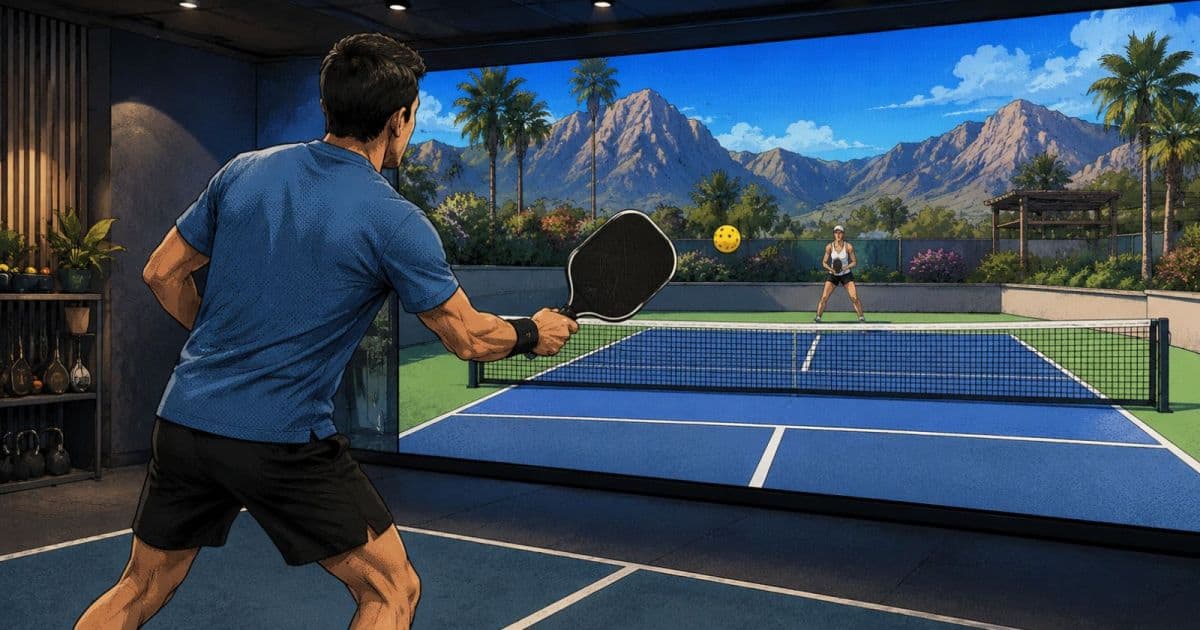
Systems use projection mapping or high resolution LED walls combined with ball tracking. You hit toward the wall, the system registers where and how hard the ball struck, and the display reacts. Some setups run target games where zones light up. Others simulate a returning ball so you can rally against the wall.
Because the technology reads the ball rather than your body, you use your own paddle and standard balls. Nothing about your stroke needs to change.
What can you actually do on one?
More than drill, less than play a real match.
- Target practice. Aim at lit zones to work on serve placement, dink depth or drive accuracy.
- Skills challenges. Commercial systems ship with libraries of challenges. One vendor advertises 30 arenas and 23 challenges.
- Solo rallying. Play against a responsive wall when you have no partner.
- Group games. Scored, arcade style formats designed for parties and corporate events rather than serious training.
- Warm up. A quick way to get your hands going before you step onto a real court.
Where do you find them?
Mostly in venues that already sell entertainment rather than pure court time.
Simulators show up in pickleball entertainment centers, indoor clubs with spare square footage, fitness studios, country clubs, resorts and corporate event spaces. The appeal to operators is straightforward. A simulator occupies a fraction of the footprint of a 20 by 44 foot court plus run off, and it can be booked in short paid sessions.
Our guide to what a pickleball entertainment center is explains the venue category, and what a pickleball lounge is covers the more social end of it.
What does it cost to play?
Priced like a bay, not like a court.
Venues generally sell simulator time in blocks, similar to how golf simulators are sold, with peak and off peak rates and membership options. For comparison, indoor court play at clubs commonly runs in the range of 14 dollars for a two hour session off peak and closer to 18 dollars at prime time, while simulator bays tend to be priced by the hour and split between a group.
Prices vary widely by market, so treat any figure as a starting point and call ahead.
Will a simulator make you better?
At specific, isolated skills, yes. At playing pickleball, only partly.
Repetition against targets genuinely improves placement, and getting hundreds of contacts in twenty minutes is more than a rec session usually gives you. What a simulator cannot teach is reading an opponent, partner communication, court positioning under pressure, or the timing of a real hands battle.
Treat it the way you would treat a ball machine. Excellent for grooving a stroke, useless for learning when to use it. Our guide to practicing pickleball by yourself covers the other solo options.
An hour on a simulator can sharpen serve placement. What it cannot rehearse is the pressure of a real match, which is the part most players actually want to practise.
Who are simulators best for?
Players with limited court access, and groups who are not really there to train.
If you live somewhere with harsh winters or few indoor courts, a simulator is a real answer to the off season. If you are organizing a birthday party or a corporate outing, it is a lower barrier version of the sport that beginners can enjoy in minutes. Serious competitive players will still need court time.
Are they the same as a training wall?
No, though the family resemblance is obvious.
A plain rebound wall gives you a physical return with no scoring and no feedback. A simulator adds tracking, targets, scoring and difficulty settings. The wall is cheaper and always available. The simulator tells you where the ball actually went, which is the part players usually guess at.
Frequently asked questions
What is a pickleball simulator? An interactive system that tracks a real ball hit at a projected or LED screen and responds with games, targets and scoring.
Do you use a real paddle and ball? Yes. Simulators are built around standard equipment, which is what separates them from video games.
Where can I find one? Entertainment centers, indoor pickleball clubs, some fitness studios, country clubs and resorts. Availability is still uneven by region.
How much does it cost? Typically sold in timed blocks like a golf bay, with peak and off peak pricing. Rates vary widely by market.
Is it good for beginners? Very. There is no partner to disappoint and no score to keep, which lowers the barrier considerably.
Can it replace court time? No. It builds isolated skills but cannot teach positioning, partner play or live decision making.
Do I need a membership? Some venues require one, many sell walk up sessions. Call before you drive.
A simulator is a training tool and a social draw, not a substitute for a court. To find a venue with simulators or indoor courts near you, browse our pickleball entertainment centers directory.
Written by the Pickler Junction Team.