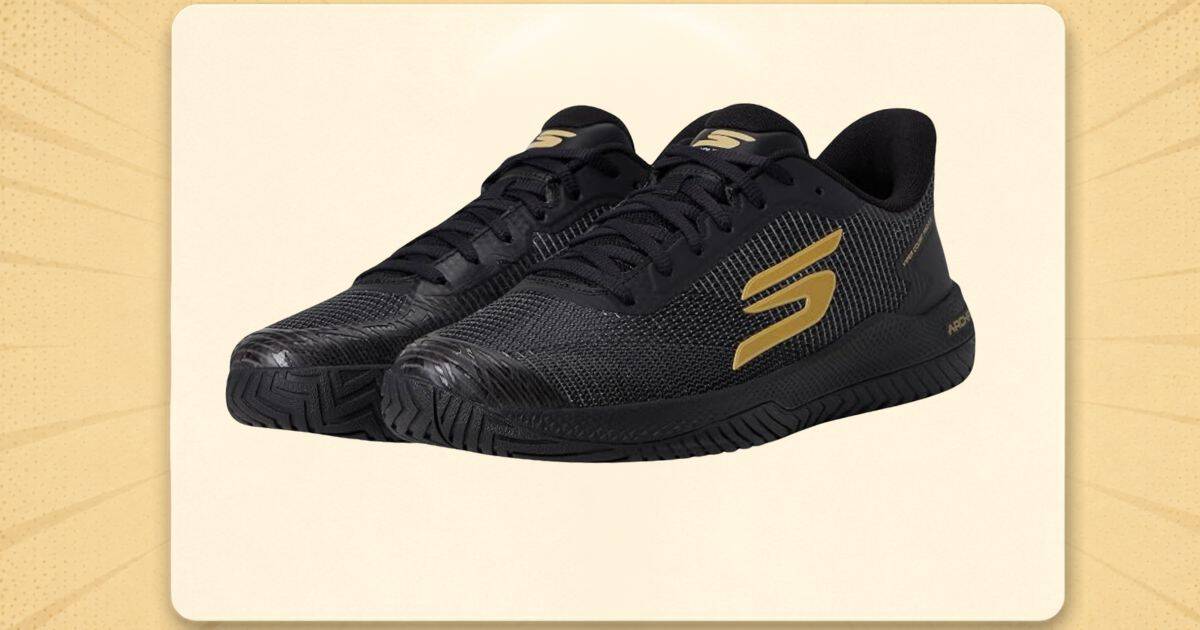
Skechers Men’s Viper Court Pro 2.0 Pickleball Shoe Review
JUNCTION SCORE 4.3 / 5
★★★★★ 4.3
Review Score: 4.3 / 5 based on 977 verified ratings (Amazon 623; Skechers 281; Pickleball Central 73)
Community Score: Well Regarded, based on Reddit and community threads
A durable, arch-supportive court shoe built for players who prioritize foot health and outsole longevity over raw speed; the main catch is a firm, heavy ride that speed-focused players may find limiting.
Best for: Wide or flat-footed players, those managing plantar fasciitis, and anyone who wants a shoe that lasts through hundreds of hours of court time.
Skip if: You have narrow feet, prioritize a lightweight feel, or need maximum bounce underfoot.
Price: $115.00
The Review
Yes, for the right player. The Viper Court Pro 2.0 is a low-top, lace-up men’s pickleball court shoe built around a podiatrist-certified Arch Fit insole, an ULTRA GO foam midsole, and a Goodyear Gold compound rubber outsole designed for exceptional tread life and multi-directional traction. The 2.0 update introduced a stiffer redesigned mesh upper over the original Pro, adding lateral lockdown without sacrificing breathability. See detailed review below.
What Reviewers Like
Arch support that stands apart from the field. The Arch Fit insole system is the most consistently praised feature across every source that reviewed this shoe. The removable EVA insole carries the American Podiatric Medical Association Seal of Acceptance and was developed using 20 years of data and 120,000 unweighted foot scans, according to Skechers’ own specifications. Players who have dealt with plantar fasciitis, flat feet, or wide feet describe the support as genuinely therapeutic rather than cosmetic, and the removable design means those who rely on custom orthotics can swap them in without issue.
Outsole durability that justifies the price tag on its own. The Goodyear Gold compound rubber outsole is the shoe’s other signature feature, and tread life measures 110 to 130 hours of high-intensity play in published testing before meaningful wear sets in. That figure comes from extended on-court use on coarse court surfaces, and it places the Viper Court Pro 2.0 in a category of its own for players who burn through shoes quickly. Retailers and reviewers alike highlight the Goodyear licensing as a meaningful durability differentiator, not just a marketing badge.
Genuine lateral lockdown from the redesigned upper. The Pro 2.0 update’s most important structural change is a stiffer mesh upper that provides real lateral stability during hard cuts and direction changes. This is not the soft, forgiving feel of a lifestyle sneaker repurposed for court use; buyers describe a planted, controlled sensation that holds the foot in place during aggressive lateral movement. The internal heel counter, TPU shank, and outrigger work together with the upper to create a stability platform that players who have switched from softer shoes notice immediately.
A roomy fit that works exceptionally well for wide and flat feet. The Relaxed Fit construction gives the toe box and forefoot noticeably more room than a standard court shoe last. For players who have historically struggled to find a court shoe that does not compress the forefoot, this is a meaningful comfort advantage. The wide and extra-wide width options extend that benefit further, and reviewers confirm the shoe is available in standard, wide, and extra-wide variants across most sizes in the men’s range.
Breathable construction that holds up across sessions. The mesh upper with synthetic overlays and a rubber toe guard keeps airflow moving while protecting the most abrasion-prone area of the shoe from toe-drag wear. Retailers and buyers consistently note that the breathability does not degrade noticeably even on coarse or demanding court surfaces, and the toe guard addresses the single most common failure point in mesh court shoes without adding significant weight or stiffness to the forefoot.
Reported Limitations
Weight and midsole firmness are the primary trade-offs. At approximately 13 to 13.4 ounces depending on size, the Viper Court Pro 2.0 sits on the heavier end of the court shoe spectrum, and the dense ULTRA GO foam midsole compounds that sensation. Players who have tested the shoe on court describe the ride as firm and planted rather than springy or responsive, and note that the mass rides low in a way that makes the shoe feel heavier in motion than the number alone suggests. For players who prioritize cushioning bounce or a light, quick feel, this is a genuine and consistent limitation, not a minor quibble.
Grip on dusty or damp outdoor surfaces has real limits. The Goodyear compound outsole performs exceptionally on clean indoor courts and well-maintained outdoor surfaces, but players who have tested it on dusty or damp outdoor courts report a noticeable grip compromise compared to shoes using herringbone carbon-rubber outsoles. The Diadem Court Burst, which uses that alternative construction, is specifically cited as a stronger option for players who primarily play on outdoor courts where surface conditions vary. This is a meaningful consideration for anyone whose home courts are not consistently clean.
The Relaxed Fit last does not suit narrow feet. The same roomy toe box that makes this shoe excellent for wide and flat feet creates a fit problem for players with narrow feet. Even after sizing down, people with slim feet describe the foot sliding laterally inside the shoe during hard cuts, which undermines the lateral stability the upper is designed to provide. Fit is critical to how this shoe performs, and the Relaxed Fit last is simply not the right geometry for a narrow foot regardless of lacing technique.
A break-in period is part of the experience. The stiffer upper and dense midsole mean the shoe does not feel its best out of the box. Players who have worn it through initial sessions report a settling-in period of roughly three to five hours before the materials conform and the shoe reaches its optimal feel. This is not unusual for a stability-focused court shoe, but buyers expecting immediate comfort should plan for it.
How Reviewers Compare It to Rivals
Against the Diadem Court Burst. The Viper Court Pro 2.0 holds a clear advantage in arch support, tread life, and lateral stability platform, making it the stronger choice for players managing foot health concerns or playing on well-maintained surfaces. The Court Burst, however, uses a herringbone carbon-rubber outsole that delivers better grip on dusty and damp outdoor courts, which is a real performance edge for players whose courts are not consistently clean. The choice between them largely comes down to surface conditions and whether arch support or outdoor grip is the higher priority.
Against the SQAIRZ XRZ2. The XRZ2 offers a roomy square toe box and solid lateral lockdown, and buyers who prioritize a speed-first feel describe it as a lighter, more agile option. The trade-off is outsole longevity: the XRZ2’s softer outsole compound does not match the Goodyear rubber’s tread life, making the Viper Court Pro 2.0 the better long-term value for players who log heavy court hours. The XRZ2 is the stronger pick for players who want to move fast and replace shoes more frequently.
Against the Selkirk CourtStrike. The CourtStrike is described as a leaner option better suited to narrow-footed or speed-first players, and it carries a six-month outsole warranty that the Viper Court Pro 2.0 does not match with any published guarantee. The Skechers shoe counters with superior arch support and the Goodyear outsole’s documented durability, which may outlast the warranty period in practice. Players with narrow feet or a preference for a slimmer fit profile are better served by the CourtStrike.
Against the PB5Star Court2. At approximately 12.9 ounces, the Court2 is lighter than the Viper Court Pro 2.0 while still offering real arch support, making it a credible alternative for players who want foot health benefits without the heavier ride. The Viper Court Pro 2.0 retains its edge in outsole durability and the depth of its Arch Fit system, but players for whom weight is a primary concern have a legitimate reason to consider the Court2 instead.
Who Is the Skechers Men’s Viper Court Pro 2.0 Best For?
The Viper Court Pro 2.0 is built for players who spend significant time on court and need a shoe that supports foot health over the long haul. It is the strongest option in its category for anyone managing plantar fasciitis, flat feet, or wide feet, and its outsole longevity makes it a genuine value proposition for players who have historically burned through court shoes in a few months. The stability platform suits players who make aggressive lateral movements and want a shoe that holds position rather than flexing underfoot, and the wide and extra-wide width options mean it accommodates foot shapes that most court shoes ignore.
Players with narrow feet, those who prioritize a lightweight and springy feel, or those whose primary courts are dusty or damp outdoor surfaces will find the shoe’s trade-offs meaningful enough to look elsewhere. The Relaxed Fit last is not adjustable by lacing alone, and the firm midsole is a design choice rather than a defect, meaning players who want bounce underfoot will not find it here regardless of break-in time.
Buy it if you:
- Have wide, flat, or high-arch feet and need genuine podiatrist-backed support
- Log heavy court hours and want an outsole that lasts 110 to 130 hours of high-intensity play
- Play primarily on clean indoor or well-maintained outdoor courts
- Use custom orthotics and need a removable insole to accommodate them
Skip it if you:
- Have narrow feet and find roomy lasts create instability on hard cuts
- Prioritize a lightweight, springy feel over stability and durability
- Play primarily on dusty or damp outdoor courts where herringbone outsoles grip better
- Want immediate out-of-the-box comfort without a break-in period
At a Glance
| Spec | Detail |
| Price | $115.00 (MSRP) |
| Weight | 13 oz (Size 9); approximately 13.4 oz (Size 11) |
| Upper Material | Breathable mesh with synthetic overlays; rubber toe guard |
| Insole | Arch Fit EVA insole system; removable; podiatrist-certified |
| Midsole | ULTRA GO foam |
| Outsole | Goodyear Gold compound rubber; multi-directional traction |
| Heel Height | 1.25 inch |
| Fit Type | Relaxed Fit; roomy toe box and forefoot |
| Shoe Height | Low (low-top) |
| Closure | Lace-up |
| Width Options | Standard, Wide, Extra Wide |
| Size Range | Men’s 7 to 13 (including half sizes) |
| Court Type | Indoor and outdoor |
| Certifications | APMA Seal of Acceptance; APP Tour, USA Pickleball, and Major League Pickleball recognized |
| Style Number | 246109 |
| Review Score | 4.3 / 5 based on 977 verified ratings (Amazon 623; Skechers 281; Pickleball Central 73) |
| Community Sentiment | Well Regarded |
The Verdict
Yes, at $115.00 MSRP, the Viper Court Pro 2.0 earns its price for the right buyer. The combination of a podiatrist-certified Arch Fit insole, a Goodyear Gold outsole rated for 110 to 130 hours of high-intensity play, and a stability platform that includes an internal heel counter, TPU shank, and outrigger represents a genuinely premium construction. Players who have tested the shoe through extended court sessions consistently describe the arch support as best-in-category, and the outsole longevity alone makes the per-hour cost of ownership lower than most competing shoes at similar or lower price points.
The honest caveats are real, however. The firm ULTRA GO midsole prioritizes stability over cushioning bounce, and players who want a springy, impact-absorbing ride will not find it here. The shoe’s weight, at 13 to 13.4 ounces depending on size, is on the heavier end of the court shoe market, and that mass plays heavier in motion than the number suggests. Players who primarily play on dusty or damp outdoor courts will also find that the Goodyear compound gives up grip in those conditions compared to herringbone carbon-rubber alternatives.
The decision framework is straightforward. Players managing foot health concerns, those who play frequently enough to care about outsole longevity, and those with wide or flat feet are getting genuine value at $115.00. Players who prioritize speed, a light feel, or outdoor grip performance should weigh those trade-offs carefully before committing, because the shoe’s design choices are intentional and not addressable through lacing or insole swaps.
For the player this shoe is built for, it is one of the most defensible purchases in pickleball footwear. The arch support is real, the outsole lasts, and the stability platform holds up under aggressive lateral play. Buy it if those priorities match yours, and look elsewhere only if the weight or midsole firmness is a dealbreaker for your style of play.
Frequently Asked Questions
Is it good for beginners?
Yes, with one caveat. The Viper Court Pro 2.0 suits beginners who are already aware of foot health concerns such as plantar fasciitis or flat feet, and who want a shoe that will last through the learning curve without wearing out quickly. The roomy Relaxed Fit toe box and podiatrist-certified arch support make it forgiving for players still developing their movement patterns. The break-in period of roughly three to five hours and the firm midsole may feel unfamiliar at first, but neither is a barrier for a new player building court time gradually.
How does it compare to the Viper Court Elite 2.0?
The Elite 2.0 is Skechers’ slip-on variant in the same line, priced at $125 and weighing approximately 15 ounces, making it heavier than the Pro 2.0. It uses Eco Flight cushioning rather than the ULTRA GO foam in the Pro 2.0. Players who want the convenience of a step-in design may prefer the Elite 2.0, but those who prioritize a lighter shoe and a secure lace-up fit will find the Pro 2.0 the stronger performance choice. The Pro 2.0 is the primary recommendation for competitive play.
Are there durability problems?
No recurring durability complaints appear in the sources reviewed. The Goodyear Gold outsole is specifically highlighted for its longevity, with players who have tested it on coarse court surfaces reporting tread life in the 110 to 130 hour range before meaningful wear. The rubber toe guard protects the mesh upper from the toe-drag abrasion that commonly degrades court shoes. The stiffer Pro 2.0 upper is described as more durable than the original Pro version without sacrificing breathability.
Does it work for players with plantar fasciitis or flat feet?
Yes, and this is arguably the shoe’s strongest use case. The Arch Fit insole system is podiatrist-certified and carries the APMA Seal of Acceptance, developed from 20 years of data and 120,000 unweighted foot scans according to manufacturer specifications. Buyers who have dealt with plantar fasciitis describe the arch support as genuinely effective rather than superficial, and the removable insole allows players who use prescription orthotics to swap them in without modification.
What is the sizing like, and does it run true to size?
Sizing depends significantly on foot width. Players with standard or wide feet find the shoe runs true to size, and the wide and extra-wide options extend the fit range further. Players with narrow feet, however, find the Relaxed Fit last too roomy even after sizing down half a size, which can cause the foot to slide laterally during hard cuts. Getting the fit right is critical to how the shoe performs, and narrow-footed players should try the shoe before committing or consider a different model entirely.
How does it perform on outdoor courts?
Performance on outdoor courts depends on surface conditions. On clean, well-maintained outdoor courts, the Goodyear compound outsole delivers solid multi-directional traction and exceptional durability. On dusty or damp outdoor surfaces, however, players who have tested it report a noticeable grip reduction compared to shoes using herringbone carbon-rubber outsoles. The shoe is classified as an outdoor court shoe by retailers, but players whose primary courts are consistently dusty or wet should weigh that grip trade-off carefully.
Is there a break-in period?
Yes. The stiffer upper and dense midsole mean the shoe requires approximately three to five hours of court time before it settles into its optimal feel. This is consistent with stability-focused court shoes that use firmer materials for lateral lockdown. Players who try the shoe for the first time and find it stiff or slightly uncomfortable should give it several sessions before drawing conclusions about long-term fit and feel.
| Written by The PJ Review Team. AI-assisted, human-verified research and analysis. |
| Sources: Skechers.com (manufacturer product page, 281 ratings, specifications and features); Amazon (product listing, 623 ratings); Pickleball Central (product listing, 73 ratings, specifications); Pickleball Galaxy (product listing, customer reviews); Matt’s Pickleball (editorial review, on-court testing and comparative analysis); JustPaddles (editorial blog, brand and model context). |
| Aggregated from publicly available ratings, reviews, and measurements from the sources listed above, plus qualitative community discussion on Reddit r/Pickleball. Scores and sentiment reflect data available at the time of publication and may change. |
| No brand paid for, sponsored, or influenced this review. The sources cited are independent and are not affiliated with or endorsing Pickler Junction. |
Still narrowing down your next pair of court shoes? Browse every category in the Pickler Junction gear directory. Pickler Junction may earn a commission if you purchase through links in our directory.