What 6 Studies Say About Pickleball and Mental Health
Quick Answer: A 2025 Frontiers in Psychology review found six studies on pickleball and mental health, covering 865 players. Together they link regular play to higher happiness, lower depression, and stronger social ties, especially among players over 50. All of it is observational data, so it points to an association, not proof that the game causes the mood.
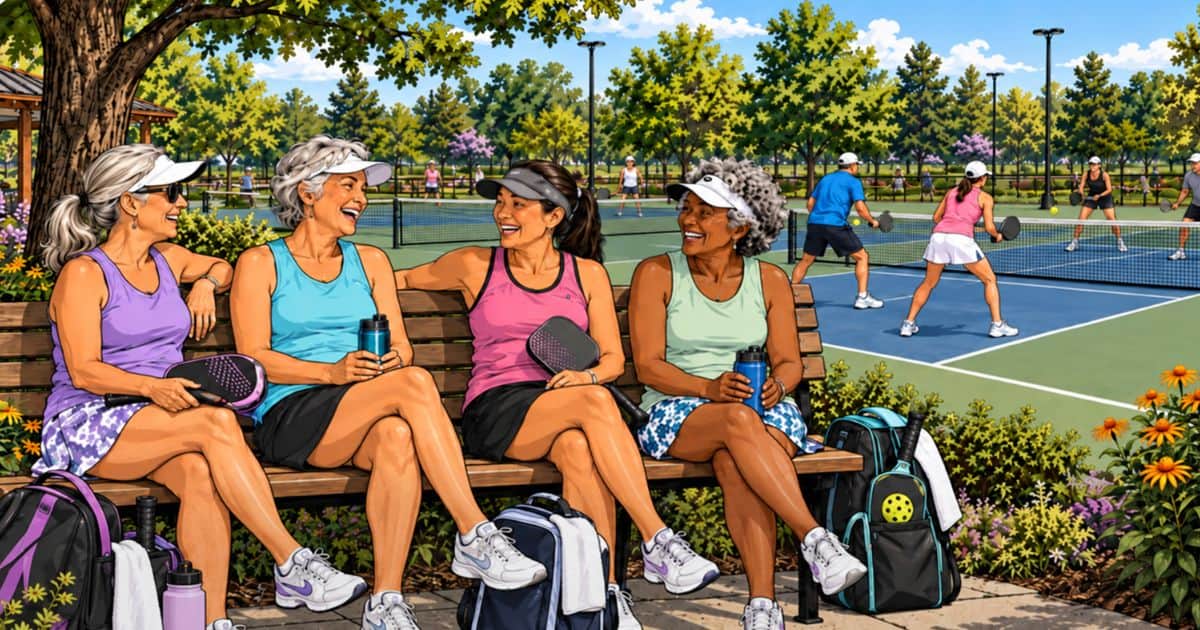
Tuesday night wraps up around eight. Someone brings orange slices, the group lingers by the cars longer than the actual games lasted, and the drive home feels lighter than the drive over did. Nothing about the scoreboard explains that. You spent ninety minutes hitting a plastic ball with people who wanted to be there, and somehow the whole week looks more manageable from here.
Plenty of players carry that same private theory: this game is doing something to mood that never shows up in the score. Researchers finally checked. Lena Lauxtermann and Brendon Stubbs, working out of the University of Vienna and King’s College London, published a systematic review titled “Padel, pickleball and wellbeing” in the journal Frontiers in Psychology on July 29, 2025. It is the closest thing yet to an answer for anyone who has wondered whether pickleball is good for mental health, or whether the good mood is just the sport’s marketing.
What the Review Actually Looked At
Lauxtermann and Stubbs screened 71 studies on padel and pickleball wellbeing and kept 14 that measured it directly, covering 1,403 players combined. Six of those fourteen were about pickleball, involving 865 players in total. Nearly all of those players were over 50, and the studies ran between 2018 and 2023, all conducted in the United States. That is a narrow slice of the sport, not a cross-section of everyone who plays, and it matters for how far the findings can be read.
A Modest but Real Happiness Link
The largest pickleball study in the review, led by Kim and colleagues in 2021, followed 208 competitive players and found a link between playing and general happiness, along with social capital measures such as trust, feeling safe, and feeling connected to the neighborhood. The correlation was 0.263, which is a modest but real link rather than a switch that flips the moment someone picks up a paddle. The same study tied playing to feeling more connected to the people nearby, not only to the three other people on the court, an idea the guide to why pickleball makes you happy explores in more depth.
Lower Depression Scores Among Committed Players
A separate 2018 study by Heo and colleagues followed 153 players and found that the more committed a player was to the sport as a serious hobby, the lower their depression score tended to be, a relationship the researchers reported at r = -0.23. Commitment here meant more than showing up occasionally. It meant treating pickleball the way people treat any serious hobby: investing time, building skill, and organizing part of the week around it.
Life Gets Better With Age, at Least on the Court
Two studies by Ryu and colleagues, one from 2018 with 153 players and one from 2022 with 250 players, both found that life satisfaction climbed with age among pickleball players, with the highest scores reported by players over 70. Women in the 2022 study reported stronger social integration than men did. Put together, the two studies suggest that whatever pickleball is doing for mood is not fading as players get older. If anything, it looks more useful the longer someone stays in the game, a pattern that lines up with what the guide to the benefits of pickleball for seniors has found elsewhere.
What Happened When the Games Stopped
The review’s most striking data point came from Casper and colleagues, who studied 36 seniors during the pandemic shutdowns of 2021. When play stopped, loneliness went up, mental health scores went down, and life satisfaction dropped. Eighty-nine percent of the group reported socializing less. Physical health scores, notably, did not change. The bodies stayed about the same. The mood did not. It is one of the clearest natural experiments in the review, because it captured what happens when the social habit disappears rather than only what happens while it is present. That same gap is why a related read on pickleball and loneliness exists on this site, looking at what fills the space when older adults lose regular group contact.
Fun, Not Fitness, Is Why People Show Up
A 2023 study by Riffee and colleagues asked 65 players why they play, and enjoyment ranked above physical health as the top reason given. That ordering matters. If fun is the primary draw and the mood benefits follow from showing up regularly, then anything that makes the game more enjoyable, like finding people to play with or joining a social league, may be doing as much for wellbeing as the exercise itself. Players are not gritting their way through pickleball for their health. They show up because it is fun, and the wellbeing numbers look like a byproduct of that.
Where Padel Fits In
The other half of the review looked at padel, a related racket sport more common in Europe. Those eight studies focused on competitive and elite players and measured things like anxiety and mental fatigue during matches, a different population asking a different question that does not carry over to recreational pickleball.
What the Research Can’t Tell You Yet
None of this proves that pickleball causes better mental health. All 14 studies in the review were observational, meaning researchers measured mood and playing habits at the same time rather than randomly assigning people to play or not play. None used a randomized design. Most relied on players filling out questionnaires about their own mood, which is useful but not the same as an outside measurement. Sample sizes were small, several under 100 players, and the pickleball research is almost entirely made up of players over 50, so it says little yet about younger players or beginners. The honest summary is association, not proof. Players who already feel good may simply be more likely to keep showing up, rather than showing up being what makes them feel good, and the review cannot fully untangle the two.
None of that makes the Tuesday group meaningless. It suggests where to put the effort. The studies keep pointing toward the social piece, the trust, the belonging, the standing appointment with people who show up, as the part doing the real work, not just the cardio. Protecting the group, not only the workout, may be the more useful takeaway from 865 players’ worth of data. Anyone noticing more than the ordinary ups and downs of mood, or finding that the lift from playing is not lasting the way it used to, can look for a local provider through the physicians and therapists directory. This article is general information, not medical advice.
Written by the Pickler Junction Team.