Indoor Pickleball Court Sizing: Dimensions, Ceiling Height and Setbacks
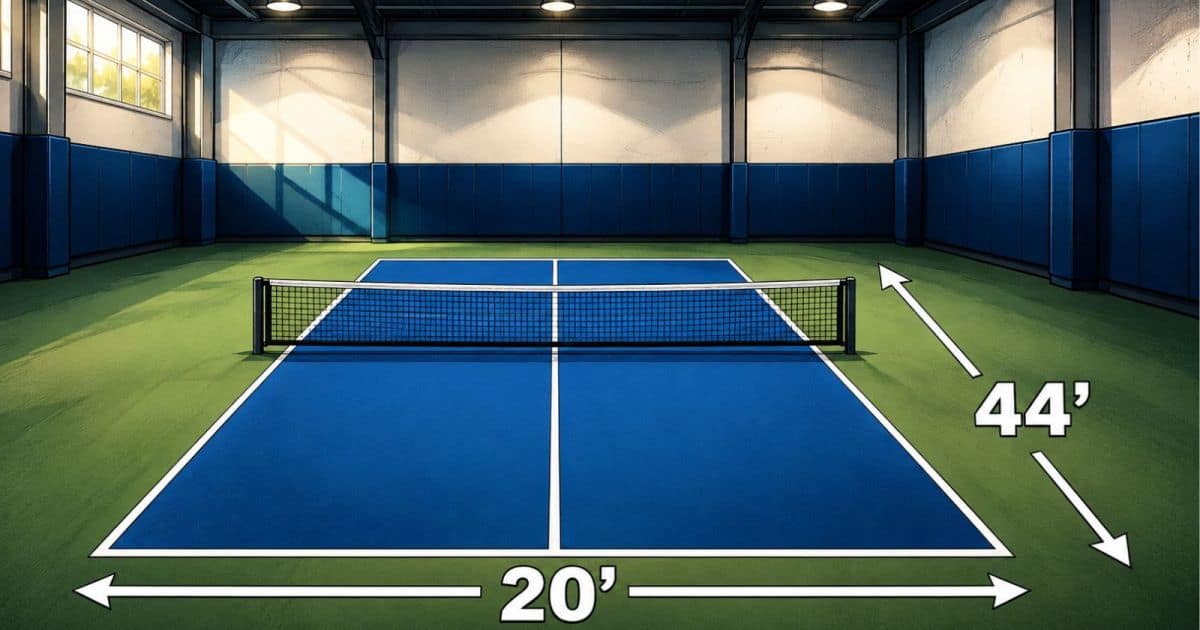
Quick Answer: Indoor pickleball courts use the same 20 foot by 44 foot playing area as any court, per the USA Pickleball rulebook. Plan a total floor footprint of at least 30 by 60 feet, with 34 by 64 feet preferred. Builders such as Miller Sports Construction recommend an 18 foot ceiling and 10 feet of clearance from walls.
Indoor court sizing is where facility plans go wrong, because the painted lines are the easy part. The space above and around the court is what decides whether the court actually plays well. Here is what to plan for, with the numbers behind each recommendation.
What size is an indoor pickleball court?
The playing area does not change indoors. Rule 3.A.1 of the 2026 USA Pickleball rulebook sets the court at 20 feet wide by 44 feet long, the same rectangle used outdoors. See Pickler Junction’s full guide to pickleball court dimensions for how those lines break down. What changes indoors is the floor space around that rectangle, since gyms and converted warehouses often have less room to give than an open outdoor pad.
Rule 3.A.3 of that same rulebook sets the surrounding footprint. The minimum playing surface is 30 feet by 60 feet, which works out to 1,800 square feet, because 30 times 60 equals 1,800. For new construction and tournament play, the rulebook lists 34 feet by 64 feet as the recommended size. That extra 4 feet of width and 4 feet of length, on top of the minimum, gives players more room to chase a wide shot without meeting a wall.
The floor footprint, in plain terms:
- Playing area: 20 feet wide by 44 feet long, set by Rule 3.A.1.
- Minimum total area: 30 by 60 feet per court, about 1,800 square feet, per Rule 3.A.3.
- Preferred total area: 34 by 64 feet for new construction or tournament play, per Rule 3.A.3.
- Buffer already built in: the 30-by-60-foot minimum leaves 5 feet at each side and 8 feet at each end beyond the 20-by-44 lines, since 30 minus 20 is 10 feet split evenly and 60 minus 44 is 16 feet split evenly. The 34-by-64-foot preferred size leaves 7 feet at each side and 10 feet at each end, the same way.
Keep walls, columns, and fixed equipment outside that 30-by-60-foot footprint at minimum. A court built hard against a wall is unsafe to play on and hard to sell to members.
How much ceiling height do you need?
No pickleball governing body publishes an official minimum ceiling height for indoor courts. USA Pickleball’s Construction and Maintenance Manual, produced with the American Sports Builders Association, includes a full chapter on indoor courts, but the specific figures sit inside that paid manual rather than on a free page. That gap is why the numbers below come from a builder, not a rulebook.
Miller Sports Construction, a racquet sports court builder, recommends an ideal ceiling height of at least 18 feet for indoor pickleball, with 20 feet or more preferred for competitive play. Ceiling height is the factor most often underestimated in a facility plan, and it cannot be fixed once the building is up. A low ceiling limits shot selection and frustrates any player who likes to lob.
What to check before signing a lease:
- Commonly asked for: at least 18 feet of clear height above the playing surface, per Miller Sports Construction’s guidance.
- Preferred: 20 feet or more, so players can hit a full arc on a lob without clipping the ceiling.
- Competitive or multi-use halls: more still, since tournament play brings higher, more aggressive lobs.
- Watch for obstructions: beams, ductwork, light fixtures, and basketball hoops all cut into usable height even when the ceiling deck itself is tall enough.
A lower ceiling does not rule out play, but it changes the game, since lobs turn into a much bigger weapon when the room cannot handle a full arc. Measure to the lowest obstruction in the space, not to the ceiling deck, before committing to a building.
What else matters for indoor sizing?
Wall clearance, court spacing, flooring, and lighting round out an indoor plan. Beyond the footprint and the ceiling, these factors decide whether an indoor court is genuinely safe and pleasant to play on.
Plan for these:
- Wall clearance: Miller Sports Construction recommends about 10 feet from the court to any wall where the building allows it, so a player chasing a wide ball has room to stop.
- Court spacing: at least 10 feet between adjacent courts in a multi-court hall, the same builder guidance used for wall clearance, since both problems come from the same run-off need.
- Flooring: options include hardwood, cushioned vinyl, or modular tile, each with a different effect on bounce, comfort, and long-term cost. A full cost breakdown, including flooring, is in Pickler Junction’s indoor pickleball court cost analysis.
- Lighting: even, low-glare lighting matters more indoors than out, since there is no daylight to fall back on. Pickler Junction’s complete guide to court lighting for night play covers fixture placement and light level targets.
- Ventilation and acoustics: worth planning early in gyms and converted warehouses, where hard surfaces bounce both sound and the ball in ways an open outdoor court never does.
A court construction contractor experienced with indoor builds can walk the actual space and flag problems, such as a low duct run or a support column, before construction starts rather than after.
Frequently asked questions
What size is an indoor pickleball court? The playing area is 20 feet by 44 feet, the same as any court, set by Rule 3.A.1. Plan a total floor footprint of at least 30 by 60 feet, with 34 by 64 feet preferred under Rule 3.A.3, to leave safe run off space around the lines.
What ceiling height do you need for indoor pickleball? No pickleball governing body publishes an official ceiling height figure. Miller Sports Construction recommends at least 18 feet of clear height, with 20 feet or more preferred for competitive play, since the extra room is for lobs and other high shots.
How much space should you leave between indoor courts? Miller Sports Construction recommends at least 10 feet between adjacent courts. Keep walls and columns outside each court’s 30-by-60-foot minimum footprint, the figure set by Rule 3.A.3, for safety.
Can you play pickleball with a low ceiling? Yes, but high shots and lobs become limited, which changes how a match is played. Measure to the lowest obstruction in the room, not the ceiling deck itself, before ruling a space in or out.
What flooring options work for indoor pickleball? Common options are hardwood, cushioned vinyl or roll out sport surfaces, and modular plastic tile. Each affects ball bounce, comfort, and cost differently, so the right choice depends on how many hours the court will see each week.
How much wall clearance should an indoor court have? Miller Sports Construction recommends about 10 feet from the court to any wall, so a player chasing a wide ball has room to stop safely instead of running into it.
Does an indoor court have to be exactly 34 by 64 feet? No. Rule 3.A.3 sets 30 by 60 feet as the minimum playing surface and lists 34 by 64 feet as the recommended size for new construction and tournament play. A smaller footprint, at or above the 30-by-60-foot minimum, still works for recreational play.
Indoor success comes down to the height and space around the court, not just where the lines get painted. Pair the numbers above with Pickler Junction’s directory of pickleball court builders to find a contractor experienced with indoor construction near you.
Written by the Pickler Junction Team.