What Is Pickleball and How Do You Play It?
Quick Answer: Pickleball is a paddle sport blending tennis, badminton, and table tennis, played on a 20 by 44 foot court with solid paddles and a perforated plastic ball. Serve underhand, let the return bounce once under the two-bounce rule, then rally until someone faults. Games go to 11 points, win by 2.
Somebody at work will not stop talking about it, the neighbors joined a league, and the park down the street just painted new lines. This page covers what pickleball is, how a game works, and how to play a first one this week.
What Exactly Is Pickleball?
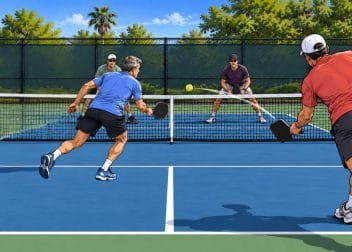
Pickleball combines tennis, badminton, and table tennis into one paddle sport that two or four players can pick up fast. Players hit a perforated plastic ball, closer to a sturdy wiffle ball than a tennis ball, over a net using solid paddles. Under the 2026 USA Pickleball rulebook, the court measures 20 feet by 44 feet under Rule 3.A.1, about a third of a tennis court. The net stands 36 inches at the sidelines and 34 inches at the center, under Rule 3.B.6 and 3.B.7. The full layout is in the guide to pickleball court dimensions.
Joel Pritchard, Bill Bell, and Barney McCallum invented the game on Bainbridge Island, Washington, in the summer of 1965. They used ping-pong paddles and a perforated ball to entertain bored kids on an old badminton court. As of September 2026, the Sports & Fitness Industry Association counts 24.3 million pickleball players in the United States in 2025, up 171 percent over three years. The ball stays slow and the court stays small, so almost anyone can rally on day one.
How Do You Play Pickleball? The Basics in Five Steps
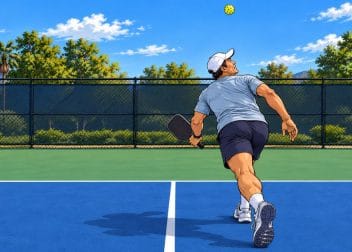
- Serve underhand, diagonally. Under the USA Pickleball rulebook, Rule 7.C requires an upward paddle swing with the ball contacted at or below the waist. Rule 7.E sends the serve diagonally into the far service box, clearing the non-volley zone.
- Let the serve and return each bounce once. Rule 10.A requires the serve and the return of serve to each bounce before anyone volleys. This is the two-bounce rule. The guide to the two-bounce rule walks through common mistakes.
- Rally until someone faults. A fault ends the rally: the ball lands in the net or out of bounds, a player volleys while touching the non-volley zone, or someone misses the two-bounce requirement. The guide to pickleball faults covers every case.
- Score only on your serve. In traditional scoring, only the serving side adds points. Lose the rally while serving and the serve passes to the other side instead. How pickleball scoring works breaks down the three-number score call.
- Play to 11, win by 2. Standard games run to 11 points, and the winning side must lead by at least 2. A game to 11 typically takes 15 to 20 minutes.
What Is the Kitchen and Why Does Everyone Talk About It?
The kitchen is the common nickname for the non-volley zone. It covers a 7 foot by 20 foot area on each side of the net, under Rule 3.A.4.c of the USA Pickleball rulebook. Players may stand in it. Rule 11.A.1 makes it a fault to volley, meaning hit the ball out of the air, while touching that zone. The rule stops players from camping at the net and smashing every ball down. Instead, both teams gather at the kitchen line and dink the ball softly until someone forces a mistake. Nobody has documented exactly why the zone earned the name kitchen. The guide to why it is called the kitchen runs through the leading theories.
What Do You Need to Start Playing?
The gear list is short:
- A paddle. A beginner paddle typically costs $30 to $80, according to Pickleball.com’s buying guide. A midweight paddle balances power and control while new players build fundamentals. The guide to beginner paddle weight explains the tradeoffs.
- Balls. Perforated plastic balls cost a few dollars each and come marked indoor or outdoor.
- Court shoes. Any tennis or court shoe works. Running shoes are the one thing to avoid, since they are built for forward motion, not side to side.
- A court. Free public courts are common. The guide to free pickleball courts helps find one nearby.
Total startup cost lands under a month of gym dues.
How Do Beginners Actually Learn? (The Honest Answer)
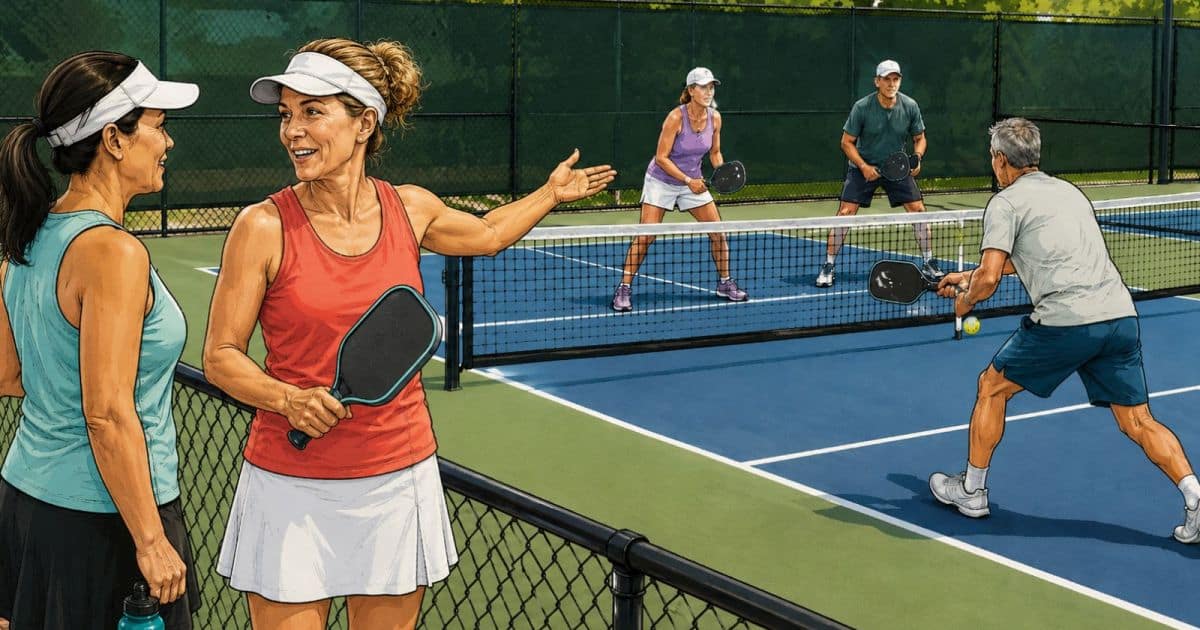
Open play is the usual starting point: drop-in sessions where whoever shows up rotates into games. The guide to open play in pickleball explains how the rotation works, and the guide to open play etiquette covers the unwritten rules newcomers should know. A new player can often hold a paddle for the first time in the morning and play a full game by afternoon, since the two-bounce rule and a slow ball soften the curve. A few sessions in, newcomers understand the kitchen. A few more, and they start forming opinions about paddles.
Structured lessons compress that timeline further. The guide to finding a pickleball coach covers what beginner clinics and lessons typically cost. Once a player wants to know where they stand, the guide to pickleball skill levels explains the 2.5 to 5.0 rating scale used across the sport.
Is Pickleball Hard to Learn?
Pickleball is easy to start and takes longer to master than the first few games suggest. The court is small and the ball is slow. The underhand serve keeps early rallies gentle, so a first game is usually playable within minutes. The depth shows up later, in the soft game, the third shot drop, and the patience battles at the kitchen line. That mix of easy entry and real depth explains why the sport keeps growing.
FAQ
What are the basic rules of pickleball? Under the USA Pickleball rulebook, serve underhand and diagonally, honor the two-bounce rule, stay out of the non-volley zone on volleys, and score only while serving. The guide to the 5 basic rules of pickleball covers each rule in plain language.
Can you play pickleball with 2 players? Yes. Singles uses the same court and most of the same rules as doubles, with small scoring differences. Doubles is the more common social format, and singles delivers a tougher workout.
Why is it called pickleball? Two stories compete for the name. One traces it to pickle boats, the rowing term for a crew of leftover rowers, a phrase co-inventor Joel Pritchard used for the new game. The other credits a family dog named Pickles. Research from USA Pickleball found the dog was born in 1968, three years after the game began, which backs the pickle boat account.
How long does a pickleball game take? Under the scoring rules, a game to 11 points typically runs 15 to 20 minutes. That is why open play rotates quickly and players rarely wait long between games.
Is pickleball good exercise? Yes. The full guide to pickleball as exercise breaks down the intensity and calorie numbers for a typical session.
What is the difference between pickleball and tennis? Pickleball uses a smaller court, a slower ball, an underhand serve, a solid paddle, and a non-volley zone. Tennis tends to reward power, while pickleball rallies lean on placement and patience.
Do you need to reserve a court? Often not. Many public courts run on a paddle stacking rotation during open play. Busier facilities use booking systems. The guide to how court reservation systems work explains what to expect at a larger venue.
What should you wear to play pickleball? Athletic clothes and court shoes are enough for a first visit. There is no dress code at public courts, and the guide to what women should wear to play pickleball covers fabric and fit in more detail.
The fastest way to understand pickleball is to play it, which takes about an hour. Find a pickleball coach through the Pickler Junction directory of pickleball coaches to shortcut the first few weeks. Borrow a paddle at open play and see why so many players get hooked after one visit.
Written by the Pickler Junction Team.