Pickleball Clinic vs. Open Play: Which One Actually Makes You Better?
Quick Answer: A pickleball clinic makes you better faster because it gives you structured drills and a coach’s feedback on your mechanics. Open play builds match experience, shot selection, and confidence, and it is cheaper and more social. The honest verdict: use clinics to learn skills and open play to apply them. Players who do both improve the quickest.
This is a head-to-head between two ways to spend your court time. A clinic is coached, drill-based instruction. Open play is unstructured games with rotating partners. Both help, but they help with different things.
What is the difference between a clinic and open play?
One teaches skills, the other tests them. A clinic is built around correction and repetition. Open play is built around competition and feel.
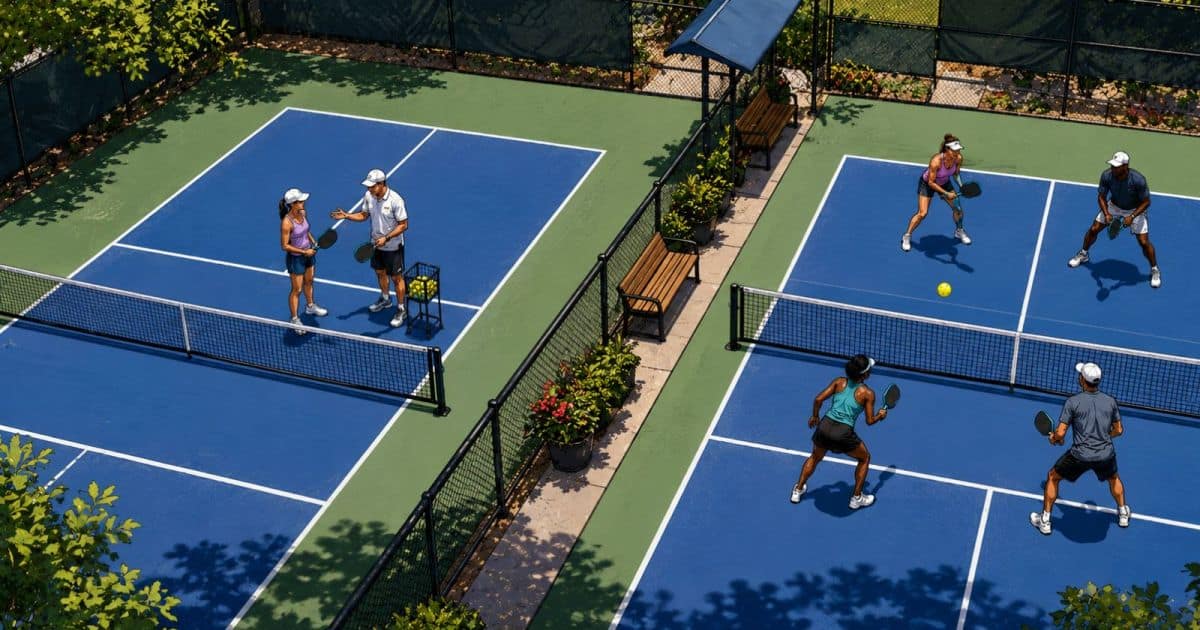
- Clinic: a coach runs drills, watches your form, and gives feedback. You hit the same shot many times to groove it.
- Open play: you show up, rotate through games with whoever is there, and play points. No coach, no drills, just matches.
The simplest way I put it: a clinic is where you fix your third shot drop, and open play is where you find out if it holds up under pressure.
Which one makes you better faster?
Clinics, for skill building. The structured feedback loop in a clinic is what changes mechanics, and changing mechanics is what raises your ceiling. You cannot easily fix a flawed stroke in the middle of a competitive game.
Where the clinic wins:
- Technique fixes (paddle angle, footwork, contact point)
- New shots you do not yet own
- Targeted reps with immediate correction
Where open play wins:
- Decision-making and shot selection under live pressure
- Reading opponents and adapting in real time
- Match stamina and nerves
- Cost and access, since open play is usually cheap or free
Here is the catch with open play alone: you tend to repeat your habits, good and bad, because nobody is correcting them. You get more athletic and more game-savvy, but a broken stroke stays broken.
Who should choose which, and what is the verdict?
Pick based on what is holding you back right now. If your strokes are the problem, you need a clinic. If your strokes are fine but you lose close games, you need more open play and match reps.
A practical split:
- Beginners: start with a clinic or two to build a foundation, then add open play.
- Intermediates stuck at a level: clinics to break specific habits, open play to test the fixes.
- Players who only drill: add open play, since skills mean nothing if you cannot use them in a game.
- Players who only play games: add clinics, since reps without feedback groove your flaws.
The verdict: it is not one or the other. Use clinics to learn and open play to apply, in a loop. For the dollars-and-results angle, see our breakdown of how many pickleball lessons it takes to improve, and if you want the fastest route, our guide on how to improve at pickleball fast.
Frequently asked questions
Should I take a clinic or just play open play? Both, in a loop. Use clinics to fix mechanics and learn new shots, and open play to apply them in real games. Skills built in a clinic only stick if you use them.
Is open play enough to get better? It improves your game sense, stamina, and decision-making, but it tends to reinforce existing habits because no one is correcting your form. For technique, you need coaching.
Is a clinic worth the money over free open play? If your strokes need work, yes. A clinic’s feedback can fix in one session what open play would never correct on its own. If your strokes are solid, open play reps may be the better use of time.
How do I combine clinics and open play? Take a clinic, then spend your next open-play sessions deliberately using the one or two things you learned, even if it costs you some games at first.
Does open play count as practice? Sort of. It is great for live decision-making but weak for grooving technique. True practice is repeating a specific shot with intent, which clinics and solo drills do better.
Which is better for beginners? Start with a clinic to learn the rules and basic strokes safely, then layer in open play to get comfortable in real games.
Want to know how clinic time stacks up against one-on-one coaching? See our comparison of a pickleball clinic vs. a private lesson. When you are ready to book structured sessions, our coaches and clinics directory lists instructors and group clinics near you.
For the bigger picture, start with how to find a pickleball coach.
Written by the Pickler Junction Team.