
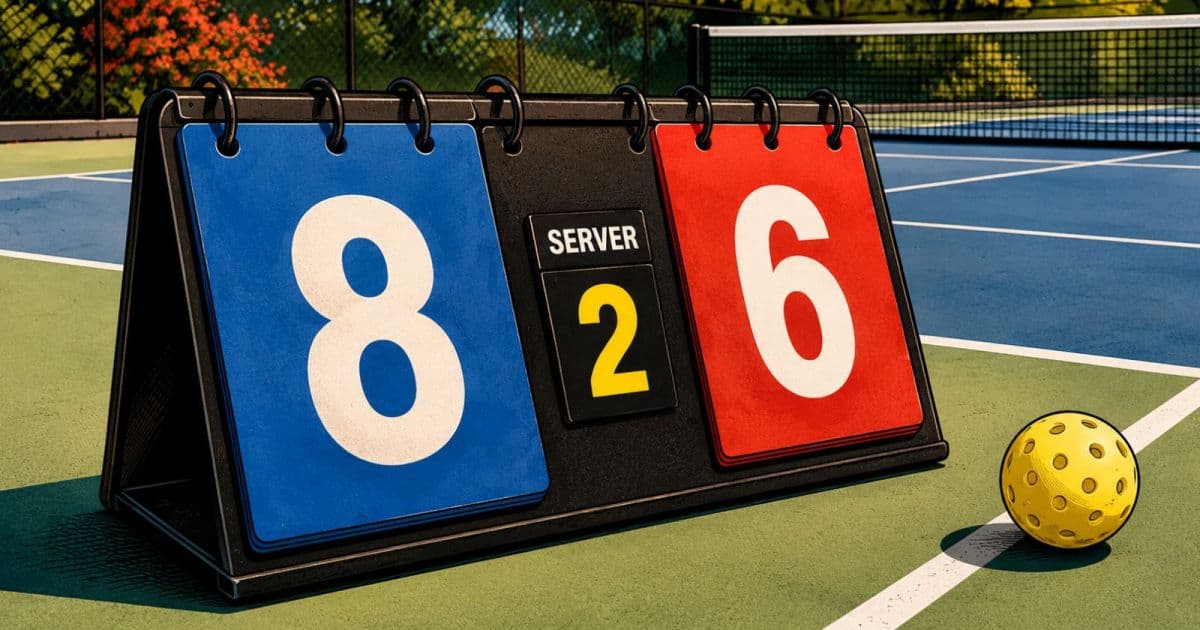
How Pickleball Scoring Works: Points, Serves, and Side-Outs for Beginners
Quick Answer: In traditional pickleball scoring, only the serving team can score a point. Games go to 11, win by 2. In doubles, the score is called as three numbers: your team’s score, the other team’s score, and the server number (1 or 2). When the serving team loses a rally, the serve passes, and after both partners have served and lost, it is a side-out and the other team serves. Every game starts at 0-0-2.
Scoring is the part of pickleball that confuses new players most, especially the three numbers called out in doubles. Once you understand who can score and how the serve moves, it clicks quickly.
Who scores points in pickleball?
Only the serving team, in traditional scoring. This is the single most important scoring concept. If your team is serving and wins the rally, you score a point. If you are receiving and win the rally, you do not score. Instead, you earn the chance to serve.
The core ideas:
- Only the serving team scores. Win a rally on serve, get a point.
- Win a rally while receiving, and you gain the serve, not a point.
- Games go to 11, and you must win by 2.
- Some tournaments play to 15 or 21, still win by 2.
Because only the server scores, careless errors while serving are costly. What I tell beginners is to play steady, high-percentage points when your team has the serve, since that is your only chance to put points on the board.
What do the three numbers mean in doubles?
Your score, their score, and the server number. In doubles, the server calls three numbers before serving, and each one has a meaning.
The three numbers are:
- Your team’s score (the serving team).
- The opponents’ score.
- The server number, 1 or 2, telling you whether the first or second server of that team is serving.
So a call of “4-2-1” means the serving team has 4, the other team has 2, and the first server is up. Every game begins at 0-0-2, because the first serving team of the game gets only one server before the first side-out, a one-time exception to keep the game fair.
For a quick-reference version you can keep courtside, see the cheat sheet section below.
How do serves, side-outs, and sides work?
Each team gets two servers, then a side-out. Understanding how the serve moves around is the last piece. In doubles, both players on a team usually get to serve before the serve passes to the opponents.
How it flows:
- The serving team’s first server serves until they lose a rally, then the second server serves until they lose a rally.
- After both servers have lost a rally, it is a side-out, and the other team serves.
- The server serves from the right side when their score is even and the left side when it is odd.
- Players switch sides with their partner only after scoring a point, not after every rally.
That even-odd trick is the easiest way to check you are serving from the correct spot. For singles, the score is just two numbers and the same even-odd positioning applies. To see the difference between this and rally scoring, read our guide on what score you need to win.
Quick-reference scoring cheat sheet
Keep this courtside until the calls become automatic. It covers traditional (side-out) scoring, which is what most recreational and amateur play uses.
The basics
- Games go to 11 points, win by 2 (some tournaments play to 15 or 21, still win by 2).
- Only the serving team can score; win a rally while receiving and you gain the serve, not a point.
Calling the score in doubles (three numbers)
- First number: your team’s score. Second: the opponents’ score. Third: the server, 1 or 2.
- Example: “6-3-2” means your team 6, opponents 3, second server. Every game starts at 0-0-2.
Which side to serve from
- Even score: serve from the right. Odd score: serve from the left. (Even = right, odd = left.)
Serving and side-outs
- Each team’s two servers serve in turn; after both lose a rally, it is a side-out.
- Switch sides with your partner only after your team scores a point.
A quick tip: call the score out loud before every serve, even in casual play. It feels awkward for about a week, then it is second nature.
Frequently asked questions
How does scoring work in pickleball for beginners? In traditional scoring, only the serving team scores. Games go to 11, win by 2. In doubles, the score is called as three numbers: your score, their score, and the server number.
Why are there three numbers in the pickleball score? The three numbers are your team’s score, the opponents’ score, and the server number (1 or 2), which tells everyone whether the first or second server is up.
Why does the game start at 0-0-2? Because the first serving team of the game gets only one server before the first side-out. Starting at server “2” reflects that one-time fairness exception.
What is a side-out? A side-out is when the serve passes to the other team. In doubles, it happens after both players on the serving team have served and lost a rally.
Which side do I serve from? Serve from the right side when your team’s score is even, and the left side when it is odd. It is the easiest way to confirm your position.
Do you have to win by 2? Yes. Games go to 11 (or 15 or 21 in some formats), and you must win by 2 points. If it is tied at 10-10, play continues until one team leads by two.
Once you know who scores and how the serve moves, the three numbers stop being scary. If the rules still feel fuzzy, a session through our coaches and clinics directory sorts it out fast.
If you are newer to this, the five basic rules of pickleball is a good next read.
Written by the Pickler Junction Team.