What Helps When Your Calves Get Tight During Play
Quick Answer: Calves that tighten in the second hour of pickleball are usually tired, not dehydrated. The two calf muscles push off, stop, land and stabilize the ankle on every step, and in pickleball they get only seconds to recover between bursts. The fix is to reduce the demand when tightness starts (a short break, gentle heel raises, a mild stretch, then a lower intensity or an earlier finish), build calf strength and endurance with straight-knee and bent-knee calf raises, stop hovering on the toes between shots, and space demanding sessions apart. Sudden pain with a pop, bruising, or swelling and warmth in one calf need a doctor, not a stretch.
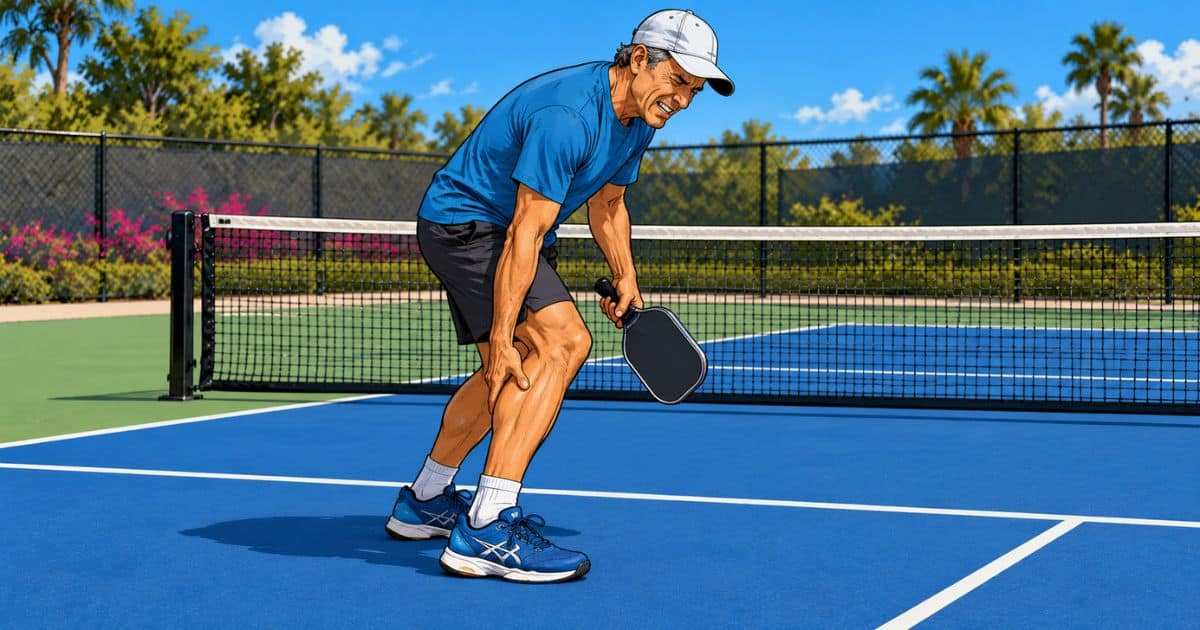
Calf tightness has a way of showing up at the worst possible moment in pickleball. A player feels fine during the first few games, but somewhere in the second hour, the calves begin to feel heavy, stiff, or unusually tight. Pushing off toward a wide ball becomes less comfortable, and those quick little adjustment steps suddenly require more effort.
Sometimes the feeling disappears after a short break. Other times it returns as soon as play resumes.
The calves do considerably more work during pickleball than their relatively small movements might suggest. They help propel the body forward, push it sideways, control landings, and stabilize the ankles during constant changes of direction. Even standing ready at the kitchen requires them to contribute.
When tightness develops during play, fatigue is one possible explanation. But conditioning, hydration, playing volume, and the way a player moves can all be part of the picture.
Why the Calves Work So Hard
The calf is made up primarily of two muscles, the gastrocnemius and soleus. Both help produce the ankle movement used to push off the ground, but they work somewhat differently depending on whether the knee is straight or bent.
That distinction matters in pickleball because players spend so much time with their knees flexed.
The soleus is particularly active when the knee is bent, while the gastrocnemius contributes strongly during more extended positions. Together, these muscles help control the ankle and provide the force needed to move.
Every quick step toward the kitchen, lateral push toward a dink, or sudden stop places another demand on them. The calves also work when slowing the body down, not just when accelerating.
Unlike a long walk, where movement is relatively repetitive and predictable, pickleball requires frequent bursts of activity in different directions. The calves may have only a brief opportunity to recover before the next rally begins.
Over several games, that workload can add up.
Fatigue May Be the Biggest Factor
When calves begin feeling tight late in a playing session, one possibility is that the muscles are simply getting tired.
Fatigue can change how a muscle feels and how comfortably it produces force. A player may notice increasing stiffness, a heavier sensation in the lower legs, or difficulty pushing off as quickly as earlier in the session.
This is particularly common when playing longer than usual, returning after time away, or suddenly increasing the number of days spent on court.
A player accustomed to an hour of pickleball may find that a three-hour session creates a very different demand, even when the games themselves are not especially intense.
The answer is not necessarily more stretching. Sometimes the calves need a reduction in workload and more time to recover.
Short breaks between games can help, but they may not completely reverse fatigue that has accumulated over an entire session. If the tightness repeatedly returns, ending play earlier may be more useful than trying to push through another hour.
Conditioning Makes a Difference
The calves can become better prepared for pickleball through regular strength and conditioning.
Calf raises are a simple starting point. Standing with both feet on the floor, slowly rise onto the balls of the feet and lower under control. As strength improves, the exercise can become more challenging by using one leg at a time or adding appropriate resistance.
Bent-knee calf raises are useful too. Performing the movement with the knees slightly bent places greater emphasis on the soleus, which works extensively during pickleball’s athletic positions.
The lowering portion deserves attention. The calf muscles help control the body when the heel lowers and when movement needs to slow down. Controlled strengthening through that part of the exercise can help build capacity for those demands.
Strength is only part of conditioning, however. The calves also need endurance.
A player may be strong enough to perform several challenging calf raises but still become fatigued after two hours of repeated court movement. Gradually increasing activity and playing time helps prepare the muscles for the volume of work they will actually encounter.
Hydration
Dehydration often gets blamed whenever a muscle feels tight or begins cramping.
Hydration certainly matters, especially during long sessions in hot weather. Sweating causes fluid and electrolyte losses, and inadequate replacement can affect comfort and physical performance.
But calf tightness does not automatically mean a player is dehydrated or needs more electrolytes.
Exercise-associated muscle cramps are complicated. Research suggests that muscle fatigue and altered neuromuscular control often play important roles, although fluid and electrolyte losses may contribute in some circumstances.
There is also a difference between a calf that gradually feels tight and a true cramp, which involves a sudden, involuntary, often painful muscle contraction.
Players should arrive reasonably hydrated, drink according to conditions and thirst, and account for longer sessions or heavy sweating. For prolonged play in the heat, replacing some sodium may be appropriate, particularly for players who sweat heavily.
Drinking excessive amounts of water or automatically taking large doses of electrolytes is not a reliable solution to every calf problem.
If the calves repeatedly tighten during play, hydration is worth considering, but it should not be the only explanation.
Your Movement May Be Adding to the Workload
Some players make their calves work harder than necessary.
Remaining constantly on the toes is one example. Being ready to move does not require holding the heels off the ground throughout every rally. That position asks the calf muscles to work continuously, even when the player is relatively stationary.
An athletic ready position should allow the weight to remain balanced through the feet while still permitting quick movement.
Excessive bouncing between shots can add workload too. Small adjustment steps are useful, but unnecessary movement over several hours means additional muscular effort.
Footwork also matters when reaching wide balls. Players who repeatedly push off hard from awkward positions or take one enormous step instead of several controlled steps may place greater demands on the calves and ankles.
The objective is efficient movement rather than trying to eliminate calf activity. Those muscles are supposed to work. They simply do not need extra work that serves no purpose.
First Steps When Tightness Starts
If the calves begin feeling tight during a game, the first step is to reduce the demand.
Take a break, walk around gently, and notice whether the feeling improves. If it is ordinary fatigue-related stiffness, a few minutes of easier movement may feel better than immediately sitting still.
Gentle calf movement can also help. Slowly raising and lowering the heels or moving the ankles through a comfortable range may relieve some of the stiff sensation.
A mild calf stretch may feel good, particularly if the muscle is not painful. Stretching with the back knee straight and then slightly bent changes which calf tissues receive more emphasis.
There is no reason to force the stretch. Aggressive stretching of a painful calf can aggravate a strain or other problem.
If the tightness settles and movement feels normal, a player may be able to resume at a lower intensity. If it returns quickly, worsens, or changes how the player walks or pushes off, continuing to play is probably not the best decision.
The goal is to recognize when the muscle is becoming overloaded rather than waiting until it forces the session to end.
Recovery Between Sessions
Calf tightness during play may also reflect what happened during the previous few days.
Several consecutive sessions, especially longer or more competitive ones, can create accumulated fatigue. The calves may feel normal at the beginning of the next session but become uncomfortable sooner than expected, the same pattern behind legs that feel heavy on the third day of play.
Recovery includes more than stretching afterward.
Adequate sleep, sufficient food and fluids, and reasonable spacing between demanding sessions all support the body’s ability to handle repeated activity. Light walking or other comfortable movement on non-playing days can help maintain activity without adding another intense court session.
Players who consistently develop tight calves late in play may benefit from adjusting their weekly playing volume while gradually building more strength and endurance.
Signs That Need Medical Attention
Recurring calf tightness should not automatically be dismissed as a conditioning problem.
A calf that suddenly becomes painful during a push-off may have sustained a muscle strain. A popping sensation, significant pain, bruising, or difficulty walking normally deserves medical evaluation.
Unexplained swelling, warmth, redness, or pain in one calf, particularly when it differs noticeably from the other, also needs prompt medical attention because a blood clot is one possible cause. Sudden shortness of breath or chest pain is an emergency.
Tightness or cramping that predictably appears with activity and improves with rest can sometimes reflect a circulation or nerve-related problem rather than ordinary muscular fatigue. Persistent symptoms, numbness, weakness, or repeated problems despite adjusting activity should be evaluated.
These situations are different from the familiar tired feeling that gradually develops after a long morning of pickleball.
Final Thoughts
The calves are involved in nearly every movement on a pickleball court. They help players push off, stop, change direction, and maintain balance through hundreds of small adjustments.
When they begin feeling tight, the cause may be as straightforward as accumulated fatigue or a playing session that exceeded their current conditioning. Hydration, movement habits, and recovery can contribute as well.
Regular calf strengthening, including both straight-knee and bent-knee exercises, can help build the capacity needed for longer sessions. Efficient footwork and sensible breaks can reduce unnecessary workload.
And when tightness appears during play, paying attention to it is usually more useful than trying to stretch it away and immediately return to the same intensity.
The goal is to have calves that can keep up with the game, without making them work harder than the game actually requires. If one calf is the problem, or the tightness keeps coming back no matter how the week is arranged, a physical therapist or sports medicine physician who works with court sports can sort out why, and the physicians and therapists directory is the place to find one. This article is general information, not medical advice.
Written by the Pickler Junction Team.